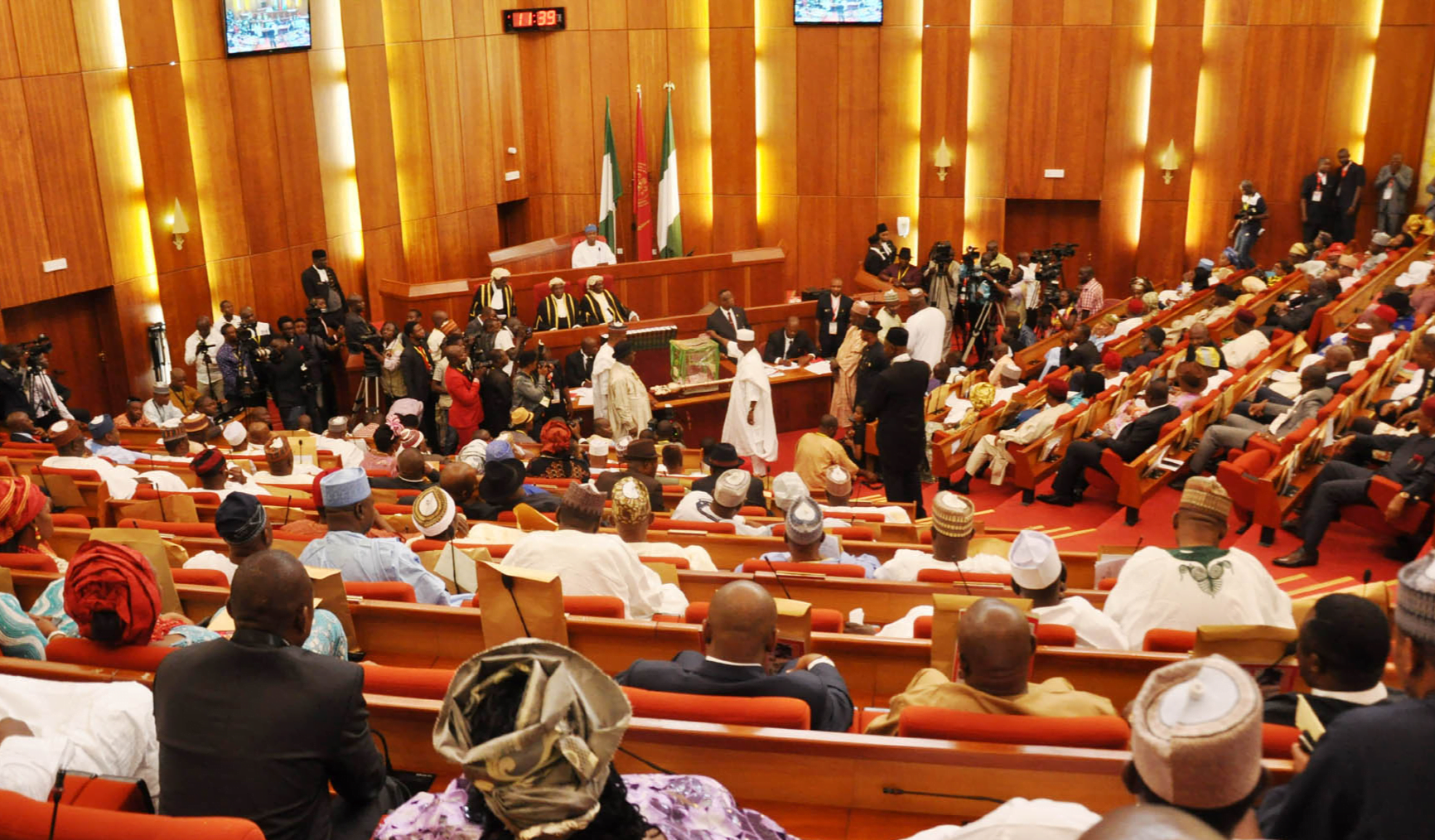
Proceedings in the Senate on Tuesday descended into chaos as lawmakers reconvened to consider and vote on the votes and proceedings of the previous Wednesday.
The disorder began when the Senate Chief Whip, Senator Tahir Monguno (APC, Borno North), raised a point of order seeking the rescission of the Senate’s earlier decision on Clause 60(3) of the Electoral Act amendment bill.

Monguno anchored his motion on Orders 1(b) and 52(6) of the Senate Standing Orders 2023, as amended. The point of order was seconded by Senator Abdul Ningi (PDP, Bauchi Central).
Tension quickly spread across the chamber as Senator Enyinnaya Abaribe (APGA, Abia South) repeatedly shouted points of order while Monguno moved his motion. In reading Clause 60(3), Monguno proposed an amendment in which the word “transfer” was changed to “transmission.”
However, in his motion, Monguno read Clause 60(3) without including the phrase “real-time,” a move that heightened disagreements among senators.
According to page 45 of the report of the Senate Committee on Electoral Matters, Clause 60(3) provides that: “The Presiding Officer shall electronically transmit the results from each polling unit to IREV portal in real time and such transmission shall be done after the prescribed Form EC8A has been signed and stamped by the Presiding Officer and/or countersigned by the candidates or polling agents available at the polling unit.”

As the debate dragged on, Abaribe invoked Order 72 of the Standing Orders, which relates to division and voting. The development prompted the President of the Senate, Senator Godswill Akpabio, to note that Abaribe had formally raised a point of order calling for division and a vote.
Moments later, however, Abaribe withdrew his point of order on division, bringing a temporary calm to the otherwise rowdy session.
What you should know
Clause 60(3) of the Electoral Act amendment bill has become one of the most contentious provisions in the ongoing legislative process.
The clause focuses on how election results are transmitted from polling units, particularly the debate over whether “real-time” electronic transmission should be mandatory. Disagreements over wording have exposed deep divisions within the Senate, reflecting wider public concern about electoral transparency ahead of future elections.
The heated session underscores how procedural rules and interpretations can significantly influence the fate of key electoral reforms.