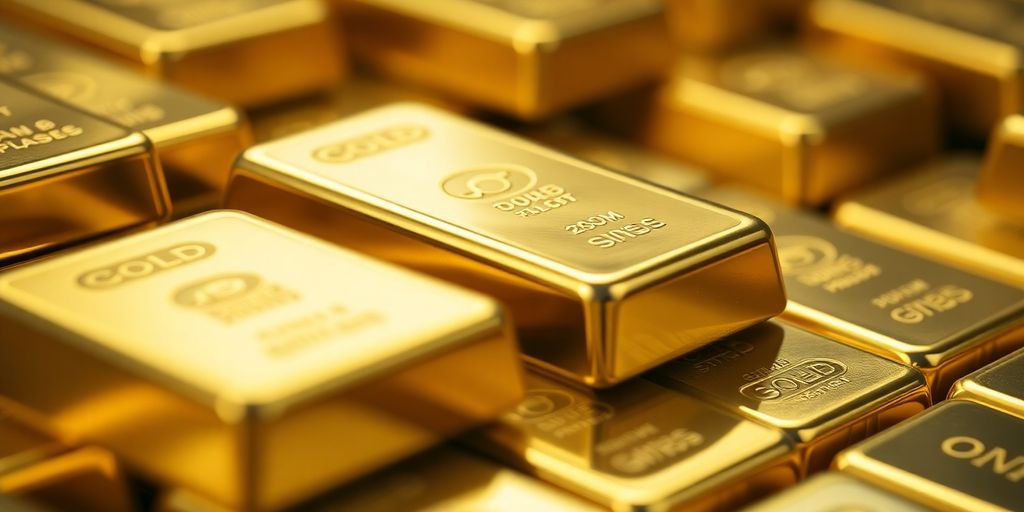
Gold prices pierced the historic $5,000-per-ounce barrier on Friday, capping a meteoric 14% surge in less than a month as investors flee traditional U.S. assets in what market analysts are describing as a potential permanent rupture in global financial confidence.
The yellow metal touched an intraday record of $4,967.03 before pulling back slightly to trade at $4,917.37 per ounce as of mid-morning GMT, while silver and platinum simultaneously notched their own all-time highs in a broad-based rally across precious metals markets.
The extraordinary moves underscore deepening anxiety about the stability of U.S.-dominated financial architecture, driven by an explosive cocktail of unpredictable trade policy, geopolitical brinkmanship, and mounting questions about American economic leadership under President Donald Trump’s second administration.
“Faith in the U.S. and its assets has been shaken, maybe permanently, and this is driving money into precious metals,” said Kyle Rodda, senior market analyst at Capital.com. “The word ‘rupture’ has been thrown around. I don’t think that’s an exaggeration.”
That stark assessment reflects the severity of recent market dislocations. Wall Street’s main indexes suffered sharp losses earlier this week after Trump unleashed fresh tariff threats against the European Union, though markets partially recovered after European leaders signaled willingness to negotiate while warning of retaliatory measures.
The dollar index languished near a more than two-week low on Friday, having shed 1% over the course of the week—a decline that makes dollar-denominated commodities more attractive to foreign buyers and reflects eroding confidence in the greenback’s traditional safe-haven status.
Adding to the geopolitical turbulence, European Union leaders convened an emergency summit in Brussels late Thursday to address Trump’s aggressive posturing over Greenland. While EU officials expressed relief over what they characterized as a U-turn by the president, the Danish territory remains a flashpoint in transatlantic relations.
Trump subsequently claimed to have secured “total and permanent U.S. access” to Greenland through a NATO agreement, though specifics of any such deal remain murky, leaving analysts and diplomats scrambling to decipher the administration’s strategic intentions.
The gold rally extends a trend that has seen central banks—particularly in emerging markets—aggressively diversify away from dollar reserves. Physical gold purchases by monetary authorities have combined with massive investor inflows into exchange-traded funds as portfolio managers seek protection against policy unpredictability and macroeconomic volatility.
Market expectations of Federal Reserve rate cuts later in 2026 have added fuel to the fire. While the Fed is widely expected to hold interest rates steady at its January 27-28 policy meeting, traders are pricing in two additional quarter-point cuts in the second half of the year. Lower rates reduce the opportunity cost of holding non-yielding assets like gold, enhancing their relative appeal.
The global scramble for precious metals is manifesting in physical markets worldwide. In India, gold premiums—the amount buyers pay above international spot prices—have jumped to their highest levels in more than a decade as investors rush to purchase bullion ahead of an expected duty increase in the upcoming national budget.
Meanwhile in China, typically the world’s largest gold consumer, premiums have actually declined as the eye-watering approach toward $5,000 per ounce prompts price-sensitive buyers to pull back.
Silver has been the standout performer among precious metals, rocketing 37% year-to-date after touching a record $99.34 per ounce on Friday before settling back to $97.85. The white metal is benefiting from dual demand drivers—both its monetary qualities as gold’s more volatile cousin and its critical industrial applications in solar panels, electronics, and emerging technologies.
“The underlying story to silver is one about the outperformance of silver versus gold and its industrial applications,” Rodda noted, highlighting how the metal straddles both safe-haven and growth-oriented investment themes.
Platinum, another key industrial metal used primarily in automotive catalytic converters, reached a record $2,684.43 before easing to $2,622.80 per ounce, marking a 27% gain since the start of 2026. Palladium, by contrast, declined 1.8% to $1,885.75, reflecting more mixed fundamentals in the automotive sector.
As precious metals markets enter uncharted territory, the critical question facing investors is whether current price levels can be sustained or whether a correction is imminent. Technical analysts point to stretched valuations and overbought conditions, while fundamental strategists argue that structural shifts in global capital allocation may support prices at these elevated levels for the foreseeable future.
What seems beyond dispute is that the financial landscape has shifted dramatically. Whether temporary or permanent, the flight to precious metals represents a vote of no confidence in the stability of traditional financial assets—and a warning signal that should concern policymakers in Washington and beyond.
Market participants will be closely watching next week’s Federal Reserve meeting for any signals that might calm—or further inflame—the precious metals bonfire.
WHAT YOU SHOULD KNOW
Global investors are abandoning U.S. assets in unprecedented numbers, driving gold past $5,000 per ounce for the first time in history—a 14% surge in under a month. This isn’t just another market rally; analysts warn of a “permanent rupture” in confidence in American financial stability, triggered by President Trump’s erratic trade threats, the Greenland crisis, and a weakening dollar.
Central banks and investors worldwide are fleeing into precious metals as a haven, with silver up 37% and platinum up 27% this year. The message is clear: the world is hedging against America, and the traditional dominance of U.S. assets can no longer be taken for granted.