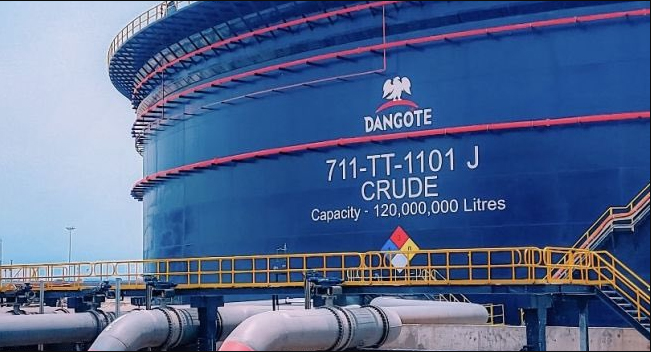
In a move that could reshape the global refining landscape, Nigeria’s Dangote Group has awarded a $350 million contract to India’s state-owned Engineers India Limited (EIL) to spearhead a massive expansion of its Lekki refinery complex, positioning the facility to become the world’s largest single-site petroleum refinery.
The contract, announced in a recent statement by EIL, marks a strategic reunion between the two entities following their successful collaboration on the existing 650,000-barrel-per-day facility. Under the new agreement, EIL will once again serve as Project Management Consultant (PMC) and Engineering, Procurement, and Construction Management (EPCM) consultant—roles that proved instrumental in delivering the original refinery, which came online in 2024.
The expansion will more than double the refinery’s capacity to 1.4 million barrels per day through the addition of a second processing train. The project places particular emphasis on producing Euro VI–compliant fuels, aligning with increasingly stringent global environmental standards and positioning Nigeria as a supplier of premium-grade petroleum products.
But the scope extends well beyond conventional refining. In a parallel push into petrochemicals, Dangote plans to nearly triple its polypropylene production capacity from 830,000 tonnes per annum to 2.4 million tonnes. This dramatic scale-up will be achieved through a three-pronged approach: revamping the existing polypropylene unit, installing an additional 1.2 million-tonne facility, and incorporating a 750,000-tonne UOP Oleflex unit to secure adequate propylene feedstock supply.
“Believing in EIL’s Engineering and project management excellence, Dangote Group has once again joined hands with EIL in this endeavor,” the Indian firm stated, characterizing the renewed partnership as validation of its technical capabilities and project delivery track record.
For EIL, which has carved out a significant presence in Africa’s energy infrastructure sector, the contract represents one of its most substantial international engagements. The company pledged to deploy “decades of experience and a global execution model” to deliver what it described as “a project of global significance.”
The expansion carries profound implications for Nigeria’s energy security and broader economic trajectory. Since its phased commissioning began in 2023—with diesel and aviation fuel production starting in early 2024, followed by petrol later that year—the refinery has already begun addressing a long-standing paradox: Nigeria, Africa’s largest crude oil producer, has historically imported the majority of its refined petroleum products due to decades of underinvestment and poor maintenance of state-owned refineries.
The planned capacity increase to 1.4 million barrels per day would dramatically reduce this import dependency while positioning Nigeria as a net exporter and regional energy hub. Analysts suggest the facility could fundamentally alter fuel trade patterns across West Africa, potentially supplying refined products to neighboring countries and strengthening regional energy security.
Upon completion, the expanded complex is expected to surpass India’s Jamnagar refinery—currently the world’s largest at 1.36 million barrels per day—claiming the top spot among single-site refineries globally.
Located in the Lekki Free Zone east of Lagos, the Dangote Refinery and Petrochemicals Complex represents an estimated $19 billion investment, making it one of the most expensive industrial projects ever undertaken on the African continent. The sheer scale and technical complexity of the facility necessitated a phased rollout, with operations gradually ramping up since the formal May 2023 inauguration.
The start of petrol production in 2024 marked a historic milestone for Nigeria, potentially ending decades of fuel import dependency and the associated foreign exchange pressures. The expansion now promises to cement that transformation while creating thousands of jobs and stimulating ancillary industries.
The project arrives at a critical juncture in global energy markets, as refiners worldwide face pressure to meet tightening fuel quality standards while navigating the energy transition. The emphasis on Euro VI compliance—which mandates ultra-low sulfur content and reduced emissions—signals Dangote’s intention to compete in premium export markets, particularly in Europe and other developed economies.
As construction on the second processing train moves forward, industry observers will be watching closely to see whether Africa’s largest economy can successfully execute this ambitious expansion and claim its position at the pinnacle of global refining capacity.
The project timeline and specific completion dates have not been disclosed, though EIL’s track record on the original facility—delivered despite the considerable technical challenges—offers grounds for optimism that the expansion will proceed according to plan.
WHAT YOU SHOULD KNOW
Nigeria’s Dangote Group is investing $350 million to expand its Lekki refinery from 650,000 to 1.4 million barrels per day, which would make it the world’s largest single-site refinery. This expansion addresses Nigeria’s historical paradox of being Africa’s top oil producer while importing most of its refined fuel.
Beyond petroleum, the project will nearly triple polypropylene production to 2.4 million tonnes annually, transforming Nigeria into a major petrochemical player.
The development promises to end decades of fuel import dependency, strengthen West African energy security, and position Nigeria as a global refining hub—marking a turning point for African industrialization and energy independence.