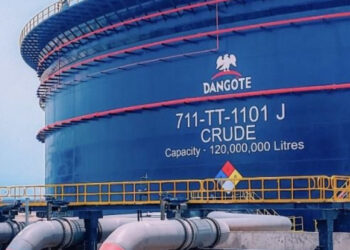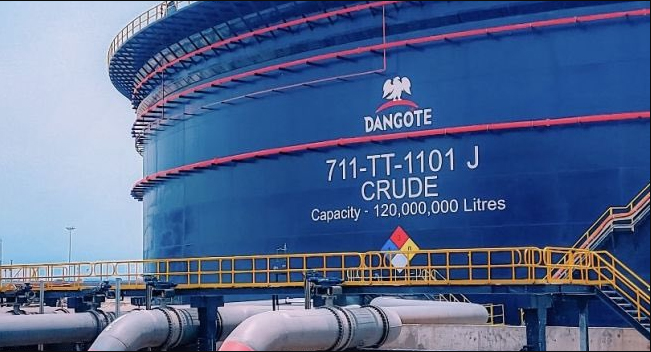
The Dangote Petroleum Refinery has moved swiftly to quash circulating reports of an imminent shutdown, describing the claims as deliberately orchestrated misinformation designed to destabilize Nigeria’s downstream petroleum sector.
In a strongly worded statement released on Monday, the $19 billion facility—which has emerged as a cornerstone of Nigeria’s energy security since commencing operations—insisted that it continues to run at full capacity, pumping over 50 million liters of petrol into the Nigerian market daily.
The 650,000-barrels-per-day Lagos-based refinery characterized the shutdown reports as “false, misleading, and deliberately promoted to create panic” at a time when fuel price volatility has already left Nigerian consumers on edge.
The refinery backed its claims with concrete production data, revealing that on January 4 alone, it produced 50 million liters of Premium Motor Spirit (PMS) and evacuated 48 million liters through its gantry system. Industry sources confirm that marketers lifted over 48 million liters this past Sunday, contradicting any notion of operational difficulties.
Perhaps most significantly, Dangote Petroleum disclosed that its current stock levels could sustain national consumption for more than 20 days—a buffer that should allay fears of imminent shortages in a country historically plagued by fuel queues and supply disruptions.
While acknowledging that routine maintenance is underway on specific units—including the Crude Distillation Unit (CDU) and Residual Fluid Catalytic Cracking (RFCC)—the refinery emphasized that its integrated design allows production to continue uninterrupted. Critical units such as the Naphtha Hydrotreater, CCR Reformer, and Hydrocracker remain fully operational, producing not just petrol but also Automotive Gas Oil (diesel) and Jet A-1 aviation fuel.
“Dangote Petroleum Refinery continues to operate at scale and retains the capacity to supply between 40 million and 50 million liters of Premium Motor Spirit daily through January and February, subject solely to market demand,” the statement declared.
The refinery also reaffirmed its ex-gantry price of N699 per liter, a rate it says remains available to all marketers and bulk consumers. This pricing becomes even more critical when viewed against the refinery’s warning that without domestic refining capacity, petrol prices could skyrocket to as much as N1,400 per litre in Nigeria’s post-subsidy environment.
Since December 16, loading volumes have ranged between 31 million and 48 million liters daily, figures the company says are “fully verifiable against depot loading records maintained by the Nigerian Midstream and Downstream Petroleum Regulatory Authority (NMDPRA).”
The refinery’s statement underscores its positioning as what it calls “a critical stabilizing force in the downstream petroleum market”—a claim that appears increasingly substantiated as Nigeria transitions away from fuel subsidies that have burdened government finances for decades.
The timing of these shutdown rumors is particularly sensitive, coming at a moment when Nigerians are still adjusting to recent pump price increases and when confidence in domestic fuel supply remains fragile after years of dependence on imported refined products.
As this story develops, market watchers will be monitoring whether the refinery’s production claims hold up under scrutiny and whether this episode represents genuine operational transparency or an attempt to manage market perception during a crucial phase of Nigeria’s energy transition.
WHAT YOU SHOULD KNOW
Dangote Refinery is not shutting down. Despite rumors causing market panic, Nigeria’s largest refinery remains fully operational, producing 40-50 million liters of petrol daily with over 20 days of supply in stock. While routine maintenance is ongoing on some units, production continues uninterrupted at a rate of N699 per liter.
Without this domestic refining capacity, Nigerians could be paying N1,400 per liter for imported fuel—making Dangote’s continued operations critical to keeping prices stable during the post-subsidy era.