United States Congressman Riley Moore has announced that he will deliver a detailed report to President Donald Trump after leading a five-member congressional team to Nigeria to investigate insecurity and alleged religious persecution.
Moore explained that the delegation travelled across Benue State in armoured vehicles due to escalating security concerns, where they met with victims of attacks, Christian groups, and religious leaders to gather direct accounts of what communities are facing.
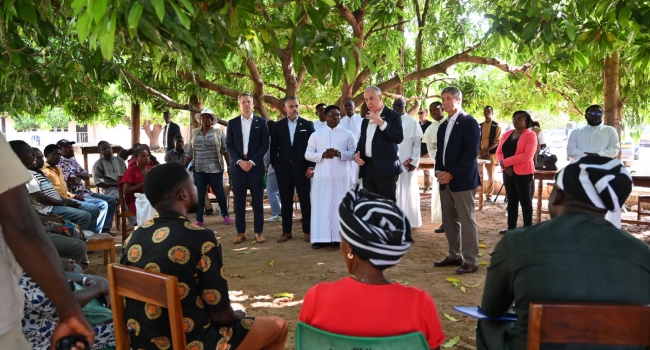
In an interview shared on X, Moore described the visit as a crucial effort to obtain firsthand evidence of the violence impacting Christian populations. He stated that “this mission was part of our report,” stressing that the team had gone to one of Nigeria’s most volatile regions because of the scale of killings targeting Christians.
The lawmaker said the delegation held discussions with Christian associations, Bishop Anagbe, the Catholic Church, Protestant leaders, and other community representatives before returning with their findings.
Moore revealed that President Trump instructed him and House Appropriations Committee Chairman Tom Cole to compile recommendations, noting that “he’s asked me and Chairman Tom Cole to give him a report and report back to him,” adding that the report is expected before the end of the month.
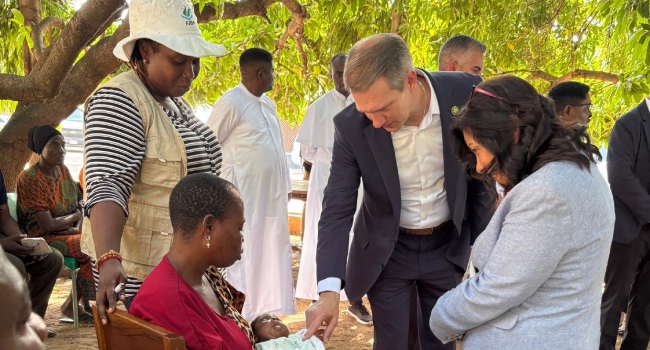
Sharing some of the testimonies they encountered, Moore described the accounts from internally displaced persons as deeply distressing. He recalled meeting a woman who lost her entire family when five of her children were murdered in her presence.
According to him, the woman, who was pregnant at the time, managed to flee and later delivered her baby in an IDP camp. He said her pain was visible and that many similar accounts were shared with the delegation. Moore narrated another incident involving a woman whose husband and two daughters were killed, and whose unborn child was violently taken from her, describing the act as the work of “Islamic terrorists.”
Moore criticized attacks on displacement camps, disputing attempts to frame the violence only in terms of economic or environmental pressures. He questioned why churches would be burnt or IDP camps attacked if the conflict were solely about land or climate issues, insisting that the pattern shows an attempt to wipe out Christian communities. He said attackers shouted “Allahu Akbar,” asserting that the violence aims to erase Christians from their ancestral homes in Benue and beyond.
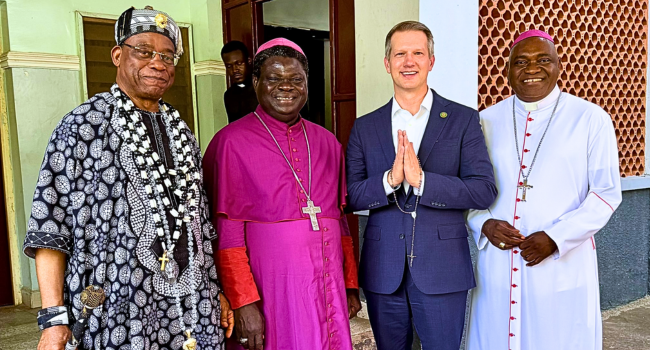
During the visit, the congressional delegation also met with Nigeria’s National Security Adviser, Nuhu Ribadu, in Abuja to discuss counter-terrorism, security concerns, and regional cooperation. Ribadu said the meeting built on previous engagements held in Washington. Moore and his team met with traditional and religious figures such as Bishop Wilfred Anagbe, Bishop Isaac Dugu, and Tor Tiv V James Ioruza to deepen their understanding of the crisis.
He commended the Nigerian Government for successfully rescuing 100 abducted children in Niger State, calling it evidence of President Bola Tinubu’s commitment to improving national security. Moore further confirmed the establishment of a joint task force between the US State Department and Nigerian authorities to examine claims of religious persecution.
His mission, however, coincided with renewed diplomatic friction following the US designation of Nigeria as a Country of Particular Concern, a categorization the Nigerian Government strongly rejects.
What you should know
The fact-finding visit led by Congressman Riley Moore marks a significant development in ongoing international conversations about insecurity and alleged religious persecution in Nigeria.
Moore’s report, which President Donald Trump personally requested, will capture firsthand accounts from victims in Benue State, a region he described as one of the most dangerous for Christians.
The mission included meetings with religious leaders, displaced families, and Nigerian security officials. Its findings could influence US policy discussions, especially given heightened diplomatic tensions over Nigeria’s recent classification as a Country of Particular Concern by the United States.