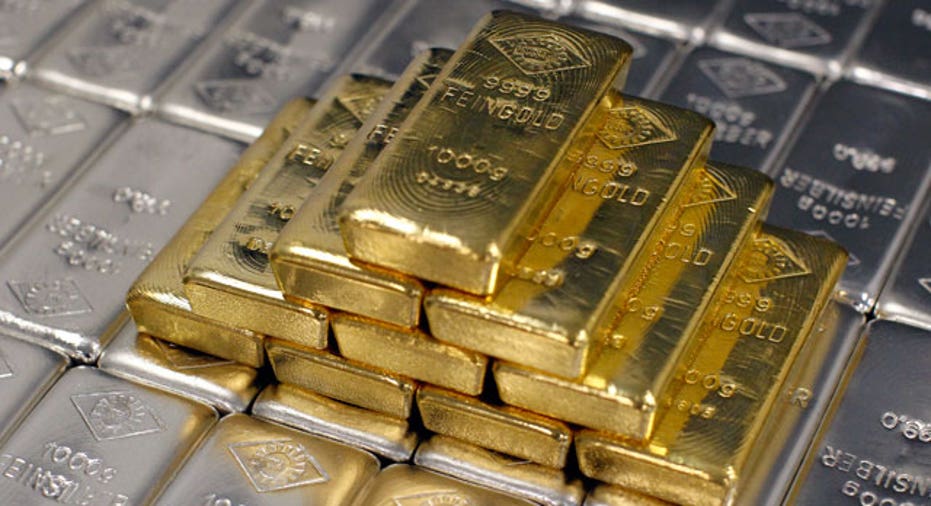
Gold prices treaded water on Wednesday morning as traders adopted a wait-and-see posture ahead of what markets widely expect to be another Federal Reserve interest rate cut, while silver continued its extraordinary ascent, breaching the psychologically significant $60-per-ounce barrier for the first time in its trading history.
As of 8:44 a.m. GMT, spot gold had dipped a modest 0.2% to $4,199.92 per ounce, with U.S. February gold futures trading similarly lower at $4,228.10. The marginal decline reflects investor caution rather than bearish sentiment, with market participants holding their positions close to the vest until Federal Reserve Chairman Jerome Powell delivers what could be critical guidance on the central bank’s monetary policy trajectory.
While gold marked time, silver emerged as Wednesday’s star performer, extending what analysts are calling a historic rally that has seen the white metal appreciate an astonishing 113% year-to-date. The breach of $60 per ounce represents not just a psychological milestone but a fundamental shift in market dynamics.
“Silver broke above the $60 per ounce mark, luring more short-term speculators and trend followers into the market,” explained Carsten Menke, analyst at Julius Baer. “This also reflects the narrative of physical tightness in the silver market.”
The silver surge has been underpinned by a confluence of factors that distinguish it from its more famous monetary cousin. Rising industrial demand—particularly from the solar panel and electronics sectors—has collided with declining global inventories to create supply constraints. The U.S. government’s recent designation of silver as a critical mineral has added further fuel to the rally, signaling official recognition of the metal’s strategic importance to modern manufacturing and green energy transitions.
The Federal Open Market Committee’s two-day policy meeting concludes today with market participants assigning an 88% probability to a quarter-point rate reduction when the decision is announced at 7 p.m. GMT. But the real focus will be on Chairman Powell’s press conference 30 minutes later, where his commentary on future policy moves could determine whether precious metals extend their remarkable runs or face a corrective pullback.
The calculus facing the Fed has become increasingly complex. On one hand, White House economic advisor Kevin Hassett—widely regarded as the frontrunner to succeed Powell when his term expires—stated on Tuesday that “plenty of room” exists for additional rate cuts. On the other hand, Hassett acknowledged that rising inflation could alter that assessment, introducing uncertainty about the pace and magnitude of future easing.
Lower interest rates typically benefit non-yielding assets like gold and silver by reducing the opportunity cost of holding them versus interest-bearing instruments like Treasury bonds. This relationship has been a key driver of precious metals’ appreciation throughout the current rate-cutting cycle.
Despite gold’s lofty price levels—trading more than four times higher than its historical averages—investor enthusiasm appears uneven across the precious metals complex. Menke pointed to a notable disparity in investment flows that may explain gold’s recent consolidation.
“During the past few weeks, the demand for gold from investors measured by holdings of physically-backed products was not as strong as for silver,” he observed. “We see this as the main factor holding back gold.”
The data bears this out. Holdings in New York’s SPDR Gold Trust, the world’s largest gold-backed exchange-traded fund, declined 0.1% on Tuesday, while the iShares Silver Trust registered a 0.53% increase—a tangible illustration of capital flowing toward the white metal.
Despite the near-term pause, major financial institutions remain decidedly optimistic about gold’s prospects. RBC Capital Markets this week raised its long-term price forecasts to an average of $4,600 per ounce in 2026 and $5,100 per ounce in 2027—projections that would represent further substantial gains from current levels.
The Canadian bank cited a trio of factors supporting its bullish stance: persistent geopolitical risks stemming from conflicts in multiple regions, expectations of continued accommodative monetary policy from major central banks, and mounting government budget deficits that threaten long-term fiscal stability and currency values.
Elsewhere in the precious metals complex, platinum and palladium—the so-called platinum group metals valued primarily for industrial applications—moved lower Wednesday. Platinum shed 1.2% to $1,670.70 per ounce, while palladium declined 0.3% to $1,501.71, reflecting different supply-demand dynamics than their monetary metal counterparts.
As trading continues through the North American session, all roads lead to Washington, where Jerome Powell’s words this evening could set the tone for precious metals markets well into the new year. Whether gold can break out of its consolidation pattern or silver can sustain its parabolic trajectory may ultimately depend on how dovish—or hawkish—the Fed chairman’s message proves to be.
WHAT YOU SHOULD KNOW
Gold prices remain stable around $4,200 per ounce as markets await today’s widely expected Federal Reserve rate cut and Chairman Powell’s crucial policy guidance. However, the real story is silver’s explosive 113% yearly surge past the historic $60 mark, driven by industrial demand, supply shortages, and its new U.S. critical mineral status.
The divergence is telling: investors are pouring money into silver ETFs while reducing gold holdings, suggesting stronger conviction in the white metal despite gold’s elevated prices. With an 88% probability of a quarter-point rate cut today, Powell’s comments at 7:30 p.m. GMT will be critical—lower rates typically boost non-yielding precious metals, and analysts project gold could reach $5,100 per ounce by 2027.
Silver is outperforming gold dramatically due to physical market tightness and industrial demand, while gold’s next major move hinges entirely on the Fed’s policy signals tonight. For investors, the question isn’t whether precious metals remain attractive—it’s which one offers better value at current levels.