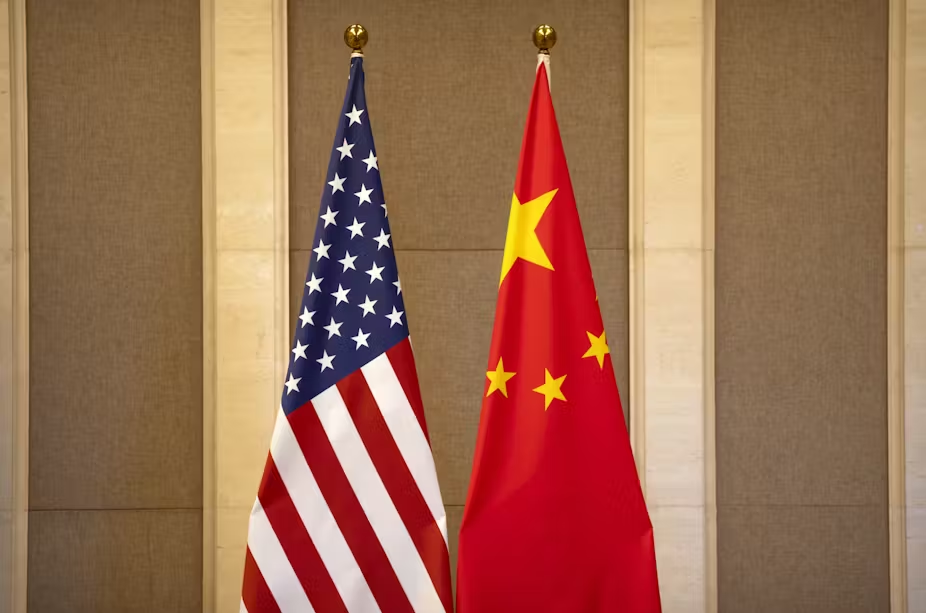
In a significant diplomatic development, the United States and China have taken preliminary steps to de-escalate their protracted trade conflict, following a critical meeting between Presidents Donald Trump and Xi Jinping in South Korea.
The agreement, while offering tangible relief on several fronts, leaves many of the fundamental disputes between the world’s two largest economies unresolved.
Tariff Relief Offers Limited Respite
The centerpiece of the détente is a 10 percent reduction in blanket tariffs on Chinese goods, effective November 10, alongside one-year exemptions for select products. This brings the average US levy on Chinese imports down to approximately 45 percent—a substantial decrease from recent highs, yet still representing a formidable barrier to free trade between nations whose economic interdependence once seemed unshakeable.
The tariff saga traces its roots to Trump’s first presidential term, when he launched an aggressive trade offensive against Beijing over intellectual property theft and what his administration characterized as systematic unfair trade practices. His successor, Joe Biden, maintained this hawkish stance, even expanding restrictions in cutting-edge sectors like electric vehicles and semiconductors—a reflection of bipartisan concerns about Chinese technological advancement.
China has pledged reciprocal tariff adjustments, though specific details remain opaque.
The Fentanyl Crisis and Rare Earth Concessions
A notable aspect of the agreement addresses the deadly fentanyl epidemic ravaging American communities. The 10 percent tariff reduction effectively halves a 20 percent penalty Trump imposed in March specifically targeting fentanyl-related trade. China remains the primary source of precursor chemicals used to manufacture the synthetic opioid, with illicit flows continuing to reach the United States via Mexico despite Beijing’s assertions that it is cracking down on such shipments.
Trump emerged from the meeting claiming Xi had committed to working “very hard” to stem these flows—a promise that skeptics note echoes previous unfulfilled Chinese assurances.
Perhaps more significant are the concessions on rare earth elements, the critical minerals essential to defense systems, electric vehicles, and consumer electronics. China’s near-monopoly on rare earth mining and processing has become a potent geopolitical weapon, and Beijing’s tightening export controls this year triggered global supply chain disruptions and factory shutdowns.
Last month’s sweeping restrictions—including limitations on related technologies—nearly sparked a catastrophic escalation, with Trump threatening blanket 100 percent tariffs. That crisis was averted when China agreed to issue export licenses for rare earths, gallium, germanium, antimony, and graphite. The confrontation has nonetheless accelerated Western efforts to develop alternative supply chains, though experts caution such diversification could take years to materialize.
Technology War Continues to Simmer
On the technology front, Washington agreed to suspend for one year its latest expansion of the “Entity List”—export restrictions targeting Chinese firms on national security grounds. However, this represents merely a pause in what has become an intensifying technological cold war.
The United States has systematically tightened export controls on advanced semiconductors and digital infrastructure, reflecting deep-seated concerns about Chinese military applications of American technology. As Wendy Cutler of the Asia Society Policy Institute observed, “The announced outcomes do little to resolve underlying structural issues that are at the heart of bilateral economic tensions.”
Agricultural Lifeline for American Farmers
American agricultural producers, a crucial constituency for Trump, stand to gain immediate relief. China’s retaliatory tariffs had devastated soybean farmers in particular—more than half of US soybean exports traditionally went to China, but Beijing halted all purchases as tensions escalated.
Under the new agreement, China has committed to purchasing at least 12 million metric tons of American soybeans in the final two months of 2025 and suspending retaliatory agricultural tariffs. Yet questions linger about whether US farmers can reclaim market share lost to Brazilian and Argentine competitors who filled the void during the trade war’s darkest days.
TikTok’s Uncertain Future
The fate of TikTok remains in flux. Both nations have signaled agreement on a framework to transfer the wildly popular app’s US operations from Chinese parent company ByteDance to American ownership—a move Washington insists is necessary for national security. Treasury Secretary Scott Bessent expressed optimism the deal would proceed “in the coming weeks,” while China’s commerce ministry offered vague assurances of cooperation.
A Truce, Not a Peace Treaty
This latest détente, achieved after years of escalating economic hostilities, represents a pragmatic pause rather than a comprehensive resolution. The 45 percent average tariff rate on Chinese goods remains historically unprecedented between major trading partners. Deep mistrust persists over technology transfer, intellectual property, and China’s state-directed economic model.
As both nations navigate this precarious new phase, the fundamental question endures: Can the world’s two economic superpowers forge a stable long-term relationship, or is this merely a temporary ceasefire in what many analysts view as an inevitable great power competition destined to define the 21st century?
For now, businesses and consumers on both sides of the Pacific can welcome the reduced tensions. But the underlying structural conflicts suggest the US-China economic relationship will remain turbulent for years to come.
WHAT YOU SHOULD KNOW
The US and China have agreed to reduce tariffs and ease tensions following the Trump-Xi meeting in South Korea, but this is a fragile ceasefire, not a lasting peace.
While tariffs drop from 55% to 45% and China promises to buy American soybeans and export rare earth minerals, the fundamental issues remain unresolved—technology rivalry, national security concerns, and competing economic models continue to divide the world’s two largest economies.
Businesses and consumers get short-term relief, but the structural conflict driving this trade war isn’t going anywhere. Expect continued instability in US-China relations for years to come, with this agreement serving merely as a pressure valve, not a permanent fix.