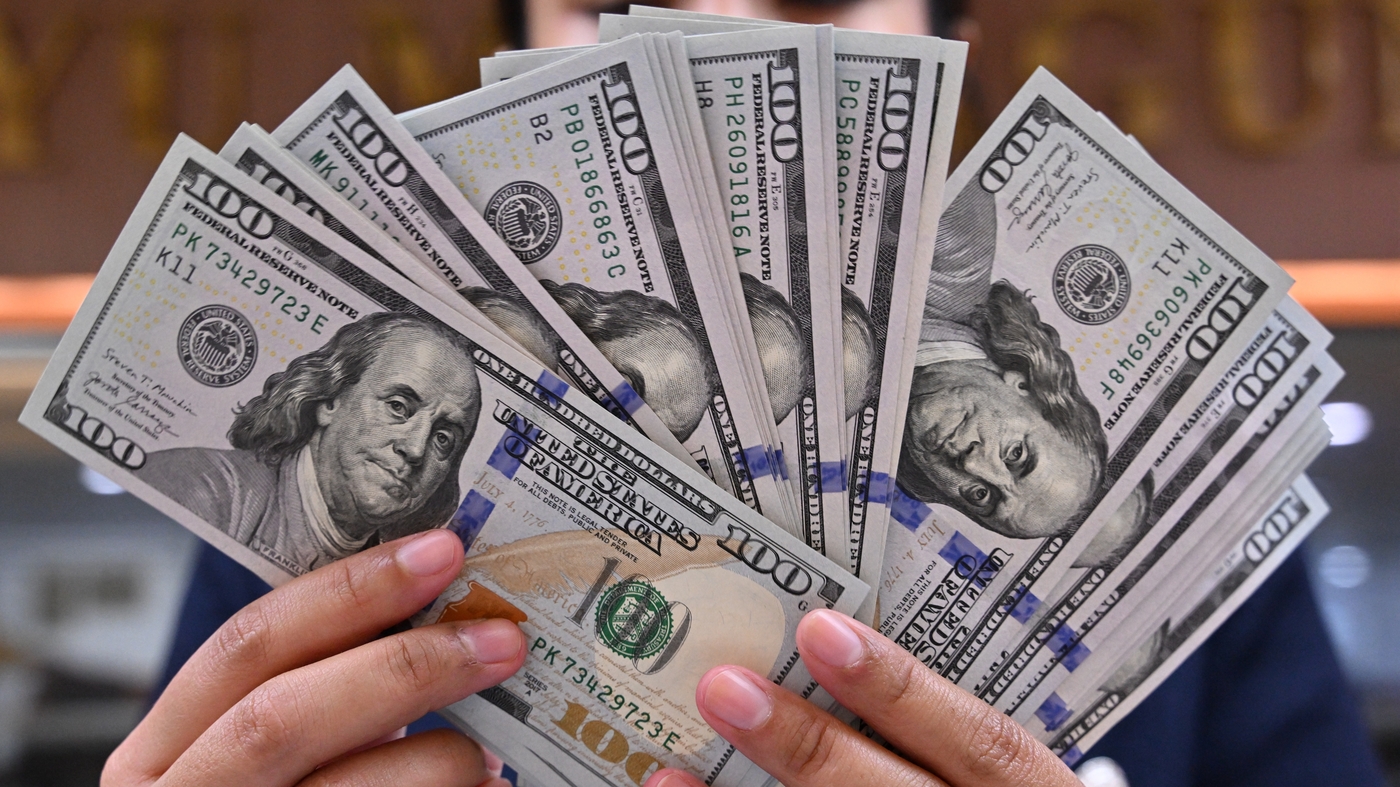
The dollar’s short-lived rebound vanished on Tuesday as intensifying trade tensions between Washington and Beijing drove investors toward safe-haven assets, highlighting how precarious relations remain between the world’s two economic giants despite recent reconciliation efforts.
The abrupt reversal comes just days after markets rallied on optimism that President Donald Trump had adopted a softer stance on Chinese tariffs and that a face-to-face meeting with his Chinese counterpart later this month could ease tensions.
That hope proved ephemeral as a series of retaliatory measures and new restrictions emerged from both capitals, serving as a sobering reminder that the fundamental disputes dividing Washington and Beijing remain unresolved.
Tit-for-Tat Escalation
Beijing delivered a one-two punch on Tuesday, announcing countermeasures against five U.S.-linked subsidiaries of South Korean shipbuilding giant Hanwha Ocean while simultaneously launching an investigation into how a U.S. Section 301 probe—a trade enforcement mechanism—impacts its domestic shipping sector. The moves signal China’s willingness to strike back at American commercial interests, even indirectly through allied nations’ corporate entities.
Compounding market anxiety, both nations implemented additional port fees on ocean shipping companies effective Tuesday, a measure that threatens to raise costs across global supply chains for goods ranging from consumer electronics to energy commodities.
Currency Markets React Swiftly
The dollar’s early-session gains quickly evaporated, with the currency sliding broadly across major crosses. The euro climbed 0.14% to $1.1585, while sterling advanced 0.12% to $1.3351. More dramatically, risk-sensitive currencies took heavy losses—the Australian dollar, widely viewed as a barometer for global risk appetite, plunged 0.63% to $0.6475, while the New Zealand dollar shed 0.5% to $0.5697.
Safe-haven currencies surged as investors sought shelter from the turbulence. The Swiss franc strengthened 0.2% against the dollar to 0.8027, while the Japanese yen reversed earlier losses to trade 0.3% higher at 151.86 per dollar.
Structural, Not Cyclical
Vishnu Varathan, head of macro research for Asia ex-Japan at Mizuho, struck a cautionary note about prospects for lasting resolution. “Beijing has been quite clear; they want negotiations, and they want a relationship that’s based on mutual respect and something that’s going to be driven by a fair basis,” he said.
“There’s a clear case to be made that this is not going to end just because parties have met to speak, because the underlying source of tensions cannot be resolved until and unless someone concedes far more than they’re willing to,” Varathan added. “This U.S.-China state of affairs is not a cyclical thing. It’s a structural feature of the new geoeconomic realities, and that’s just what it is.”
His assessment suggests that markets may be in for prolonged volatility as the two economic superpowers navigate what appears to be a fundamental realignment of the global economic order rather than a temporary trade dispute.
Rare Earth Controls and Back-Channel Talks
Adding another dimension to the dispute, China’s commerce ministry revealed Tuesday that it had notified Washington about rare earth export controls—critical materials used in everything from electric vehicles to military equipment—before implementing them last week. The ministry also confirmed that working-level talks between the two sides occurred on Monday, suggesting diplomatic channels remain open even as public tensions escalate.
Japan’s Political Uncertainty Caps Yen Gains
While the yen benefited from safe-haven flows, domestic political uncertainty prevented more substantial gains. Sanae Takaichi’s bid to become Japan’s first female prime minister was thrown into jeopardy Friday when her ruling party’s junior coalition partner withdrew support. The currency continues to languish near eight-month lows, despite the political drama halting its recent steep decline.
Nigel Foo, head of Asian fixed income at First Sentier Investors, sees potential for yen appreciation ahead. “Given the current interest rate differential between the U.S. and Japan, which should be the primary driver of the exchange rate as well, dollar/yen should not be at 152, so I do expect this trend to reverse pretty soon,” he said.
Crypto Markets Catch Contagion
The risk-off sentiment extended to digital assets, with bitcoin tumbling 2.7% to $112,714.58 and ether plunging 4.9% to $4,077.79. The cryptocurrency sector is still reeling from Friday’s carnage, when over $19 billion in leveraged positions were liquidated in a cascade of panic selling exacerbated by thin liquidity.
Looking Ahead
As traders assess the damage from Tuesday’s sell-off, the overarching question remains: can the planned meeting between Trump and his Chinese counterpart later this month produce meaningful progress, or will it prove to be yet another false dawn in an increasingly entrenched economic confrontation?
For now, markets appear to be pricing in prolonged uncertainty, with volatility likely to remain elevated as each new development in U.S.-China relations triggers swift and sometimes violent reactions across asset classes.
The era of assuming smooth sailing in global trade relations appears definitively over, replaced by a new normal of persistent tension and periodic flare-ups that will continue to test investor nerves and challenge portfolio strategies built for calmer times.
WHAT YOU SHOULD KNOW
The dollar’s recovery attempt collapsed Tuesday, reversing earlier gains as renewed U.S.-China trade hostilities triggered a broad sell-off in the greenback. Investors abandoned the dollar in favor of safe-haven currencies like the yen and Swiss franc, while risk-sensitive currencies like the Australian and New Zealand dollars suffered even steeper losses