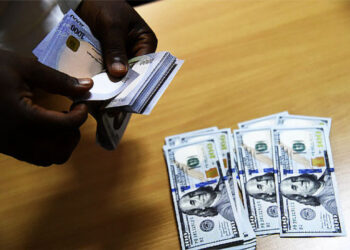
Nigeria channeled $2.86 billion toward external debt servicing between January and August 2025, according to newly released figures from the Central Bank of Nigeria (CBN), underscoring the continued strain that debt obligations place on the nation’s foreign exchange resources.
The amount represents a commanding 69.1% of the country’s total foreign payments of $4.14 billion during the review period—meaning that for every $10 leaving Nigerian shores, approximately $7 was directed toward servicing debt owed to foreign creditors.
While the latest figures show a modest year-on-year reduction of $198 million—or 6.49%—from the $3.06 billion spent on debt service in the corresponding period of 2024, the proportional weight of debt payments remains largely unchanged. In 2024’s first eight months, debt servicing accounted for an even higher 70.7% of total foreign payments of $4.33 billion.
Erratic Payment Pattern Reflects Loan Structure
A month-by-month breakdown reveals significant volatility in Nigeria’s debt service obligations, with payments swinging dramatically throughout the year.
January 2025 saw an outflow of $540.67 million, marginally lower than the $560.52 million recorded in January 2024. The following month brought relief as payments dropped sharply to $276.73 million—a decline of nearly 49%.
However, March witnessed a dramatic surge to $632.36 million, more than double the $276.17 million paid in March 2024 and representing a 129% spike from February’s figures. This marked the single highest monthly debt payment in the review period.
April maintained elevated levels at $557.79 million—up considerably from $215.20 million the previous year—before May brought a steep 59% decline to $230.92 million. This was a sharp drop from the $854.37 million paid in May 2024, which had been one of the heaviest months for debt servicing in the prior year.
June’s payment of $143.39 million, while nearly triple the $50.82 million recorded a year earlier, represented a further 38% decline from May. July saw another dip to $179.95 million—down two-thirds from the $542.50 million paid in July 2024—before August brought a modest recovery to $302.30 million, slightly above the $279.95 million recorded in August 2024.
Growing Concerns Over Fiscal Flexibility
The persistent dominance of debt servicing in Nigeria’s foreign payment obligations raises several red flags for economic managers and policy analysts.
First, the heavy concentration of foreign exchange on debt repayments places continuous pressure on the country’s external reserves, particularly during months of peak outflows such as March. Second, it curtails the government’s ability to allocate scarce dollars toward critical imports—ranging from raw materials and machinery to medical supplies and food items—that could bolster domestic production and economic growth.
Third, because debt obligations are contractual and non-discretionary, the government has limited room to maneuver in the event of a foreign exchange crunch. Defaulting or deferring payments would trigger severe consequences, including credit downgrades, loss of access to international capital markets, and potential legal action from creditors.
Reserves Surge Despite Oil Price Volatility
Interestingly, even as Nigeria continues to service substantial external debt, the country’s foreign reserves have climbed to over $42 billion—the highest level in more than six years. CBN data shows that reserves have been on an upward trajectory since mid-July 2025, defying earlier projections.
This growth is particularly notable given the turbulence in global crude oil markets, where prices have hovered below $70 per barrel—well beneath the federal government’s 2025 budget benchmark of $75 per barrel. Oil remains Nigeria’s dominant foreign exchange earner, contributing roughly 90% of dollar inflows.
Market analysts attribute the reserve buildup to improved crude oil production levels, which have risen significantly from previous lows, as well as possible inflows from multilateral loans, diaspora remittances, and other non-oil sources.
However, experts caution that while rising reserves provide a crucial buffer, the sustainability of this trajectory depends on maintaining production gains, managing the exchange rate effectively, and ensuring that debt servicing does not crowd out investments in infrastructure and human capital that could drive long-term economic resilience.
As Nigeria navigates its fiscal challenges in an increasingly uncertain global environment, the balancing act between meeting debt obligations and fostering inclusive growth remains a central policy dilemma.
WHAT YOU SHOULD KNOW
Nigeria is spending nearly 70% of its foreign exchange outflows—$2.86 billion in the first eight months of 2025—on external debt servicing alone. This means that out of every $10 leaving the country, $7 goes toward paying foreign creditors, leaving limited resources for critical imports, infrastructure, and economic development.
While debt payments have decreased slightly from 2024 and foreign reserves have risen to a six-year high of over $42 billion, the dominance of debt obligations remains a major constraint on Nigeria’s fiscal flexibility and economic growth potential. The country faces a difficult balancing act: meeting non-negotiable debt commitments while trying to invest in long-term prosperity.