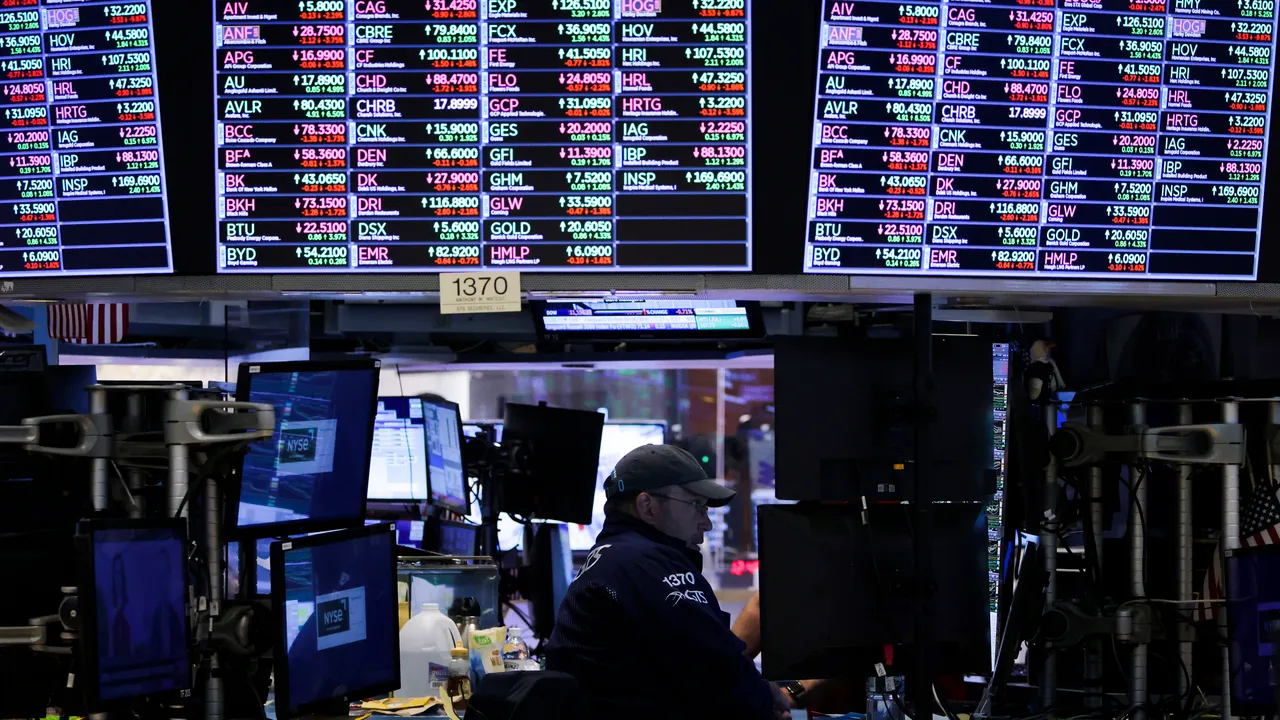
Wall Street closed in the red on Thursday as political drama from the White House and uncertainty surrounding the next Federal Reserve chair rattled investor confidence, pushing all three major U.S. stocks indexes into negative territory.
The Dow Jones Industrial Average dropped 333.27 points, or 0.75%, to 43,859.85, while the S&P 500 shed 28.61 points, or 0.45%, to settle at 6,316.45. The tech-heavy Nasdaq Composite also slipped, losing 50.62 points, or 0.24%, to close at 21,118.81.
The day’s biggest corporate headline came from Intel (INTC.O), which saw its shares tumble 3.7% after President Donald Trump publicly called for the immediate resignation of the chipmaker’s newly appointed CEO, Lip-Bu Tan. Trump accused Tan of being “highly conflicted” due to alleged business ties with Chinese companies, escalating tensions in an already sensitive U.S.-China tech standoff.
Meanwhile, investors also digested reports from Bloomberg indicating that Fed Governor Christopher Waller has emerged as Trump’s top pick to replace current Federal Reserve Chair Jerome Powell. Trump has long criticized Powell for not acting swiftly enough to lower borrowing costs. With inflation easing and the economy showing signs of softening, many investors are betting that a rate cut could come as soon as September.
Fueling those bets was Thursday’s labor market data, which showed that weekly jobless claims rose by 7,000 to a seasonally adjusted 226,000 — the highest since early July, and slightly above analysts’ expectations. Despite the marginal uptick, the CME FedWatch Tool still places the likelihood of a September rate cut at a strong 93.2%, slightly down from the previous day’s 94.6%.
Adding to the market turbulence, Trump also announced a new 100% tariff on imported semiconductors. However, in a move that soothed some of the sector’s biggest players, the tariffs excluded companies manufacturing within the U.S. or those pledging to do so. As a result, Apple (AAPL.O) stock rose 3%, buoyed by its exemption from the tariff hike. Nvidia (NVDA.O) and Broadcom (AVGO.O), however, saw modest declines.
Elsewhere, Eli Lilly (LLY.N) shares plummeted by 14.3% following the release of data on its late-stage oral weight-loss drug. The drop came despite the company raising its full-year profit guidance, signaling investor disappointment in the drug’s clinical performance.
Overall, market breadth was negative, with declining issues outnumbering advancers by a 1.12-to-1 ratio on the NYSE and 1.61-to-1 on the Nasdaq. A total of 206 stocks hit new 52-week highs on the NYSE, while 68 hit new lows.
Commenting on the state of the markets, Peter Cardillo, chief market economist at Spartan Capital Securities, said, “The market rally is beginning to look a little bit tired here. We ran up on earnings, and of course, the market was basically ignoring a lot of the tariff news.”
With political developments, trade policies, and interest rate expectations all converging, investors are bracing for a bumpy ride ahead.
WHAT YOU SHOULD KNOW
U.S. stocks fell as President Trump called for Intel’s CEO to resign and pushed for Fed leadership changes, fueling market uncertainty amid rising tariffs and growing expectations of a September interest rate cut.