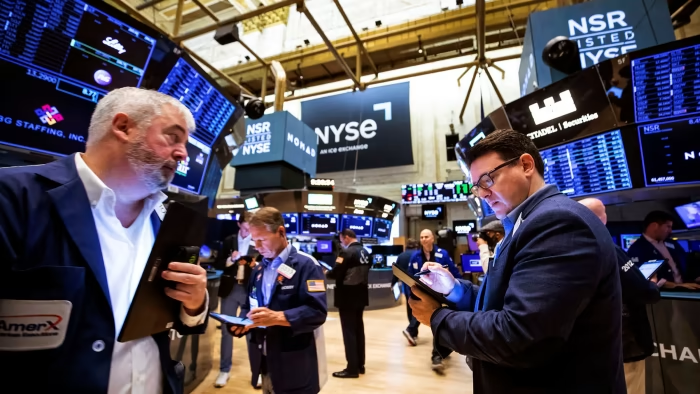
Wall Street extended its remarkable summer rally on Thursday, with the S&P 500 and Nasdaq Composite surging to fresh record highs as technology heavyweights delivered stellar earnings that reinforced investor confidence in artificial intelligence investments, even as new inflation data cast doubt on potential Federal Reserve rate cuts.
The technology-driven surge was led by Microsoft, which became only the second publicly traded company in history to eclipse the $4 trillion market capitalization threshold, joining chipmaker Nvidia in this exclusive club. The software giant’s blockbuster quarterly results showcased the transformative power of AI investments, validating the massive capital expenditures that have defined Big Tech’s strategic pivot over the past year.
Meta Platforms amplified the tech sector euphoria, rocketing 12.1% to an all-time high in early trading after the social media conglomerate projected third-quarter revenue well above Wall Street expectations. The company attributed its robust outlook to artificial intelligence enhancements that have significantly boosted its core advertising business, demonstrating how AI is translating into tangible revenue growth across the sector.
By mid-morning, the market’s momentum was unmistakable. The S&P 500 climbed 0.71% to 6,408.08, while the Nasdaq surged 1.16% to 21,374.76. Even the traditionally staid Dow Jones Industrial Average participated in the rally, gaining 0.20% to 44,550.01. The S&P technology index and communication services index both notched record highs, rising 1.2% and over 3%, respectively.
However, beneath the market celebration lurked economic complexities that could reshape the Federal Reserve’s policy trajectory. A Commerce Department report revealed that U.S. inflation accelerated in June, driven partly by tariffs on imports that have begun raising costs for American consumers. The data reinforced economists’ predictions that price pressures would intensify in the latter half of 2025.
“Thursday’s PCE was stronger than expected and throws cold water on the idea of a fall rate cut, as it’s clear that lower interest rates are not justified at this time,” said Clark Bellin, president and chief investment officer at Bellwether Wealth. “Inflation remains sticky and justifies the Fed’s decision to keep interest rates unchanged at Wednesday’s meeting.”
The inflation surge has dramatically altered market expectations for monetary policy. Traders now assign just a 58.8% probability that the Federal Reserve will maintain its current stance in September, according to CME’s FedWatch tool, down from earlier expectations of potential rate cuts.
Federal Reserve Chair Jerome Powell’s cautious stance on Wednesday further tempered rate-cut optimism. Following the central bank’s decision to hold rates steady, Powell emphasized it was premature to predict September policy moves, noting that current monetary policy was not constraining economic growth. His comments came after stronger-than-expected second-quarter GDP data underscored the economy’s resilience.
The economic backdrop extends beyond domestic considerations, with trade policy emerging as a critical factor. President Trump’s administration faces a looming tariff deadline, having refused to extend trade negotiations with lagging partners. European officials indicated that European liquor could face 15% tariffs beginning August 1 unless alternative agreements are reached, though talks are scheduled to continue this fall. Meanwhile, Trump secured a trade agreement with South Korea on Wednesday, reducing that country’s import tariff to 15% from a previously threatened 25%.
Despite these policy uncertainties, Wall Street appears positioned for significant monthly gains. The S&P 500 and Dow Jones are tracking toward their third consecutive monthly advance—their longest winning streak in nearly a year. The Nasdaq is on pace for its strongest monthly performance since March 2024, driven by renewed optimism about artificial intelligence applications and signs of U.S. economic durability.
The market’s resilience reflects a confluence of factors: easing global trade war concerns, demonstrations of economic strength, and mounting evidence that AI investments are generating substantial returns. Individual stock performances reinforced these themes, with Applied Digital soaring 32.7% after the data center operator exceeded quarterly revenue estimates, highlighting investor appetite for AI infrastructure plays.
Looking ahead, market attention pivots to Friday’s non-farm payrolls report, which could provide additional insight into labor market conditions and economic momentum. Weekly jobless claims increased marginally last week, suggesting employment conditions remain stable—a positive sign for sustained economic growth.
As Wall Street navigates this complex landscape of technological innovation, policy uncertainty, and economic resilience, Thursday’s rally underscored the market’s continued faith in America’s capacity for adaptation and growth, even amid shifting monetary and trade policy environments.
WHAT YOU SHOULD KNOW
Wall Street hit new record highs on Thursday, driven by Microsoft crossing the $4 trillion market cap milestone and strong AI-powered earnings from tech giants like Meta. However, rising inflation data is now making September Federal Reserve rate cuts unlikely, creating a complex backdrop where tech innovation is driving market gains while economic pressures are stiffening monetary policy.
AI investments are paying off for Big Tech and lifting markets, but inflation concerns are keeping interest rates higher for longer than investors initially hoped.