Nigeria’s fiscal architecture has undergone a dramatic transformation in the first half of 2025, with exchange rate gains—once a crucial revenue stream—collapsing by 73% as the government abandoned artificially low currency benchmarks that had generated billions in arbitrage profits.
Data from the Federation Account Allocation Committee reveals that exchange rate gains plummeted to N589.45 billion in the first six months of 2025, down from N2.199 trillion during the same period last year. This represents the effective end of a fiscal strategy that had allowed Nigeria to profit handsomely from the gap between official budget rates and market realities.
The revenue stream’s contribution to total federal allocations tells the story of this shift starkly: from commanding 30.7% of all FAAC distributions in the first half of 2024, exchange rate gains now account for a mere 6.06% of the pie. What was once Nigeria’s fiscal ace in the hole has become little more than a rounding error.
The End of the Arbitrage Era
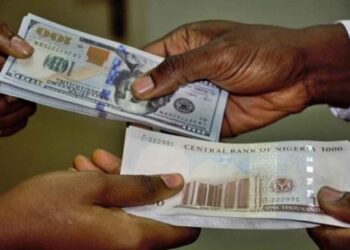
The collapse stems from the federal government’s decision to align its budget exchange rate assumptions with market conditions, effectively closing a loophole that had generated windfall revenues for years. In 2024, while the naira traded around N1,455 to the dollar on the parallel market, the official budget benchmark remained stubbornly anchored at N800 per dollar—an 82% spread that created massive naira surpluses when government dollar receipts were converted at market rates.
This lucrative arrangement began unraveling in late 2024, culminating in January 2025 when the new budget benchmark was set at N1,500 per dollar. The impact was immediate and decisive: while N402.71 billion in exchange rate gains was still distributed in January 2025—reflecting December 2024 revenues under the old system—February and March recorded zero such gains as the artificial spread disappeared.
Central Bank of Nigeria data confirms this convergence, with official rates averaging N1,475 per dollar in January and N1,500 in February, virtually matching the budget assumption and eliminating the arbitrage opportunity that had become a cornerstone of Nigeria’s fiscal strategy.
A Tale of Two Junes
The transformation is perhaps most vividly illustrated by comparing June 2024 with June 2025. Twelve months ago, exchange rate gains contributed N507.46 billion to the N1.143 trillion shared among the three tiers of government—a commanding 44% share that underscored the federal government’s reliance on currency arbitrage.
By June 2025, that figure had shrunk to N76.61 billion out of N1.659 trillion distributed, representing just 4.6% of total allocations. The numbers confirm what fiscal policy experts have long warned: arbitrage-driven revenues are inherently unsustainable and subject to policy shifts that can eliminate them overnight.
Federal Dominance Persists Despite Decline
Even as exchange rate revenues collapsed, Nigeria’s centralized fiscal structure remained unchanged. The federal government maintained its traditional dominance, claiming N280.93 billion of the N589.45 billion in FX gains distributed in the first half of 2025. State governments received N140.26 billion, local government councils N113.14 billion, and oil-producing states N64.52 billion under the 13% derivation principle.
While these absolute figures represent declines of approximately 68% across all tiers of government compared to 2024, the proportional distribution remained remarkably consistent, highlighting the entrenched nature of Nigeria’s fiscal federalism.
Silver Lining in Overall Growth
Despite the exchange rate revenue collapse, total FAAC allocations actually grew by 35.6% year-on-year to N9.723 trillion in the first half of 2025, compared to N7.171 trillion in 2024. This suggests that while the government has lost its currency arbitrage windfall, other revenue streams—likely including oil receipts and domestic taxes—have more than compensated for the shortfall.
The development signals a maturation of Nigeria’s fiscal framework, moving away from what economists have criticized as an unsustainable reliance on exchange rate manipulation toward more transparent, market-based revenue generation. While painful in the short term, this transition promises greater fiscal stability and credibility in the long run.
For state and local governments, however, the adjustment represents a harsh awakening. Having grown accustomed to substantial monthly allocations from exchange rate gains, subnational entities now face the challenge of operating with reduced federal transfers at a time when economic pressures remain intense.
As Nigeria continues its journey toward exchange rate liberalization, the collapse of arbitrage revenues marks not just an accounting adjustment but a fundamental shift toward a more sustainable, if less immediately lucrative, fiscal model.
WHAT YOU SHOULD KNOW
Nigeria has effectively ended its practice of profiting from artificial exchange rate gaps, causing exchange rate revenues to crash 73% to N589 billion in H1 2025. By aligning its budget exchange rate (N1,500/$) with market reality, the government eliminated a lucrative arbitrage scheme that once provided nearly one-third of all federal distributions.
While this marks the end of an unsustainable revenue stream that generated billions through currency manipulation, overall federal allocations still grew 35.6% as other revenue sources compensated for the loss. The shift represents Nigeria’s move toward fiscal transparency and market-based policies, trading short-term windfalls for long-term stability—though state and local governments now face significantly reduced federal transfers.