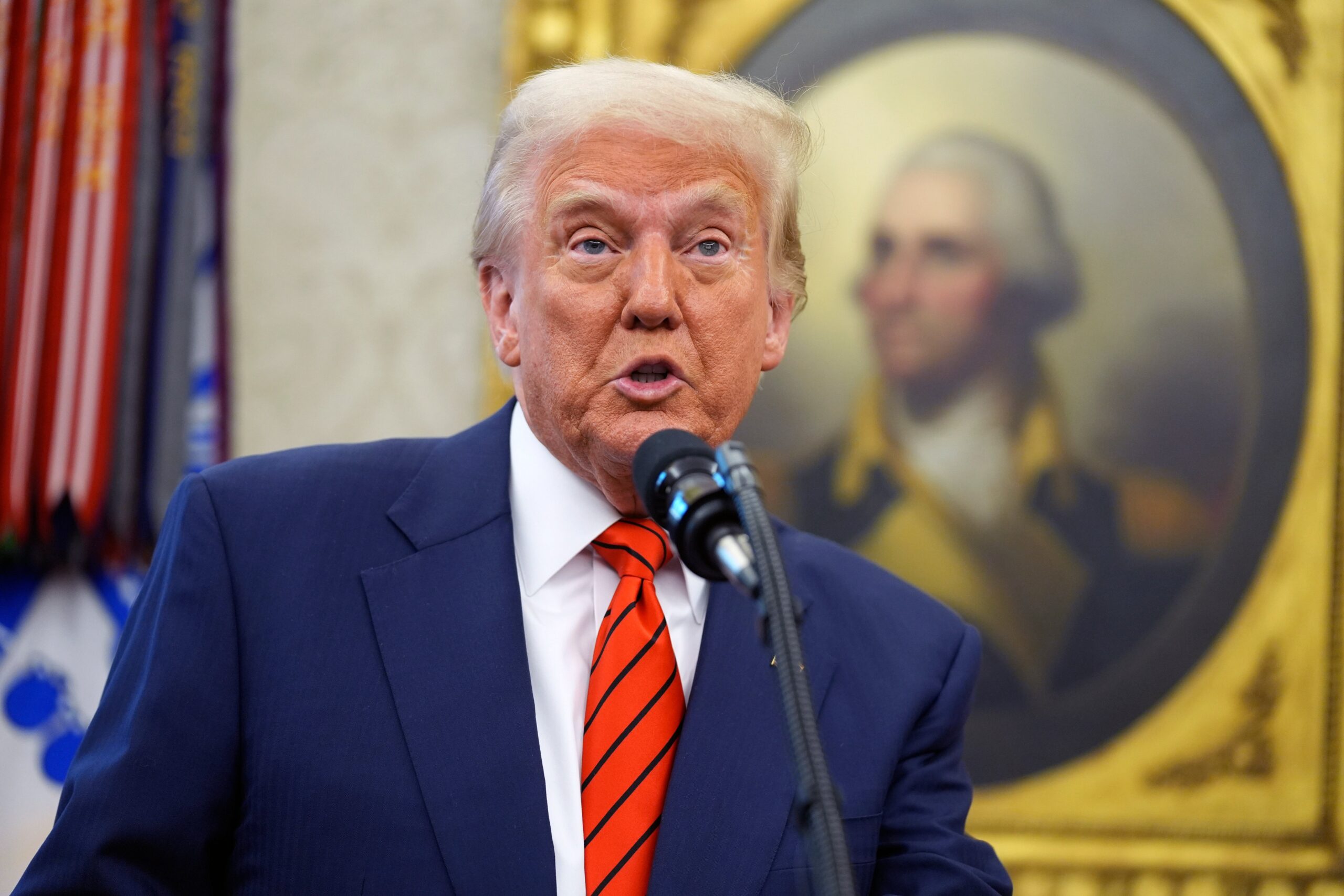
Gold prices retreated from near-record highs on Thursday as markets digested President Donald Trump’s latest comments suggesting he was unlikely to dismiss Federal Reserve Chair Jerome Powell, marking a potential cooling in the political tension that has driven the precious metal’s remarkable rally this year.
Spot gold was down 0.4% at $3,334.19 per ounce as of 0655 GMT. U.S. gold futures fell 0.6% to $3,340.30. The decline comes after gold has surged over 30% this year, with the metal hitting historic peaks above $3,500 per ounce in April amid escalating tensions between the White House and the Federal Reserve.
The market’s retreat reflects the intricate relationship between political uncertainty and safe-haven demand that has characterized gold trading throughout Trump’s presidency. The precious metal, traditionally viewed as a hedge against economic and political instability, has found strong support as investors navigate the administration’s unconventional monetary policy pressures.
Dollar Strength Weighs on Gold
The dollar’s resurgence played a crucial role in Thursday’s gold decline, with the greenback gaining 0.4% against major currencies. This strength makes dollar-denominated gold more expensive for international buyers, dampening demand. “Gold dropped (to) $3,340/oz as the U.S. dollar regained ground following eased uncertainty over the Federal Reserve chair’s position,” explained Jigar Trivedi, senior commodity analyst at Reliance Securities.
The currency’s recovery followed Trump’s Wednesday remarks distancing himself from speculation about Powell’s dismissal, though the president maintained his criticism of the Fed chief’s reluctance to lower interest rates. This nuanced positioning appeared to provide just enough clarity for markets to reduce their premium for political risk, at least temporarily.
Fed Chair Speculation Continues
The ongoing speculation surrounding Powell’s tenure has become a defining feature of current market dynamics. Reuters reported Wednesday that Trump remains “open to the idea” of firing the Fed chair, keeping alive a source of market uncertainty that has persisted throughout the administration. Trump’s public criticism of Powell has centered on the Fed’s cautious approach to interest rate cuts, with the president arguing that monetary policy should be more accommodative to support economic growth.
The tension has created an unusual dynamic where gold benefits from both sides of the equation: the prospect of Fed chair dismissal drives safe-haven demand. At the same time, expectations of easier monetary policy also support gold prices by reducing the opportunity cost of holding the non-yielding asset.
Economic Data Provides Mixed Signals
Thursday’s market reaction was also influenced by the latest U.S. economic data, which showed producer prices remained flat in June. This unexpected stability occurred as higher import costs from tariffs were offset by weakness in services pricing. “June’s flat U.S. PPI reading indicated steady wholesale prices, suggesting tariffs may be impacting the economy less than initially feared,” Trivedi noted.
This data point adds another layer of complexity to the Fed’s decision-making process, as policymakers weigh the inflationary impacts of Trump’s trade policies against broader economic conditions. Fed funds futures traders are pricing in a more than 76% likelihood that the central bank once again holds rates steady at the July policy gathering, reflecting market expectations of continued monetary policy caution.
Trade Talks Add to Market Dynamics
International trade developments continued to influence precious metals markets, with EU trade chief Maros Sefcovic traveling to Washington for tariff discussions with U.S. Commerce Secretary Howard Lutnick and Trade Representative Jamieson Greer. These ongoing negotiations represent another source of potential market volatility, as trade policy remains a key driver of both dollar strength and gold demand.
Institutional Demand Remains Strong
Despite Thursday’s decline, institutional interest in gold continues to grow. The SPDR Gold Trust, the world’s largest gold-backed exchange-traded fund, reported holdings increased 0.33% to 950.79 tons on Wednesday, up from 947.64 tons in the previous session. This continued accumulation by institutional investors suggests underlying demand for the precious metal remains robust despite short-term price volatility.
Broader Precious Metals Market
The weakness in gold extended to other precious metals, with spot silver declining 0.2% to $37.87 per ounce. Platinum fell more sharply, dropping 0.6% to $1,408.85, while palladium experienced the steepest decline, slipping 1.3% to $1,214.53. This broad-based weakness across the precious metals complex suggests the dollar’s strength and reduced political uncertainty were the primary drivers of Thursday’s market action.
Looking Ahead
With gold prices remaining near historic highs despite Thursday’s retreat, the precious metal continues to reflect the complex interplay between political uncertainty, monetary policy expectations, and global economic conditions. As the Federal Reserve prepares for its next policy meeting and trade negotiations continue, gold’s role as both a safe-haven asset and an inflation hedge ensures it will remain sensitive to developments in Washington.
The market’s reaction to Trump’s comments about Powell demonstrates how quickly sentiment can shift in today’s politically charged environment, though the underlying factors supporting gold’s long-term appeal—including central bank demand, geopolitical tensions, and monetary policy uncertainty—remain largely intact.
WHAT YOU SHOULD KNOW
Gold prices dropped 0.4% on Thursday as President Trump’s comments suggesting he was “highly unlikely” to fire Fed Chair Jerome Powell reduced political uncertainty, strengthening the dollar and pressuring the precious metal.
Despite this pullback, gold remains near record highs above $3,300/oz, supported by ongoing tensions between the White House and Federal Reserve over interest rate policy.
The market’s swift reaction demonstrates how sensitive gold has become to political developments, though underlying factors like institutional demand and monetary policy uncertainty continue to support elevated prices. Investors should watch for further Fed-related commentary and trade developments as key drivers of gold’s direction.