The remains of former Nigerian President Muhammadu Buhari have departed the United Kingdom en route to his hometown, Daura, Katsina State, where he will be laid to rest later today.
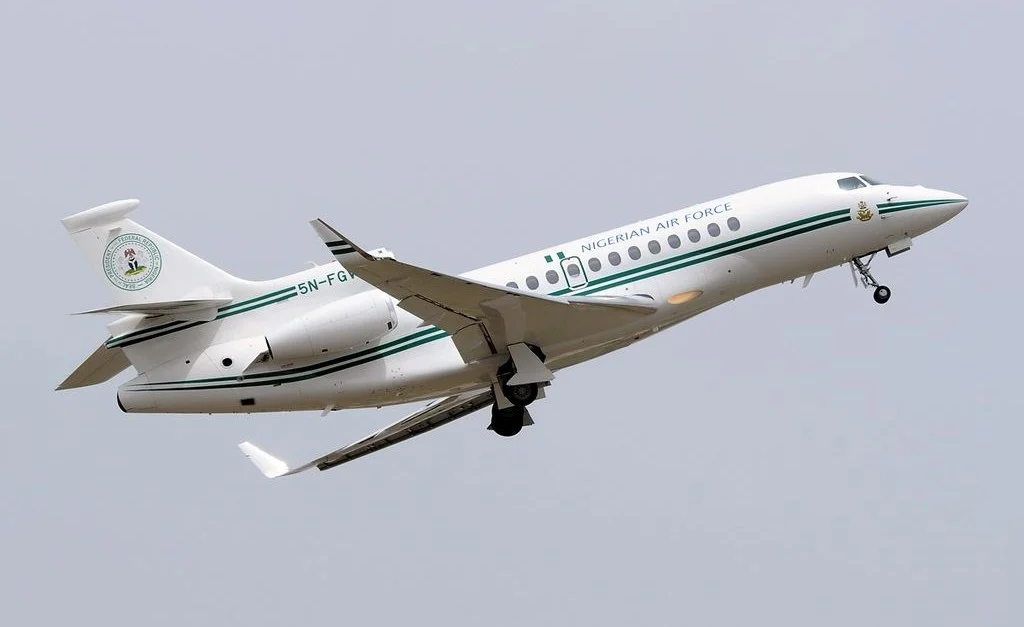
The solemn journey commenced before 8:00 a.m. on Tuesday aboard a Nigerian Air Force (NAF) aircraft, as a high-powered government delegation accompanied the late leader’s body.
Vice President Kashim Shettima, Chief of Staff to the President Femi Gbajabiamila, and several other senior officials formed part of the delegation accompanying Buhari’s remains, which are expected to arrive in Katsina by noon. President Bola Ahmed Tinubu is scheduled to personally receive the late president’s body before final burial rites commence in Daura.
The Nigerian government, in recognition of Buhari’s decades of service, declared Tuesday, July 15, 2025, a public holiday to facilitate a full state burial. The day forms part of a week-long national mourning period declared by President Tinubu following the passing of the former Head of State in a London hospital on Sunday, July 13, at approximately 4:30 p.m. The cause of death, following a prolonged illness, has not been disclosed. Buhari was 82 years old.
A native of Daura in Katsina State, Muhammadu Buhari’s straight-backed gait and austere image earned him admiration, particularly in northern Nigeria, where he was fondly referred to as “Baba Buhari.” His reputation for discipline, dating back to his military years, underpinned a political career that spanned over two decades, despite facing early electoral defeats.
Buhari first led Nigeria as a military ruler from January 1984 to August 1985, following a coup that ousted the Second Republic. After the country’s return to democratic rule in 1999, he became a persistent figure in presidential races, running unsuccessfully under various platforms in 2003, 2007, and 2011. Each of those attempts, however, reflected a remarkable consistency—he polled around 12 million votes in each election cycle, demonstrating a solid grassroots following.
In 2013, seeking to unify opposition forces against the dominant Peoples Democratic Party (PDP), Buhari’s party, the Congress for Progressive Change (CPC), merged with the Action Congress of Nigeria (ACN), some PDP defectors, and the All Progressives Grand Alliance (APGA) to form the All Progressives Congress (APC). The coalition’s “Change” message struck a national chord, and in the 2015 general election, Buhari finally claimed the presidency alongside running mate Yemi Osinbajo, defeating the incumbent, Goodluck Jonathan—a historic first in Nigeria’s Fourth Republic.
Buhari and Osinbajo assumed office on May 29, 2015, and were re-elected in 2019. Their administration came to an end on May 29, 2023, when they handed over power to their fellow APC stalwarts Tinubu and Shettima.
A defining pillar of Buhari’s presidency was his fight against corruption. Though he gained a reputation for personal integrity, his administration was marred by several high-profile scandals involving senior aides and appointees. Critics often accused the late president of detachment from day-to-day governance and of failing to rein in corrupt practices within his cabinet. Still, Buhari’s inner circle, including spokesperson Garba Shehu, maintained that such narratives overlooked the institutional challenges he faced and the reforms he introduced.
As Buhari’s remains return to Nigerian soil, the mood in the country is one of solemn reflection. From Daura to the national capital, tributes continue to pour in for a man whose towering presence shaped Nigeria’s post-military political landscape. The late president will be interred at his private residence in Daura following Islamic rites, with a military honor guard expected to conduct full ceremonial protocols.
Security has been reinforced in Katsina and surrounding areas to manage the anticipated influx of mourners, dignitaries, and government officials. A total of 25 Federal Executive Council members have been mandated to attend the funeral and remain in Daura for the three-day prayer.
As Nigerians across the country remember Muhammadu Buhari, many will reflect not only on his time in office but also on the enduring impact of his unique blend of military discipline, political resilience, and complex legacy.
What you should know
President Muhammadu Buhari, a former military leader turned civilian president, led Nigeria through significant transitions. Though admired for his discipline and anti-corruption stance, his civilian presidency was marked by controversies involving his appointees.
He is being laid to rest today in Daura, Katsina State, following his death on July 13 in London at the age of 82.