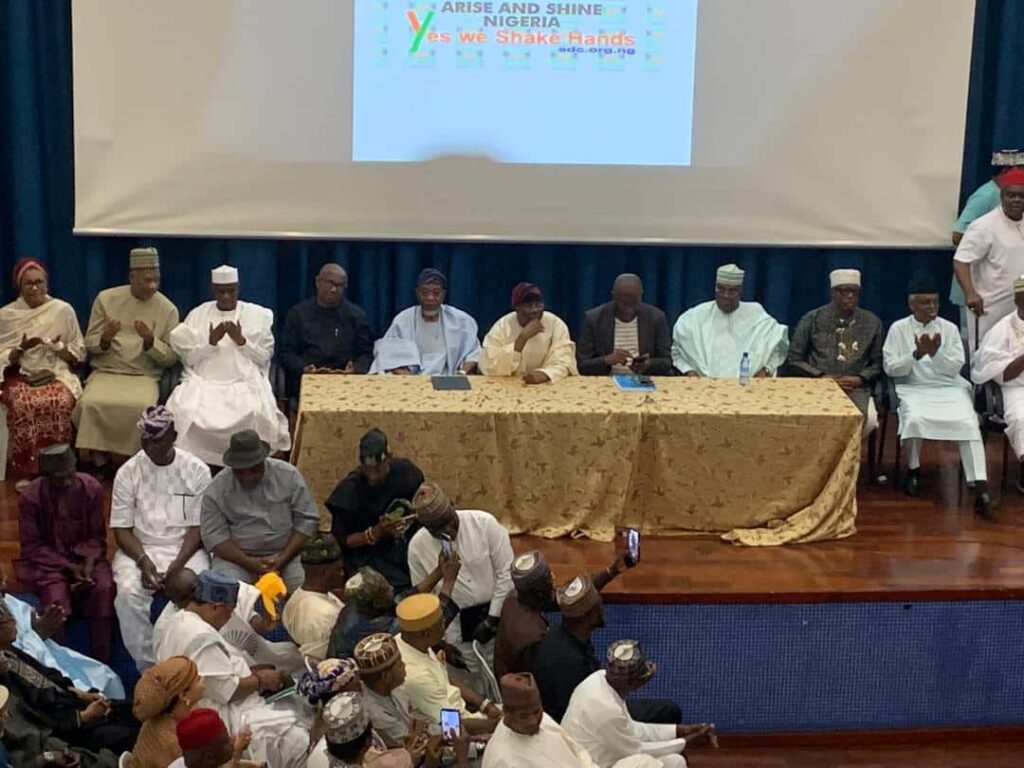
The African Democratic Congress (ADC) coalition, unveiled on July 2, 2025, in Abuja, has positioned itself as a formidable opposition to President Bola Ahmed Tinubu’s All Progressives Congress (APC) for the 2027 Nigerian presidential election.
Comprising heavyweights like Atiku Abubakar, Peter Obi, David Mark, Rotimi Amaechi, and Nasir El-Rufai, the coalition aims to unseat Tinubu by leveraging the ADC platform after INEC’s delay in registering their proposed All Democratic Alliance (ADA).
However, despite its ambitious lineup, several factors drawn from recent developments and public sentiment suggest the ADC coalition may struggle to defeat Tinubu’s entrenched APC machine.
Firstly, the coalition’s internal disarray undermines its unity. The Labour Party (LP), a key coalition partner, faces a leadership crisis, with Acting Chairman Nenadi Usman endorsing Obi’s involvement while dismissing Julius Abure’s faction as “political jesters” with no legal standing, as stated on July 3, 2025. This internal LP strife, coupled with Atiku’s exit from the PDP, risks fragmenting voter bases. FCT Minister Nyesom Wike, during a July 4 road commissioning in Gwagwalada, capitalized on this, mocking Atiku’s history of party-switching since 1999 and challenging coalition leaders to showcase their governance records, stating, “God gave you opportunity to be in office to make Nigerians to be happy, but you refused.” Such critiques resonate with voters skeptical of recycled politicians, which question the coalition’s credibility.
Secondly, Tinubu’s APC has demonstrated tangible achievements, particularly in the FCT, where Wike highlighted 16 consecutive days of project commissioning, including the Aguma–Radio Nigeria–New Market Road. This “operation show your scorecard” narrative contrasts with the coalition’s lack of a unified policy platform. Wike’s pointed attack on Mark’s tenure, “How did I help the people of Otukpo? Is it by flying a helicopter to Otukpo?” and Amaechi’s alleged role in Nigeria’s debt burden via Chinese loans in 2019, amplifies perceptions of the coalition’s past governance failures. Tinubu’s focus on infrastructure and security, as evidenced by his administration’s support for a July 7–9 nutrition and food security summit addressing farmers’ safety, strengthens the APC’s appeal.
Thirdly, the coalition’s zoning ambiguity could alienate voters. Amaechi’s July 3 Channels Television interview endorsed a single-term presidency and the North-South power rotation, insisting the South complete its eight-year tenure by 2031. However, the ADC’s failure to clarify whether it will field a northern or southern candidate risks confusing its base, especially as Tinubu, a southerner, benefits from regional loyalty.
Finally, public sentiment favors Tinubu’s APC due to its established political infrastructure and incumbency advantages. The APC’s dismissal of the coalition as “dead on arrival” by Publicity Director Bala Ibrahim reflects confidence in Tinubu’s 2027 re-election bid. The coalition’s youth wing has already expressed dissent, threatening to back a northern candidate if zoning favors the South, further weakening unity. Meanwhile, Tinubu’s legislative successes, like the July 3 passage of the “One Big Beautiful Bill Act” in the US, inspire confidence in his administration’s ability to deliver bold reforms, indirectly bolstering his global image.
In conclusion, the ADC coalition’s internal divisions, lack of a compelling track record, zoning indecision, and Tinubu’s robust incumbency position the APC as the likely victor in 2027. Unless the coalition consolidates its base and presents a clear alternative, Tinubu’s scorecard may outshine their ambitions.
What You Should Know
- The ADC coalition, launched July 2, 2025, faces internal LP and PDP strife, weakening its unity against Tinubu’s APC.
- Wike’s July 4 critique of Atiku, Mark, and Amaechi’s past records highlights the coalition’s credibility gap.
- Tinubu’s FCT projects and the July 7–9 summit showcase APC’s governance, contrasting with the ADC’s vague platform.
- Zoning ambiguity in the ADC risks voter confusion, as Amaechi supports South’s tenure until 2031.