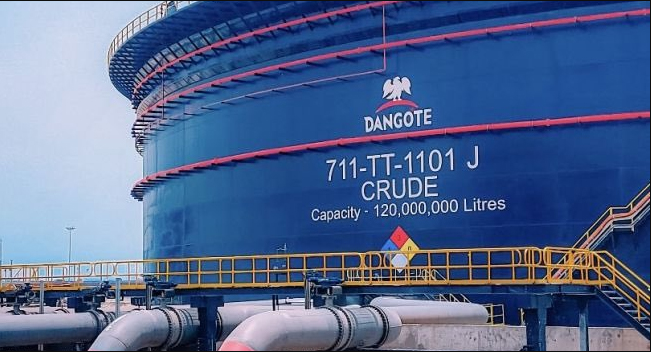
Nigerian motorists and consumers are bracing for another round of fuel price increases following the Dangote Petroleum Refinery’s decision to raise its ex-depot price for Premium Motor Spirit (PMS) to N880 per liter, representing a significant N55 jump from the previous N825 rate.
The price adjustment, confirmed through verified industry documentation and petroleum pricing platforms, took effect on Friday, marking the latest in a series of volatile pricing decisions that have characterized Nigeria’s downstream petroleum sector since the mega-refinery began operations.
The immediate impact is expected to reverberate across the nation’s fuel distribution network, with industry analysts predicting retail pump prices could surge beyond the N900 per litre threshold, particularly in regions distant from major distribution centers. This development comes as a harsh blow to Nigerian consumers already grappling with mounting economic pressures and inflation.
Global Oil Prices Paint Different Picture
The timing of Dangote’s price increase appears counterintuitive given the current trajectory of international crude oil markets. As of Friday’s trading session, Brent crude futures had declined by 3.02 percent to $76.47 per barrel, while West Texas Intermediate (WTI) settled at $74.93 per barrel. Murban crude, another key benchmark, traded at $76.97 per barrel.
This disconnect between falling global oil prices and rising domestic fuel costs has become a recurring source of frustration for Nigerian consumers and industry stakeholders. The phenomenon underscores the complex web of factors affecting local fuel pricing, including foreign exchange volatility, supply chain disruptions, and the country’s evolving energy independence strategy.
Exchange Rate Pressures and Import Dependency
Nigeria’s persistent foreign exchange challenges continue to exert significant pressure on fuel pricing mechanisms. The naira’s continued depreciation against the dollar has made petroleum product imports increasingly expensive, creating upward pressure on local prices even when global crude costs decline.
Adding to these complexities is the Dangote Refinery’s growing dependence on imported crude oil, particularly from the United States. Aliko Dangote, the facility’s owner and president of the Dangote Group, recently disclosed that the 650,000-barrel-per-day refinery has been forced to rely heavily on American crude supplies due to persistent shortages of Nigerian crude oil.
“The refinery is increasingly depending on the United States for crude oil,” Dangote explained during discussions with the Technical Committee overseeing Nigeria’s naira-for-crude policy. This revelation highlights the ironic situation where Africa’s largest oil producer struggles to supply its own refining capacity with domestic crude.
Industry documents reveal the scale of this import dependency, with the refinery planning to import approximately 17.65 million barrels of crude oil between April and July 2025. Of this volume, about 3.65 million barrels have already been delivered, underscoring the facility’s immediate reliance on foreign supplies.
Market Disruption and Speculation
The price adjustment announcement triggered immediate market reactions across Nigeria’s petroleum distribution network. Several depot operators in Lagos and other major cities reportedly withheld supplies earlier in the week, responding to uncertainty about Dangote’s pricing strategy and temporary sales suspensions.
This supply hesitancy created a ripple effect throughout the downstream sector, with marketers engaging in speculative pricing and panic adjustments that further complicated the already volatile fuel market. The pattern reflects the outsized influence the Dangote Refinery now wields over Nigeria’s petroleum supply chain.
Industry Criticism and Consumer Impact
The latest price increase has drawn sharp criticism from industry leaders, who argue that Nigerian consumers are bearing the brunt of pricing inconsistencies that favor suppliers over end users. Festus Osifo, president of the Petroleum and Natural Gas Senior Staff Association of Nigeria (PENGASSAN), has been particularly vocal about the disconnect between global price trends and local market realities.
“If you go online and check the PLAT cost per cubic meter of PMS, convert that to liters and then to our naira, you will see that with crude at around $60 per barrel, petrol should be retailing between N700 and N750 per liter,” Osifo stated, providing a stark contrast to current pricing levels.
His criticism extends beyond mere pricing calculations to encompass broader questions of market fairness and consumer protection. “If the people are forced to endure the hardship of high prices, they should at least benefit when prices drop,” he added, capturing the sentiment of millions of Nigerians who have watched fuel prices climb steadily despite periodic declines in global oil markets.
Economic Implications and Future Outlook
The fuel price increase comes at a particularly challenging time for the Nigerian economy, with inflation already straining household budgets and transportation costs affecting the prices of goods and services across all sectors. The prospect of petrol prices exceeding N900 per liter threatens to compound these economic pressures, potentially triggering another round of price increases for essential commodities.
For the Dangote Refinery, the pricing adjustment reflects the operational realities of running a major petroleum facility in Nigeria’s complex economic environment. The facility’s role as the country’s primary domestic refining capacity makes its pricing decisions particularly consequential for national fuel security and economic stability.
As Nigerian consumers prepare for higher fuel costs, the incident highlights the ongoing challenges in the country’s quest for energy independence and stable fuel pricing. The interplay between global market forces, local economic conditions, and supply chain complexities continues to shape a petroleum sector that remains central to Nigeria’s economic well-being and development prospects.
The coming weeks will likely reveal the full extent of the price increase’s impact on retail fuel costs nationwide, as marketers adjust their pricing strategies to reflect the new ex-depot rates from the country’s most significant refining operation.
WHAT YOU SHOULD KNOW
The Dangote Petroleum Refinery has raised petrol prices to N880 per liter (up N55), likely pushing pump prices above N900 nationwide. This increase comes despite global oil prices falling, creating a frustrating disconnect for Nigerian consumers.