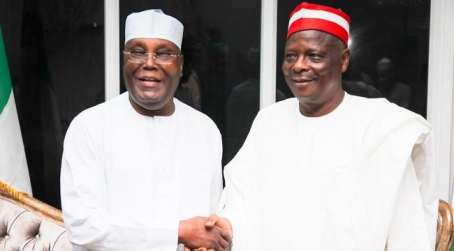
Former Vice-President Atiku Abubakar and former Kano State Governor Rabiu Musa Kwankwaso met in Abuja on Saturday, in a development widely seen as part of ongoing political realignments ahead of the 2027 general elections.
Both men were key contenders in the last presidential election won by President Bola Ahmed Tinubu. Atiku, who ran under the platform of the Peoples Democratic Party (PDP), emerged second, while Kwankwaso, candidate of the New Nigeria Peoples Party (NNPP), secured strong support in Kano State.
Confirming the meeting, Atiku described it as a courtesy visit, noting that both leaders engaged in discussions on national issues.
“This evening, I received the former Governor of Kano State and the Presidential candidate of the New Nigeria People’s Party (NNPP), Rabiu Musa Kwankwaso, on a courtesy visit. We had a robust discussion on the state of the nation,” he wrote on his social media handles.
The meeting comes amid rising speculation that Kwankwaso may leave the NNPP for the African Democratic Congress (ADC), as political stakeholders continue to build new alliances and reposition themselves ahead of the next election cycle.
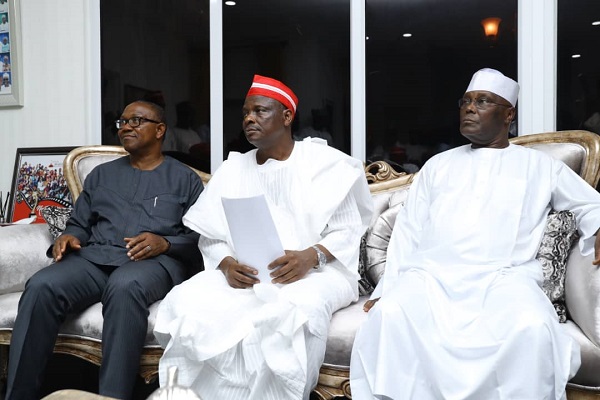
Kwankwaso’s engagement with Atiku follows closely after he hosted several prominent opposition figures at his residence in Kano during the recent Eid al-Fitr celebrations.
Among those present were former Labour Party presidential candidate Peter Obi, Governor of Oyo State Seyi Makinde, and former Bayelsa State Governor Seriake Dickson.
The gathering, held at Kwankwaso’s Miller Road residence, drew supporters and well-wishers, creating a lively atmosphere across the Kano metropolis as political leaders interacted with citizens celebrating the festive season.
The visit, which coincided with the annual Kwankwasiyya Sallah festivities, provided an opportunity for political figures to exchange pleasantries with the host and Muslim faithful marking the occasion.
What you should know
The meeting between Atiku Abubakar and Rabiu Musa Kwankwaso signals increasing momentum in opposition realignments ahead of Nigeria’s 2027 elections.
With speculation surrounding Kwankwaso’s possible move to the African Democratic Congress, the development points to efforts to build a stronger coalition capable of challenging President Bola Ahmed Tinubu.
Recent political gatherings and consultations among key figures suggest that alliances are still fluid, and the eventual configuration of opposition forces could play a decisive role in shaping the next presidential contest.