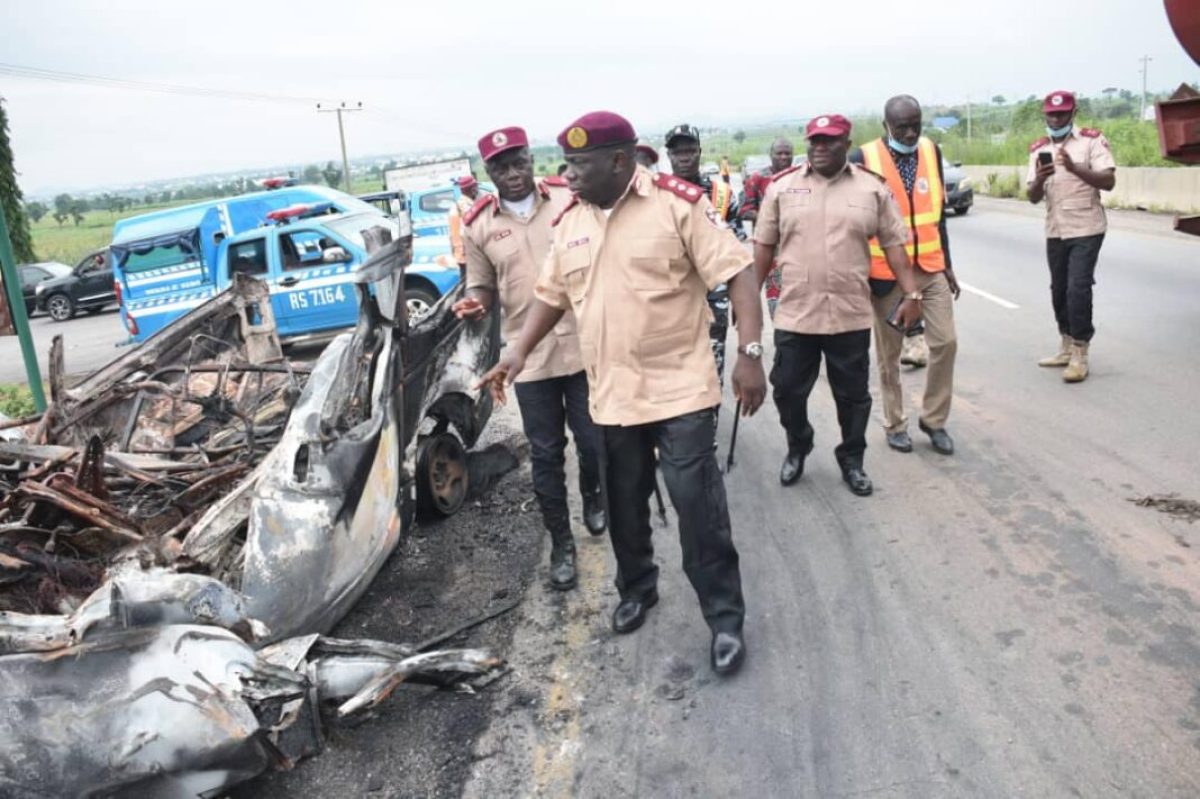
At least 16 people are dead, and two others are fighting for their lives after a commercial passenger bus careened off a bridge in the early hours of Friday morning, in what is shaping up to be one of the deadliest single-vehicle accidents recorded in Kogi State this year.
The ill-fated 18-seater bus, believed to have been transporting travellers along the busy Okene–Osara–Lokoja corridor, lost control and veered off a bridge in Osara, within the Adavi Local Government Area of Kogi State, plummeting to the ground below with devastating force.
The crash occurred in the pre-dawn darkness, a period when visibility is low, fatigue runs high, and the odds are cruelly stacked against road users.
First responders from the Federal Road Safety Corps (FRSC) were quickly mobilized. Rescue teams from the Zariagi Unit descended on the scene to carry out what must have been a grim and harrowing operation, pulling bodies from the wreckage, triaging the injured, and working to clear the road.
Of the 18 passengers believed to have been on board, only two survived. Both are reported to have sustained serious injuries and are currently receiving medical attention at a hospital in the area. Their condition, as of the time of this report, remains a cause for grave concern.
The Kogi State Sector Commander of the Federal Road Safety Corps, Lawal Fagge, confirmed the incident in a telephone interview to press men, offering the first official account of events.
He stated that the bodies of the 16 deceased have since been deposited at a morgue in Lokoja, the state capital, a sobering end to what, for many of them, was likely just an ordinary journey.
Commander Fagge did not mince words when identifying the cause of the crash. He attributed the tragedy squarely to excessive speeding, a factor that, tragically, is not new to this road or to Nigerian highways at large.
The Okene–Osara–Lokoja road, a critical artery connecting communities across Kogi State and linking the north and south of the country, has long had a reputation as one of Nigeria’s more treacherous stretches of highway. Its winding terrain, combined with a culture of reckless driving among some commercial operators, has made it the setting of repeated tragedies over the years.
Road safety advocates have consistently pointed to the pressure placed on commercial drivers by vehicle owners and transport unions’ pressure to make multiple trips, meet revenue targets, and keep moving regardless of the hour or their physical condition as a root cause of speed-related crashes.
Friday’s disaster appears to be yet another bitter fruit of that systemic failure.
The incident has reignited public outrage over the state of road safety governance in Nigeria. Authorities have once again called on motorists to adhere to speed limits and road safety regulations, a message that, to many grieving Nigerians, is beginning to ring hollow without meaningful enforcement.
Nigeria consistently ranks among the countries with the highest road traffic fatality rates in the world. According to data from the World Health Organization and local safety bodies, thousands of Nigerians lose their lives on the roads annually, with speed, driver fatigue, and poorly maintained vehicles among the leading contributing factors.
As the nation grapples with the news from Kogi State, the questions being asked are not new, but they are becoming increasingly urgent. How many more must die before enforceable, consistent, and punitive road safety measures are put in place? How many more morgues must receive the bodies of Nigerians who simply wanted to reach their destination?
Civil society groups and road safety campaigners are expected to intensify pressure on federal and state authorities to move beyond condolences and public advisories.
Among the measures being advocated are stricter licensing requirements for commercial drivers, mandatory vehicle roadworthiness checks, the installation of speed-limiting devices on commercial vehicles, and increased deployment of FRSC personnel along high-risk routes.
For now, however, 16 families across Nigeria are beginning the painful process of coming to terms with a loss that should never have happened, claimed not by fate but by a preventable, reckless disregard for human life on the road.
WHAT YOU SHOULD KNOW
A preventable tragedy has claimed 16 lives on the Okene–Osara–Lokoja Road in Kogi State, after a passenger bus plunged off a bridge due to excessive speeding. Only two survivors remain, both in critical condition.
Until Nigeria moves beyond repeated warnings and public advisories to enforce strict, punitive road safety measures, these tragedies will continue to repeat themselves on our highways.