The National Drug Law Enforcement Agency (NDLEA) says its operatives recorded a series of arrests across the country’s land and maritime borders in the past week, ranging from a multi-billion-naira seizure of synthetic cannabis shipped in from Thailand to the arrest of a 101-year-old great-grandmother caught peddling skunk from a village in Ogun State.
In a statement issued on Sunday, the agency’s Director of Media and Advocacy, Femi Babafemi, painted a picture of a drug trade that has grown both more industrial and more improvised, moving hundreds of kilograms of synthetic narcotics through the country’s busiest ports while, at the other end of the scale, reducing a great-grandmother in her hundreds to selling sachets of skunk to survive.
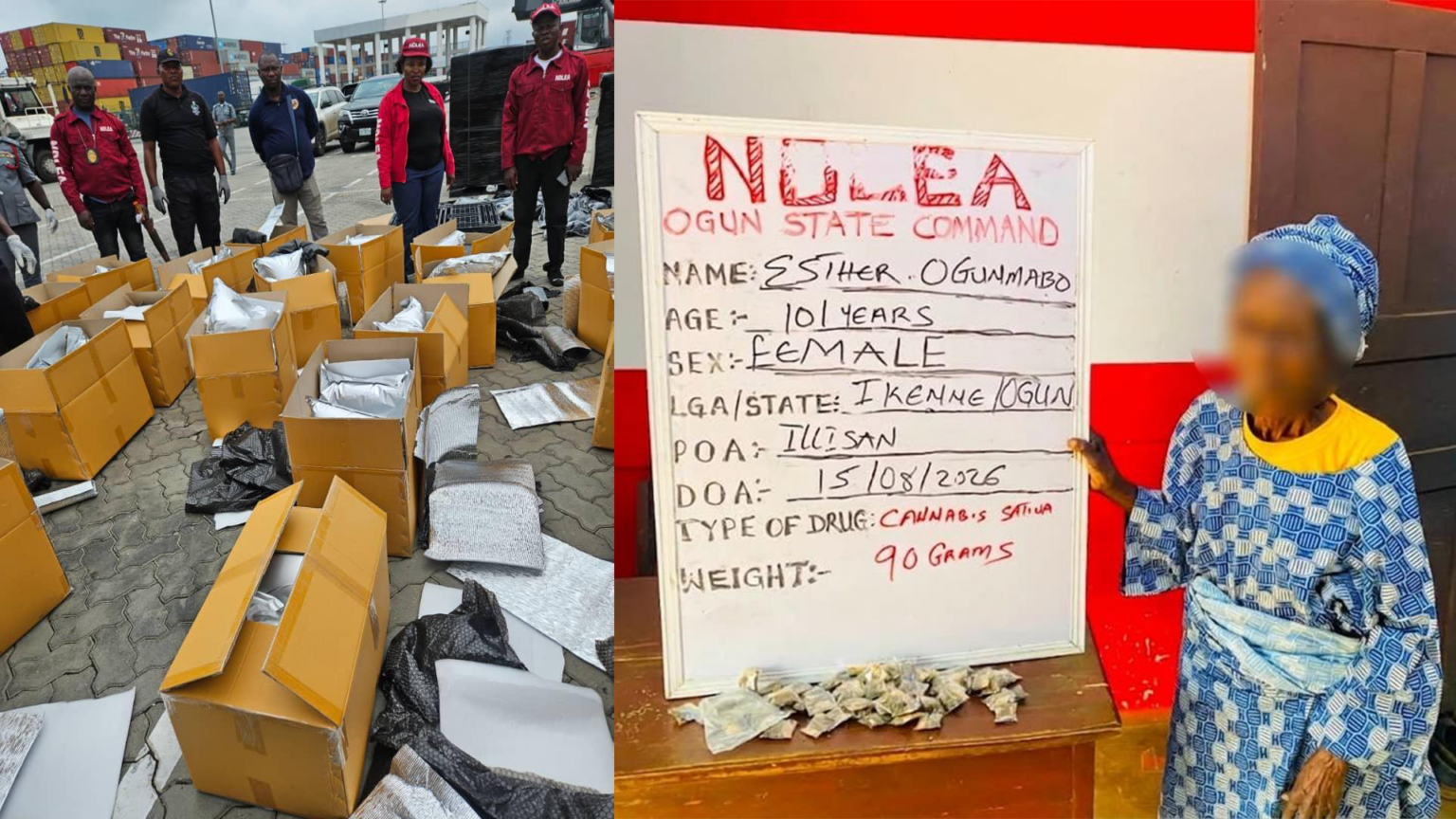
Nothing captured public attention quite like the arrest of Esther Ogunmabo, 101, apprehended by NDLEA operatives on August 15 at Ilisan in Ogun State. She was found in possession of 90 grams of skunk, carefully broken down into retail sachets for street sale.
Her account, as relayed by the agency, is a stark reminder of how economic desperation can pull even the most unlikely figures into the drug trade. Ogunmabo told operatives that she turned to peddling after her provisions shop went up in flames, wiping out her livelihood.
She said a daughter based in Lagos kept her supplied with the drug every four days, effectively running the operation through her elderly mother while remaining several steps removed from the point of sale.
That daughter has since been arrested. Ogunmabo herself, however, was granted bail and placed under counselling rather than facing full prosecution, a decision NDLEA Chairman Brig. Gen. Mohamed Buba Marwa (rtd) attributed directly to her age, a rare display of leniency from an agency more often associated with hard-edged enforcement.
Nearly 700 kilometers away in Akwa Ibom, a joint intelligence-led operation on August 21 intercepted a wooden boat ferrying narcotics toward fishing settlements across the border in Cameroon, a route long suspected by security agencies but rarely caught in the act.
Three suspects were arrested, among them 27-year-old Kingsley Effiong John, who investigators say had concealed 20 grams of cocaine inside a wrap of edible fufu, apparently banking on the innocuous appearance of the staple food to slip past inspection. He was also carrying 435 grams of skunk.
Altogether, operatives recovered 42.622 kilograms of narcotics from the trio, a haul that underscores how deeply embedded the maritime smuggling routes along Nigeria’s southern coastline have become in regional trafficking networks.
But it is the operation at Nigeria’s premier seaports that NDLEA officials appear most eager to highlight. Acting on intelligence, operatives intercepted two containers of Thai-origin synthetic cannabis, street name “Loud,” at the Apapa and Lekki Deep Sea ports in Lagos, with a combined estimated value exceeding N4.4 billion.
The agency described it as the first time drugs have been traced arriving in Nigeria by sea directly from Thailand, a development that, if it holds, would mark a significant shift in the geography of the country’s synthetic drug supply chain, which has traditionally leaned more heavily on Asian air routes and West African land corridors.
The concealment methods were elaborate. A container at Apapa, declared on the manifest as containing dry fish, rice, spare parts, soap and inverter batteries, was found on inspection to be hiding 1,090.5 kilograms of Loud packed into 2,181 sachets.
At Lekki Deep Sea Port, a second container that had already been flagged on a watchlist yielded 400 kilograms of the drug, buried beneath 798 reams of ordinary A4 paper.
The week’s tally did not end there. Elsewhere across the country, NDLEA units reported a string of parallel operations:
- Niger State: Operatives intercepted 24,410 tramadol pills concealed inside waybill packages aboard a bus travelling from Enugu to Zuba, resulting in the arrest of the consignment’s owner in Kontagora.
- Ondo State: A four-hectare cannabis farm deep in Ijare Forest was raided and destroyed, with an estimated 10,000 kilograms of skunk plants uprooted.
- Kwara State: A vehicle stopped along the Ogbomosho-Ilorin Expressway yielded 1.325 kilograms of methamphetamine and cannabis.
- Oyo State: In Ibadan, a 65-year-old woman was arrested with a 4.68-kilogram cocktail of assorted drugs: Loud, tramadol, codeine syrup, diazepam, and flunitrazepam, suggesting a diversified, one-stop supply operation.
- Kano, Seme, and Abia States: Further raids turned up additional seizures, including a residence in Umuahia South, Abia State, found stocked with Loud, Colorado, tramadol and rohypnol.
Even as its operatives were making arrests and hauling in narcotics by the ton, the agency says it kept up its public sensitization drive under the War Against Drug Abuse (WADA) campaign, engaging schools, religious institutions, and community leaders across Kano, Oyo, Kebbi, Taraba, Edo, and Ogun states, an effort officials frame as the preventive counterpart to the week’s enforcement blitz.
Commending the operatives involved, Chairman Marwa urged continued commitment to what he called the agency’s “balanced approach” to drug control, one that pairs aggressive interdiction with rehabilitation and public awareness, and one that, this week at least, stretched from a Thai cargo container in Lagos to a 101-year-old grandmother’s sachets of skunk in a small Ogun State town.
WHAT YOU SHOULD KNOW
The week’s operations show a drug trade operating on two extremes at once: sophisticated, high-value trafficking like the N4.4 billion Thai synthetic cannabis shipped through Lagos’s ports in the agency’s first-ever seizure of its kind and desperate, small-scale survival peddling, embodied by a 101-year-old woman selling skunk sachets after losing her shop to fire.
The real takeaway is that Nigeria’s narcotics problem isn’t confined to one type of offender or one route; it spans international cargo containers, cross-border boats, food staples used to hide cocaine, and ordinary households, meaning enforcement alone won’t fix it.
The NDLEA’s own framing, pairing arrests with counselling and community sensitization, underscores that lasting impact requires tackling both supply networks and the economic desperation feeding street-level dealing.