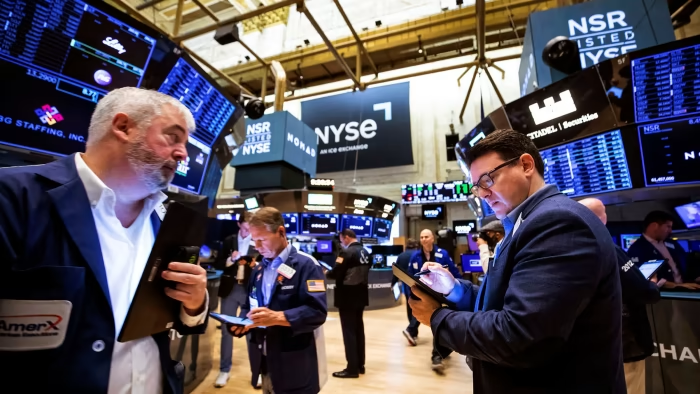
Wall Street rallied on Wednesday afternoon as a combination of robust corporate earnings and mounting speculation over Federal Reserve policy easing propelled the major indices higher, with technology and consumer stocks leading the charge.
The market’s upward trajectory gained steam by midday, with the Dow Jones Industrial Average climbing 0.22% to 44,207.51, while the S&P 500 posted stronger gains of 0.54% at 6,332.91. The tech-heavy Nasdaq Composite outpaced its peers with a 0.72% advance to 21,067.86, reflecting continued investor appetite for growth stocks.
Corporate Results Drive Sector Rotation
The session’s standout performer was Arista Networks, which soared 17.5% to an all-time high after the cloud networking specialist delivered better-than-expected revenue guidance for the current quarter. The company’s strong outlook underscored the ongoing demand for data center infrastructure amid the artificial intelligence boom.
Consumer discretionary names also contributed meaningfully to the rally. McDonald’s shares gained 2.8% as the fast-food giant’s value-focused menu strategy successfully drove global comparable sales beyond Wall Street forecasts. The results highlighted how major brands are adapting their pricing strategies to maintain growth in an uncertain economic environment.
Financial services stocks found favor as well, with Global Payments advancing 5.2% after reporting second-quarter profits that topped analyst expectations. Match Group, the parent company of Tinder, jumped 14.1% on revenue beats for the same period, suggesting resilient consumer spending on digital services.
Apple Leads Mega-Cap Rally on Manufacturing Pledge
Technology giant Apple provided the S&P 500’s biggest single-stock boost, surging 5.2% following reports that the company would announce a $100 billion domestic manufacturing commitment. The move comes as President Trump has recently imposed an additional 25% tariff on Indian goods over the country’s Russian oil purchases, part of his broader push to encourage domestic production and reduce foreign dependencies.
The Apple rally marked the stock’s strongest single-day performance in nearly three months, reflecting investor optimism about the company’s strategic pivot toward increased U.S. manufacturing capacity.
AI Sector Shows Mixed Performance
While the broader market celebrated earnings beats, several prominent artificial intelligence plays faced headwinds. Advanced Micro Devices tumbled 7.7% as its data center chip revenue failed to meet the elevated expectations that have characterized the AI sector throughout this earnings cycle.
The semiconductor selloff extended to server companies, with Super Micro Computer plunging 20.7% after missing fourth-quarter sales estimates. The weakness rippled through related names, dragging Dell Technologies down 2.4%.
“Earnings are seeing a mixed reaction. Particularly for a few of the AI names, expectations were just extremely high, but by and large, the earnings in aggregate have been good enough to keep a floor under the market,” explained Ross Mayfield, investment strategy analyst at Baird.
Federal Reserve Policy Expectations Shift Dramatically
Beyond corporate results, markets found substantial support from rapidly evolving Federal Reserve policy expectations. The Federal Reserve currently maintains its policy interest rate range at 4.25-4.50%, but traders have dramatically repriced the likelihood of near-term easing.
According to CME Group’s FedWatch tool, the probability of a September rate cut has surged to 93.2%, up from just 46.7% a week earlier. The dramatic shift follows last week’s employment report, which showed slowing job growth and downward revisions to previous months’ data, suggesting labor market softening that could prompt Fed intervention.
Market participants are now pricing in at least two rate cuts by the end of 2025, a more aggressive easing cycle than previously anticipated. The shift reflects growing concerns about economic momentum as various data points suggest moderating growth.
Economic Headwinds Mount
Adding to recession concerns, Tuesday’s services sector data revealed unexpected stagnation in July activity, highlighting the strain that trade policy uncertainty is placing on American businesses. Trump has escalated trade tensions with India, imposing 25% tariffs on Indian imports with additional penalties over the country’s Russian energy purchases.
The tariff escalation represents a broader shift in U.S. trade policy, as the administration seeks to pressure countries that maintain significant economic ties with Russia. The moves have introduced additional uncertainty for multinational corporations and their supply chains.
Federal Reserve officials have begun acknowledging these crosscurrents. Minneapolis Fed President Neel Kashkari told CNBC that the central bank needs to respond to economic slowing while cautioning that tariff-induced inflation could potentially force policymakers to pause or even reverse course on rate cuts.
Leadership Changes Loom at Federal Reserve
The monetary policy landscape faces additional uncertainty as Trump prepares to nominate a replacement for outgoing Fed Governor Adriana Kugler by week’s end. The president has also indicated he has narrowed his list of potential successors to Fed Chair Jerome Powell to four candidates, setting up potential changes in the central bank’s leadership philosophy.
Market Breadth and Technical Outlook
Wednesday’s session demonstrated healthy market breadth, with advancing issues outnumbering decliners by a 1.32-to-1 ratio on the New York Stock Exchange. However, the Nasdaq showed more selective participation, with declining issues slightly outpacing advancers by a 1.25-to-1 margin.
The S&P 500 recorded 15 new 52-week highs against 13 new lows, while the Nasdaq posted 38 new highs compared to 80 new lows, suggesting some underlying divergence beneath the headline gains.
Earnings Calendar Continues
Market attention will shift to after-market earnings reports from several high-profile companies, including Airbnb, DoorDash, and Lyft. These gig economy stalwarts will provide additional insight into consumer spending patterns and the broader economic health as investors assess whether the current earnings momentum can sustain the market’s recent advances.
The combination of solid corporate fundamentals and increasingly dovish Federal Reserve expectations has created a supportive backdrop for risk assets, though the sustainability of both trends remains a key question as the earnings season progresses and economic data continues to evolve.
WHAT YOU SHOULD KNOW
Wall Street rallied Wednesday on strong corporate earnings and surging Federal Reserve rate cut expectations. The probability of a September rate cut jumped dramatically from 47% to 93% in just one week, driven by weakening employment data that suggests economic softening.
Markets are being supported by two key forces—solid company profits (led by Arista Networks, McDonald’s, and Apple) and growing confidence that the Fed will ease monetary policy to counter economic headwinds. However, Trump’s escalating trade tensions with India and mixed results from AI companies show underlying volatility remains beneath the surface gains.