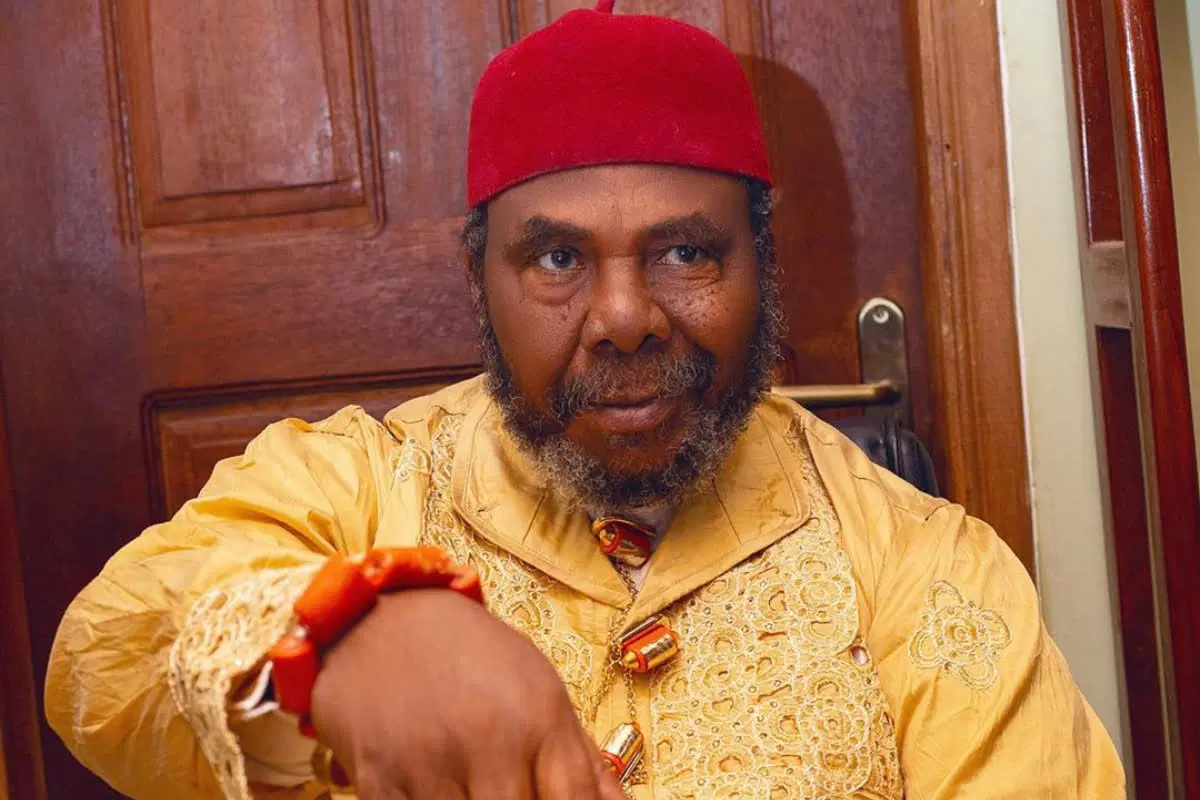
Renowned Nollywood actor Pete Edochie has ignited controversy with his recent assertions about the political aptitude of Igbo people, suggesting that cultural traits may hinder their effectiveness in Nigeria’s political landscape.
In a candid interview with Afia TV, the 77-year-old thespian argued that Igbo men struggle in politics due to their intolerance for betrayal and deception—elements he characterized as commonplace in political maneuvering. His comments have since sparked widespread discussion across social media platforms and within political circles.
“An Igbo man is not a good politician,” Edochie stated unequivocally during the interview. “People who are used to politics or the treachery that characterizes politics can overlook a lot of things. But the Igbo man is not constituted to condone treachery a second time.”
The veteran actor, who hails from Anambra State in Nigeria’s Southeast region, elaborated on what he sees as a fundamental incompatibility between Igbo cultural values and political pragmatism. According to Edochie, once an Igbo politician experiences betrayal, they permanently sever ties with the offending party, potentially limiting their ability to build the flexible alliances often necessary for political success.
“If you hurt the Igbo man once in politics, he will never allow you to hurt him again. He will recoil himself,” Edochie explained. “The moment you exhibit treachery in your involvement with an Igbo man, they cut you off. That’s it.”
These remarks come at a time when questions about Igbo political representation continue to resonate in Nigerian discourse. The Southeast region has historically faced challenges in achieving prominent national political positions, with many attributing this to various factors, including alleged marginalization and internal political divisions.
Edochie’s comments suggest that cultural factors may also play a role, presenting what he views as an inherent tension between traditional Igbo values of trust and loyalty and the often transactional nature of political relationships in Nigeria’s complex federal system.
The actor’s analysis touches on broader themes about how ethnic and cultural backgrounds influence political behavior in Nigeria’s diverse democracy. While some may view his observations as insightful cultural commentary, others are likely to challenge his generalizations about an entire ethnic group’s political capabilities.
Political analysts and Igbo leaders have yet to respond formally to Edochie’s statements, though the comments are expected to generate significant debate about political participation, cultural identity, and the dynamics of Nigeria’s multiethnic democracy.
The timing of these remarks is particularly noteworthy as Nigeria continues to grapple with questions of regional representation and the role of ethnicity in political advancement across the country’s six geopolitical zones.
WHAT YOU SHOULD KNOW
Veteran Nollywood actor Pete Edochie has controversially claimed that Igbo men struggle in politics because their cultural intolerance for betrayal makes them unsuitable for the compromises and shifting alliances that characterize political success.
He argues that once betrayed, Igbo politicians permanently cut ties rather than maintaining strategic relationships, ultimately limiting their political effectiveness. These sweeping generalizations about an entire ethnic group’s political capabilities are likely to spark significant debate about cultural identity and political participation in Nigeria’s diverse democracy.