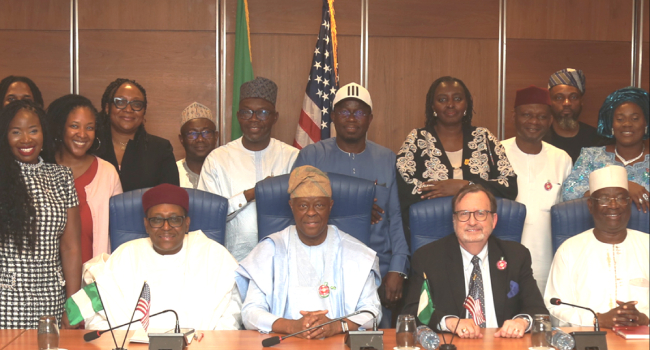
In a landmark agreement that represents the most substantial bilateral health commitment under the Trump administration’s America First Global Health Strategy, the United States and Nigerian governments have formalized a five-year, $5.1 billion health cooperation framework aimed at transforming Nigeria’s healthcare infrastructure while advancing American strategic interests.
The Memorandum of Understanding, signed December 19 and announced Sunday by the U.S. Mission in Nigeria, structures an unprecedented financing arrangement: Washington will contribute approximately $2.1 billion in health assistance over five years, while Abuja commits to $3 billion in new domestic health expenditures during the same period. This marks the largest co-investment any nation has pledged under the America First framework to date.
Addressing Critical Health Challenges
The agreement targets Nigeria’s formidable public health crisis head-on. Africa’s most populous nation, with 230 million people, shoulders roughly 30 percent of the global malaria burden and records among the world’s highest maternal and child mortality rates. The partnership will channel resources toward expanding access to preventive and curative services for HIV/AIDS, tuberculosis, malaria, polio, and maternal and child health programs.
American support will specifically bolster surveillance and outbreak response systems, laboratory infrastructure, health commodity supply chains, frontline healthcare worker capacity, and data management systems—fundamental pillars for building what U.S. officials characterize as a “resilient, self-reliant, and durable” health system.
Faith-Based Healthcare at the Forefront
In a distinctive element of the agreement, approximately $200 million has been earmarked specifically for Christian faith-based healthcare providers, who the MOU identifies as playing an “indispensable role” in Nigeria’s healthcare delivery system. According to the U.S. Mission’s statement, more than 900 Christian-affiliated clinics and hospitals serve over 30 percent of Nigeria’s population, frequently operating in underserved areas where government health facilities are scarce or nonexistent.
The dedicated funding will strengthen these Christian institutions, enhance their workforce capabilities, and expand integrated services for HIV, tuberculosis, malaria, and maternal and child health. U.S. officials describe these faith-based facilities as “uniquely positioned to complement public-sector facilities and reinforce Nigeria’s overall health infrastructure.”
Political Conditions and Security Linkages
The agreement explicitly connects health cooperation to broader security and religious freedom concerns. The U.S. mission statement indicates the MOU “was negotiated in connection with reforms undertaken by the Government of Nigeria to prioritize the protection of Christian populations from extremist violence.”
Washington has made clear that continued assistance depends on the Nigerian government’s performance in combating religiously motivated violence against Christian communities. The agreement preserves executive authority to modify or terminate programs, with the statement noting that “the President and Secretary of State retain the right to pause or terminate programs that do not align with U.S. national interests.”
The U.S. government expects Nigeria to demonstrate “measurable progress” in addressing attacks on Christian populations, effectively tying health assistance to security sector reforms and religious freedom protections.
Broader Regional Strategy
This Nigeria agreement represents the latest in a series of bilateral health cooperation MOUs the United States has signed with African nations this month, part of a systematic rollout of the America First Global Health Strategy across the continent. The strategy emphasizes what U.S. officials describe as “accountability and shared responsibility,” requiring recipient nations to substantially increase their own health spending while accepting American priorities and conditions.
The framework represents a departure from previous U.S. global health approaches by explicitly conditioning assistance on recipient government reforms in areas beyond health policy, including security measures and protections for specific religious communities.
For Nigeria, the agreement represents both a significant financial commitment and an embrace of greater national ownership over its health system—a principle U.S. officials have emphasized as central to achieving long-term sustainability in global health programs.
The five-year timeframe provides both governments a medium-term planning horizon while preserving American flexibility to adjust assistance based on Nigerian government performance across multiple policy domains.
WHAT YOU SHOULD KNOW
The U.S. and Nigeria have signed a groundbreaking $5.1 billion health deal—America’s largest under the America First strategy—with the U.S. contributing $2.1 billion and Nigeria pledging $3 billion over five years to combat the country’s severe health crises, including high maternal mortality and 30% of global malaria cases.
This isn’t just a health agreement. Washington has explicitly tied continued funding to Nigeria’s progress in protecting Christian communities from extremist violence, with $200 million specifically designated for Christian faith-based healthcare facilities.
The U.S. reserves the right to pause or terminate the program if Nigeria fails to meet security and religious freedom benchmarks—making this deal as much about American strategic interests and political conditions as it is about public health outcomes.