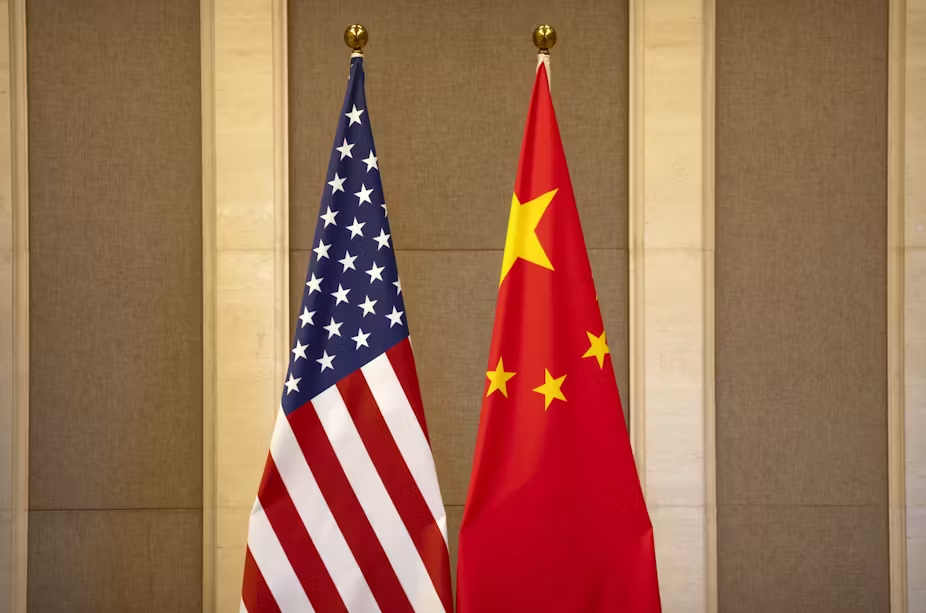
In a last-ditch diplomatic effort to prevent a complete unraveling of recent progress, Chinese Vice Premier He Lifeng will sit down with senior U.S. trade officials in Malaysia this week, as both nations attempt to cool an abrupt escalation in economic hostilities that threatens to derail a planned meeting between their leaders.
The high-stakes talks, scheduled to begin on Friday on the sidelines of an ASEAN summit in Kuala Lumpur, will bring together He—China’s most powerful economic policymaker—with U.S. Treasury Secretary Scott Bessent and Trade Representative Jamieson Greer. The meeting represents a critical opportunity to arrest the downward spiral in relations between the world’s two economic superpowers.
According to China’s commerce ministry, he will be in Malaysia from October 24 to 27 for the Association of Southeast Asian Nations gathering, which Malaysia is hosting. U.S. officials confirmed separately that Bessent and Greer would also attend, specifically to address Beijing’s controversial restrictions on rare earth exports—a move that has sent shockwaves through global supply chains.
Rare Earths Dispute Ignites New Crisis
The current crisis erupted earlier this month when China dramatically broadened export controls on rare earth elements, materials critical to everything from smartphones to military hardware. Beijing’s move came in direct retaliation to Washington’s decision to expand its list of Chinese firms banned from purchasing American technology—a roster that now includes dozens of additional companies accused of ties to China’s military or human rights abuses.
The tit-for-tat measures have injected fresh uncertainty into a relationship that, until recently, appeared to be warming. Trade analysts warn that the rare earth restrictions could disrupt manufacturing across multiple industries, particularly in the technology and defense sectors, where alternatives to Chinese supplies remain limited.
Thaw Interrupted
The timing of the flare-up is particularly awkward given what had seemed like promising momentum toward stabilization. Just over a month ago, on September 19, President Donald Trump and Chinese President Xi Jinping held a phone conversation that both sides characterized as constructive—a rare bright spot in years of increasingly strained relations.
That call had followed a summit in Madrid that diplomats on both sides hailed as a breakthrough, particularly for reaching an agreement on the future of TikTok, the Chinese-owned social media platform that has been a persistent flashpoint in bilateral tensions. The Madrid accord was seen as evidence that pragmatic cooperation remained possible despite broader strategic competition.
Summit in Jeopardy
Now, however, officials in both capitals are working frantically to salvage a planned summit between Trump and Xi in South Korea, scheduled for just one week away. The meeting, which would mark a significant milestone in bilateral diplomacy, risks being overshadowed—or even canceled—if the current tensions cannot be contained.
Sources familiar with the planning suggest both sides remain publicly committed to the South Korea summit, but behind closed doors, diplomats are engaged in what one observer called “damage control mode.” The success or failure of this week’s meetings in Malaysia may well determine whether the leaders’ summit proceeds as planned.
Blame Game Intensifies
Even as they prepare for talks, officials from both nations have been quick to point fingers. Chinese foreign ministry spokespersons have accused Washington of “economic bullying” and “unreasonable suppression” of Chinese companies, while U.S. officials counter that Beijing’s export restrictions amount to “economic coercion” and represent a dangerous weaponization of supply chains.
The recriminations reflect deeper structural tensions in a relationship marked by profound mistrust, competing visions of global order, and economic interdependence that both sides increasingly view as a vulnerability rather than a benefit.
High Stakes for the Global Economy
The outcome of this diplomatic scramble carries implications far beyond bilateral relations. With the global economy still navigating uncertain waters, a full-blown trade war between the world’s largest and second-largest economies could ripple across markets, supply chains, and growth prospects worldwide.
For now, all eyes turn to Malaysia, where three of the most powerful economic officials in the world will attempt to find common ground—or at least buy time—before their bosses are scheduled to meet. Whether they succeed may shape the trajectory of U.S.-China relations for months, if not years, to come.
WHAT YOU SHOULD KNOW
The U.S. and China are in crisis mode. After weeks of improving relations—including a positive Trump-Xi phone call and a breakthrough Madrid summit on TikTok—tensions have exploded over China’s rare earth export restrictions, imposed in retaliation for new U.S. tech bans on Chinese firms.
With a crucial Trump-Xi summit in South Korea just one week away, top officials from both sides are meeting urgently in Malaysia this Friday to prevent the situation from spiraling out of control. The outcome will determine whether months of diplomatic progress collapse or survive.