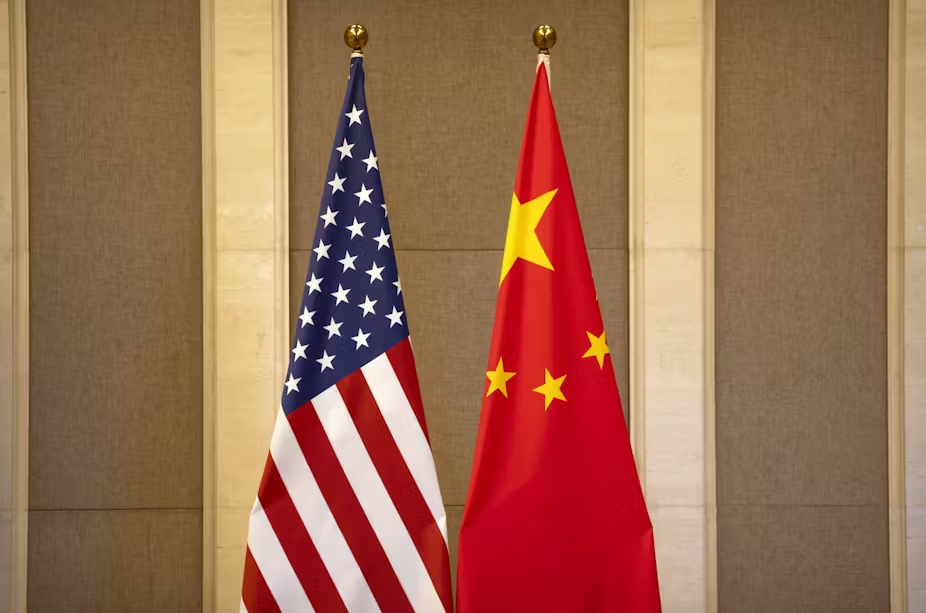
President Donald Trump escalated his confrontation with Beijing on Tuesday, warning that the United States could terminate certain trade relationships with China in retaliation for what he characterized as deliberate economic aggression against American farmers.
In a social media post, Trump accused China of engaging in an “Economically Hostile Act” by refusing to purchase U.S. soybeans, a move he said was deliberately designed to inflict hardship on American agricultural producers. The president singled out cooking oil as one sector where Washington could cut commercial ties with Beijing.
“We are considering terminating business with China having to do with Cooking Oil, and other elements of Trade, as retribution,” Trump wrote, adding that the United States possesses the domestic capacity to produce cooking oil independently.
Agricultural Battleground
The dispute centers on soybeans, a critical American export crop that has become a flashpoint in the broader U.S.-China trade war. China, the world’s largest consumer of soybeans, has dramatically curtailed its purchases from American suppliers in recent months, instead turning to major South American producers Brazil and Argentina to meet its demand.
Industry analysts view Beijing’s shift away from U.S. agricultural products as a strategic response to the Trump administration’s aggressive tariff policies. The president himself acknowledged earlier this month that he hoped to address the soybean issue directly with Chinese President Xi Jinping, even as he threatened to block substantial portions of Chinese imports.
The impact on American soybean farmers has been severe, with many facing compressed profit margins and uncertain market access to what was historically their largest foreign customer.
Broader Trade Offensive
The cooking oil threat represents just the latest salvo in Trump’s sustained trade offensive against China. Since taking office, the president has imposed sweeping tariff orders affecting billions of dollars in Chinese goods, justifying the measures as necessary to reduce America’s substantial trade deficit with Beijing, revitalize domestic manufacturing, and combat the flow of fentanyl into the United States.
The relationship between Washington and Beijing has deteriorated markedly during Trump’s tenure, with friction extending far beyond economic policy. The two powers remain locked in disputes over advanced technology access, human rights practices, the origins of the COVID-19 pandemic, and geopolitical flashpoints including Hong Kong, Taiwan, and more recently, Ukraine.
Trade experts suggest that both sides are now engaged in a high-stakes game of economic brinkmanship, with each government wielding trade policy as a weapon to extract concessions from the other. Agricultural products have emerged as particularly potent leverage points, given their political significance in key American farming states and China’s dependence on imported foodstuffs to feed its massive population.
Uncertain Path Forward
Whether Trump will follow through on his threat to terminate cooking oil trade remains unclear. Such a move would require careful consideration of supply chain implications and potential economic blowback for American consumers and businesses.
What is certain is that the U.S.-China relationship—arguably the most consequential bilateral partnership in the global economy—shows little sign of stabilization, with both governments appearing willing to absorb economic pain in pursuit of strategic advantage.
For American farmers watching commodity prices and export markets, the uncertainty continues.
WHAT YOU SHOULD KNOW
President Trump has threatened to cut trade ties with China over cooking oil and other products in retaliation for Beijing’s sharp reduction in U.S. soybean purchases—a move he calls economically hostile to American farmers.
This escalation is part of the ongoing trade war between the world’s two largest economies, where China has shifted its soybean imports to Brazil and Argentina while the U.S. has imposed billions in tariffs on Chinese goods.
Both nations are using agricultural trade as leverage in a high-stakes standoff that directly impacts American farmers and could reshape global supply chains, with no resolution in sight.