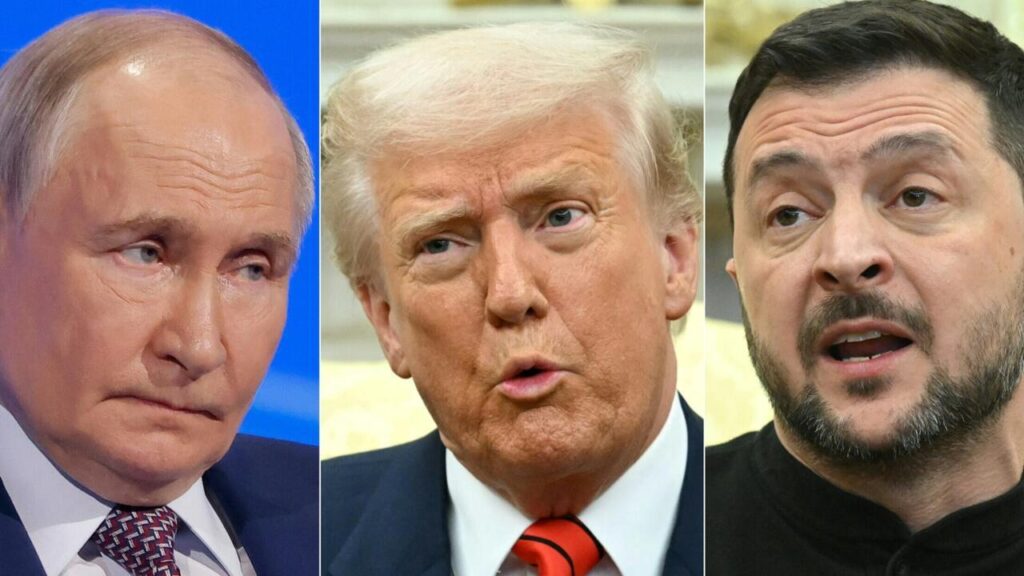
A possible breakthrough in the Russia-Ukraine conflict emerged on Monday as US President Donald Trump moved closer to arranging a historic meeting between Russian President Vladimir Putin and Ukrainian President Volodymyr Zelensky.
The development followed a series of fast-paced discussions in Washington between Trump and European leaders, centering on long-term security guarantees for Kyiv.
Trump revealed that he had spoken with Putin by phone shortly after hosting Zelensky and several European leaders at the White House. He described the exchanges as “very good” and announced that he had begun preparations for a face-to-face meeting between the Russian and Ukrainian presidents—their first since Moscow’s invasion nearly three and a half years ago.
On his Truth Social platform, Trump wrote that “everyone is very happy about the possibility of PEACE for Russia/Ukraine.” He added that he intends to follow the bilateral meeting with a three-way summit involving himself, Putin, and Zelensky.
German Chancellor Friedrich Merz confirmed that Putin had agreed to a meeting within the next two weeks, though no date or venue has yet been set.
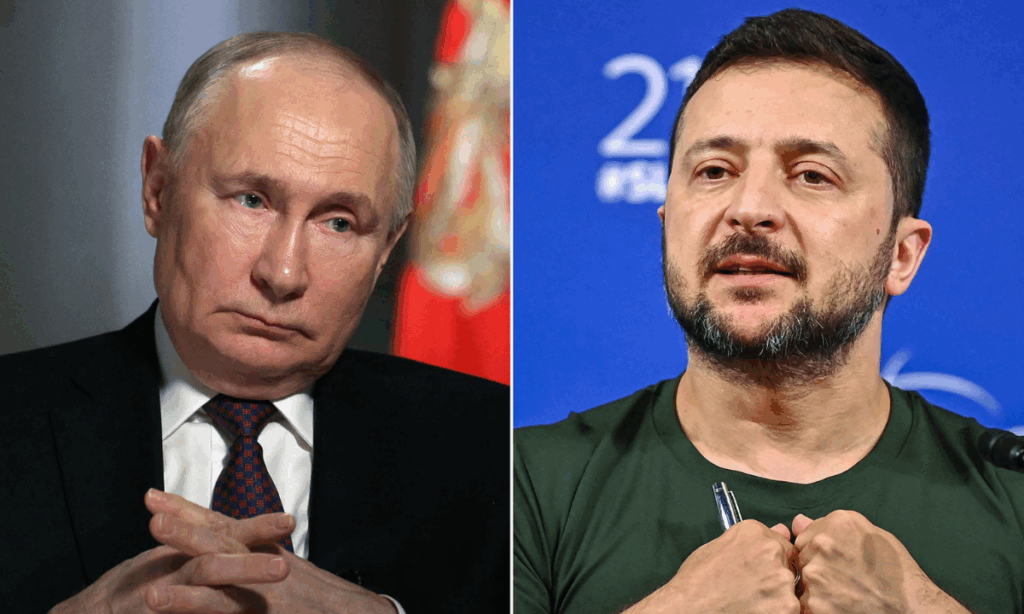
Zelensky ‘ready’ to meet Putin
Speaking outside the White House, Zelensky confirmed he was “ready” to hold direct talks with Putin, despite the devastation caused by Russia’s invasion. In Moscow, Kremlin officials indicated that Putin was open to the “idea” of such discussions.
The war has largely stalled in recent months, even as Russian forces made limited gains. Trump’s earlier meeting with Putin in Alaska did not result in a ceasefire, but his push for a new summit reflects his determination to fulfill his campaign pledge of quickly ending the conflict.
European leaders, including those of Britain, France, Germany, Italy, Finland, the European Commission, and NATO, rallied behind the talks, signaling broad support for a negotiated path to peace.
Zelensky also met privately with Trump in the Oval Office, marking a sharp contrast to their tense February encounter. He later described the exchange as their “best” meeting yet, while Trump publicly praised him—even complimenting his trademark black jacket, which had drawn criticism from right-wing media in the past.
Security guarantees for Ukraine
Central to the negotiations are security assurances for Kyiv. Trump stated that while Ukraine would not be admitted to NATO, Putin had accepted alternative security guarantees that would involve European nations in coordination with the United States.
NATO Secretary General Mark Rutte described the talks as “very successful,” noting that Trump had “broken the deadlock” over the guarantees.
According to the Financial Times, Ukraine has agreed to purchase $100 billion worth of US weapons financed by Europe in exchange for American-backed guarantees. Zelensky, however, spoke of a $90 billion package, adding that the details would be finalized within 10 days.
European leaders also expressed caution about Trump’s approach, fearing he could shift toward Moscow’s positions. Ahead of the meetings, Trump had urged Ukraine to abandon its NATO ambitions and give up Crimea—two of Putin’s central demands.
French President Emmanuel Macron warned that sanctions on Russia should be strengthened if Putin fails to move forward with peace talks. Finland’s President Alex Stubb emphasized that Putin was “not to be trusted,” while Germany’s Merz firmly rejected any suggestion that Ukraine should cede its remaining territory in Donbas.
“The Russian demand that Kyiv give up the free parts of Donbas corresponds, to put it bluntly, to a proposal for the United States to have to give up Florida,” Merz said.
What you should know
The possible summit between Putin and Zelensky, brokered by Trump, would mark the first direct talks between the two leaders since Russia’s 2021 invasion.
While security guarantees for Ukraine are at the heart of the negotiations, European leaders remain divided over whether Trump’s strategy risks forcing Kyiv into concessions that favor Moscow.