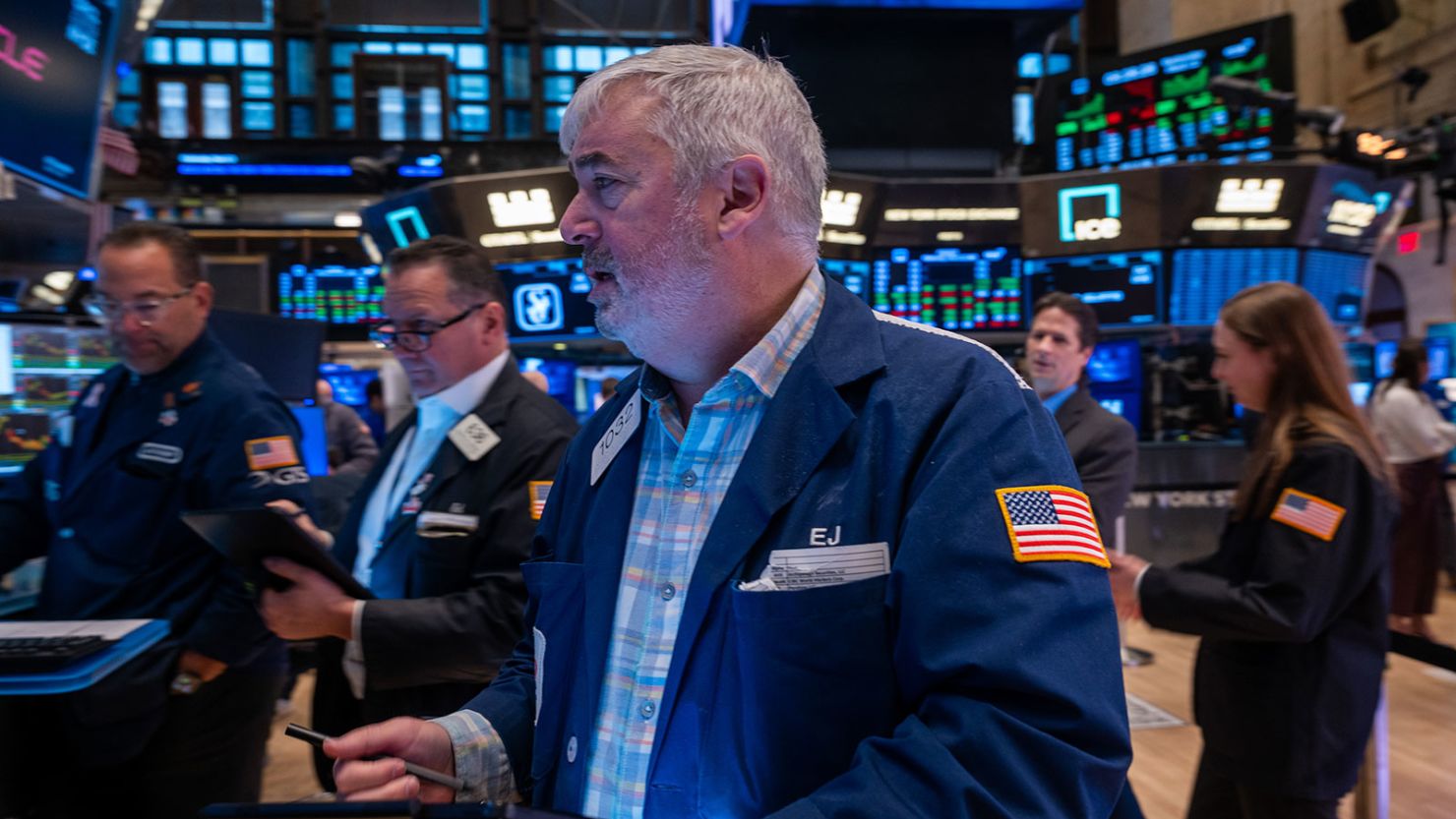
Wall Street faced another session of mixed signals on Wednesday morning as investors grappled with mounting evidence that President Trump’s expanding tariff regime is beginning to fuel inflation concerns, while a fresh wave of corporate earnings provided both bright spots and cautionary tales.
The S&P 500 added 0.14% to close at 6,268.56, while the Nasdaq Composite rose 0.27% to settle at 20,640.33 in Tuesday’s session, but futures pointed to a more subdued start Wednesday. By 6:57 a.m. ET, Dow E-minis had gained a modest 24 points, while S&P 500 E-minis slipped 1.5 points and Nasdaq 100 E-minis fell 36.75 points, reflecting the market’s increasingly cautious stance.
The semiconductor sector bore the brunt of tariff-related anxiety, with equipment manufacturers suffering sharp declines after Dutch lithography giant ASML delivered a sobering assessment of its growth prospects. Like many companies in the semiconductor industry, ASML has been grappling with uncertainty created by U.S. tariff policy, with the company warning it may struggle to achieve growth targets in 2026 due to the uncertain trade environment.
The ripple effects were immediate and widespread across the sector. Applied Materials and Lam Research each tumbled 2.8% in premarket trading, while KLA Corp shed 2.7% and Teradyne declined 0.9%. More than $130 billion of value has been wiped off of ASML in under a year amid restrictions on exports to China and U.S. tariff uncertainty, highlighting the sector’s vulnerability to trade disruptions.
The market’s unease reflects broader concerns about the inflationary impact of Trump’s trade policies. This increase would bring the overall US average effective tariff rate to 20.6%, the highest since 1910, according to recent analysis from Yale’s Budget Lab. Economists, researchers, and analysts have warned that President Donald Trump‘s sweeping trade policy of tacking steep tariffs on most goods that come into America will deliver a taxing blow to consumers via higher prices.
Deutsche Bank analysts captured the prevailing sentiment in a research note, warning that “inflation risks are still being underestimated, with a remarkable complacency across key assets.” Money markets now price in just 43 basis points of Federal Reserve easing by year-end, with a July rate cut completely off the table and September’s prospects reduced to a coin flip.
The trade tension escalated further as Trump announced a 19% tariff on Indonesian goods as part of what sources described as rushed negotiations ahead of an August 1 deadline for broader tariff implementation. U.S. stock futures fell on Sunday as Trump continued his letter-writing blitz, warning the EU and Mexico over the weekend that they face 30% tariffs unless they reach trade deals by Aug. 1.
However, the earnings picture provided some relief for investors. Bank of America emerged as a standout performer, gaining 1.4% after reporting stronger-than-expected quarterly profits driven by robust trading revenue during the period’s volatile market conditions. The bank joined JPMorgan Chase and Citigroup in delivering better-than-anticipated results, though all three institutions expressed caution about the potential economic impact of escalating tariff policies.
Johnson & Johnson provided another bright spot, rising 1% after beating profit estimates and raising its full-year sales forecast by approximately $2 billion. Global Payments surged 6.1% following reports that activist investor Elliott Management had built a significant stake in the payments technology company.
The technology sector, while facing headwinds from tariff concerns, continued to demonstrate resilience. The Nasdaq closed at a record high Tuesday, powered by gains in Nvidia shares after the chip designer announced plans to resume sales of its H20 AI chips to China, though the stock retreated 0.4% in Wednesday’s premarket trading.
Looking ahead, investors awaited the release of producer price data at 8:30 a.m. ET, seeking additional insights into inflationary pressures at the factory level. With the Federal Reserve’s policy outlook increasingly tied to inflation developments, the data could provide crucial guidance for both monetary policy expectations and market direction.
The European Union’s preparation of retaliatory measures should trade talks with Washington falter, adding another layer of complexity to an already challenging environment. As markets navigate this intersection of corporate performance and trade policy uncertainty, the coming sessions will likely test investors’ resilience in the face of mounting economic crosscurrents.
WHAT YOU SHOULD KNOW
Trump’s expanding tariff policies are beginning to create real inflationary pressures that are reshaping market expectations. The Federal Reserve is now unlikely to cut rates significantly this year, with money markets pricing in minimal easing and September rate cuts becoming uncertain.
While corporate earnings showed resilience—with Bank of America, Johnson & Johnson, and major banks beating expectations—the semiconductor sector’s sharp decline following ASML’s tariff-related growth warnings signals broader economic headwinds.
The combination of rising inflation risks and trade uncertainty is creating a more cautious investment environment, despite the tech sector’s recent record highs.