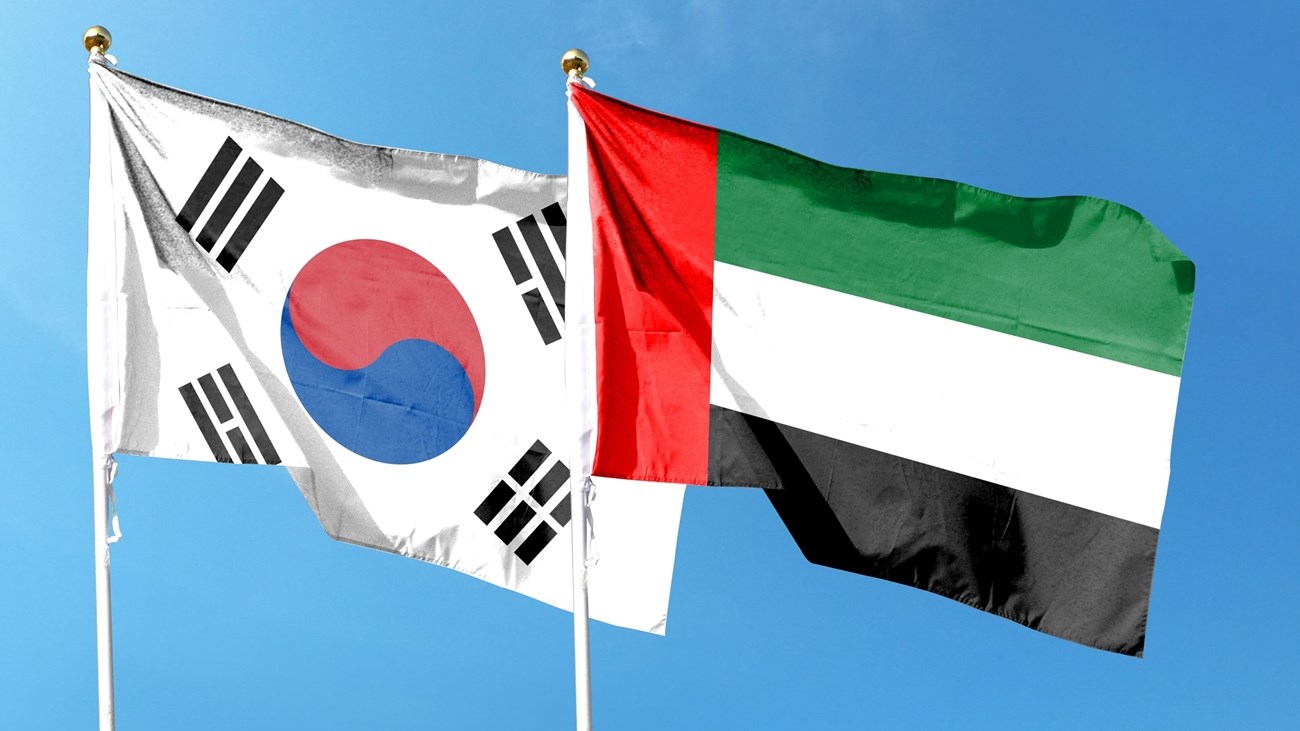
South Korea announced on Friday a critical agreement to import approximately four million barrels of crude oil from the United Arab Emirates (UAE).
The deal comes as global energy markets reel from disruptions caused by Iran’s bold claim of control over the Strait of Hormuz, a vital artery for international oil trade.
The conflict, which has seen joint military operations by the United States and Israel targeting Iranian assets, has sent shockwaves through commodity markets, with oil prices surging to multi-year highs. Brent crude futures climbed above $120 per barrel in early trading sessions today, reflecting fears of prolonged supply shortages.
Iran’s declaration of dominance over the Strait—a narrow waterway at the mouth of the Persian Gulf through which roughly one-fifth of the world’s seaborne oil transits has heightened tensions, prompting nations like South Korea to scramble for alternatives.
South Korea, the world’s fourth-largest importer of crude oil according to data from the U.S. Energy Information Administration, is particularly vulnerable. Government statistics reveal that about 70% of its imported oil typically passes through the Strait of Hormuz, making any blockade or restriction a potential economic catastrophe.
The country’s heavy industries, including shipbuilding, petrochemicals, and automotive manufacturing, rely on steady fuel supplies to maintain operations and exports.
Presidential Chief of Staff Kang Hoon-sik outlined the details of the UAE agreement during a press briefing at the Blue House. “We have dispatched two South Korean-flagged oil tankers, each capable of carrying up to 2 million barrels, to secure immediate supplies,” Kang stated. ” These vessels will berth at alternative ports in the UAE that bypass the need to navigate the Strait of Hormuz, ensuring safe and uninterrupted delivery.”
In addition to the tanker shipments, the deal includes a flexible provision for accessing joint strategic reserves. “The UAE has pledged that up to 2 million barrels from the reserves they store in South Korea can be released upon request at any time,” Kang added.
This arrangement leverages existing bilateral energy ties between the two nations, which have deepened in recent years through investments in storage facilities and joint ventures.
The UAE, a major OPEC producer and a key ally in the region, has positioned itself as a stable supplier amid the chaos. Abu Dhabi’s willingness to step in underscores the shifting alliances in the Middle East, where traditional oil exporters are navigating the fallout from the US-Israel-Iran hostilities. Analysts suggest this could mark the beginning of a broader realignment in global oil flows, with Asian importers like South Korea, Japan, and India seeking diversified sources from the Arabian Peninsula and beyond.
Energy experts warn that the situation remains fluid. Iran’s control claim, if enforced through military means such as mine-laying or naval patrols, could choke off supplies not just for South Korea but for much of Asia and Europe. “The Strait is a global chokepoint,” said Dr. Elena Park, a senior analyst at the Korea Institute for International Economic Policy. “Any prolonged disruption could lead to rationing, higher consumer prices, and even recessionary pressures in import-dependent economies.”
South Korean officials emphasized that the UAE deal is part of a multi-pronged strategy. The government is also exploring increased imports from the United States, Russia, and Saudi Arabia, while accelerating investments in renewable energy and liquefied natural gas (LNG) to reduce long-term reliance on Middle Eastern oil. President Yoon Suk-yeol’s administration has convened an emergency task force to monitor the crisis, with potential activations of domestic stockpiles if the conflict escalates further.
As the war unfolds, the international community watches closely. Diplomatic efforts, including UN Security Council discussions, aim to de-escalate tensions, but with Iran’s Revolutionary Guard vowing to defend the Strait “at all costs,” the risk of broader involvement looms large. For South Korea, this oil lifeline from the UAE buys precious time, but it highlights the fragile interdependence of global energy systems in an era of geopolitical volatility.
This development follows weeks of market turbulence, with shipping insurance premiums skyrocketing for vessels transiting the Gulf. Industry insiders predict that if the Strait remains contested, alternative routes—such as pipelines through Saudi Arabia or overland transport—could become the new norm, albeit at higher costs.
South Korea’s proactive stance may serve as a model for other nations. As one of the world’s top economies, its ability to pivot quickly underscores the importance of strategic partnerships in mitigating the ripple effects of distant conflicts.
WHAT YOU SHOULD KNOW
South Korea has secured an emergency 4-million-barrel oil lifeline from the UAE to protect its economy as the US-Israel war on Iran threatens the Strait of Hormuz—the chokepoint carrying one-fifth of global crude.
70% of South Korea’s oil imports normally pass through the Strait of Hormuz, which Iran now claims to control. Without swift alternative supplies like this UAE deal, the country’s fuel security and much of Asia’s would be in immediate jeopardy.