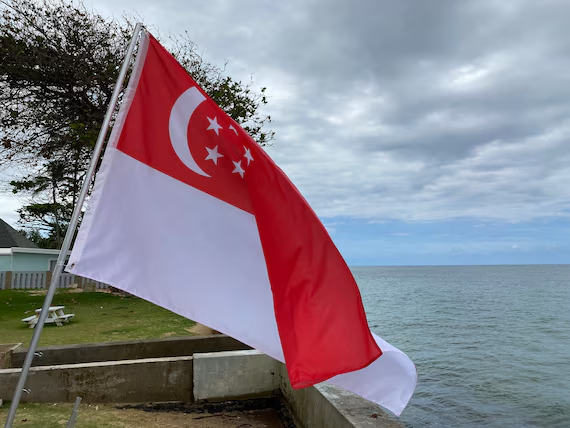
Singapore’s monetary authority defied market expectations Wednesday, keeping its policy settings unchanged as the city-state’s economy showed unexpected resilience in the face of global trade headwinds that have dominated headlines throughout 2025.
The Monetary Authority of Singapore (MAS) announced it would maintain the current trajectory of its Singapore dollar policy band, leaving both the rate of appreciation and the band’s width and center point untouched. The decision split analysts down the middle, with half of the 12 Reuters-polled experts predicting the status quo, while the remainder had anticipated a third policy easing this year.
Trade Tensions Ease, Growth Surprises
The central bank’s rationale centered on two key developments: Singapore’s stronger-than-expected second-quarter economic performance and a notable de-escalation in global trade tensions since April. The economy expanded 1.4% quarter-on-quarter in preliminary data, helping the trade-dependent nation sidestep what could have been a technical recession.
“The risk of a sharp step-down in global growth in the near term has receded along with the general de-escalation in trade tensions as well as more benign financial conditions since April,” MAS stated, signaling confidence in its current policy stance after implementing two previous easings earlier in 2025.
Recent weeks have seen the United States forge new trade agreements with key partners, including Europe and Japan, contributing to the improved global trade environment that appears to have influenced Singapore’s monetary policy calculus.
Unique Policy Framework in Focus
Singapore’s distinctive approach to monetary policy—managing exchange rates rather than interest rates—came under scrutiny as economists debated the timing of potential future moves. The city-state allows its dollar to fluctuate against a trade-weighted basket of currencies within an undisclosed band, adjusting three key parameters: the slope, midpoint, and width of this policy corridor.
OCBC economist Selena Ling characterized the MAS decision as “keeping its ammunition dry,” noting the complex inflation dynamics at play. “Tariff impact on Chinese exports to the rest of the world may be disinflationary, but geopolitics and supply chain recalibrations may be inflationary, so the net impact still has to be assessed,” she explained.
Export Rush Boosts Near-Term Performance
The economy’s recent outperformance appears linked to exporters accelerating shipments to avoid potential U.S. tariff increases, creating a temporary boost that officials acknowledge may not be sustainable. Singapore authorities have cautioned that growth momentum will likely decelerate in the latter half of 2025 as this front-loading effect diminishes.
The MAS emphasized ongoing uncertainty, particularly looking toward 2026, while noting that the effective U.S. tariff rate on Singapore exports has risen to 7.8% from 6.8% in April—a reminder of the persistent trade policy challenges facing the export-oriented economy.
Inflation Cooling, Growth Forecasts Rising
The policy decision comes against a backdrop of cooling price pressures, with core inflation dropping to just 0.6% year-on-year in June—a dramatic decline from the 5.5% peak recorded in early 2023. This disinflationary trend has provided the central bank with greater policy flexibility.
Despite the government’s conservative GDP forecast range of 0.0% to 2.0% set in April, private sector economists are growing more optimistic. Maybank’s Chua Hak Bin projects 3.2% growth for 2025 and expects official forecasts to be revised upward when final second-quarter data is released in August.
October Decision Looms
Looking ahead, major financial institutions, including Bank of America, Goldman Sachs, and DBS, continue to anticipate a third policy easing at the MAS’s October meeting, suggesting Wednesday’s pause may prove temporary if global conditions deteriorate or domestic growth momentum falters.
The central bank’s cautious approach reflects the delicate balancing act facing policymakers in an interconnected global economy where trade policy shifts can rapidly alter economic trajectories. For now, Singapore appears content to wait and assess, betting that its current policy stance provides adequate flexibility to respond to whatever challenges the remainder of 2025 may bring.
WHAT YOU SHOULD KNOW
Singapore’s central bank surprised markets by keeping monetary policy unchanged, citing stronger-than-expected economic growth and easing global trade tensions. The economy grew 1.4% in Q2, avoiding recession, largely due to exporters rushing shipments to beat potential U.S. tariffs. However, officials warn this growth boost is temporary and expect a slowdown in late 2025.
With inflation now at just 0.6% (down from 5.5% in 2023), the central bank is keeping policy options open while most analysts still expect another easing by October. The decision reflects Singapore’s cautious approach amid ongoing trade uncertainty and mixed economic signals.