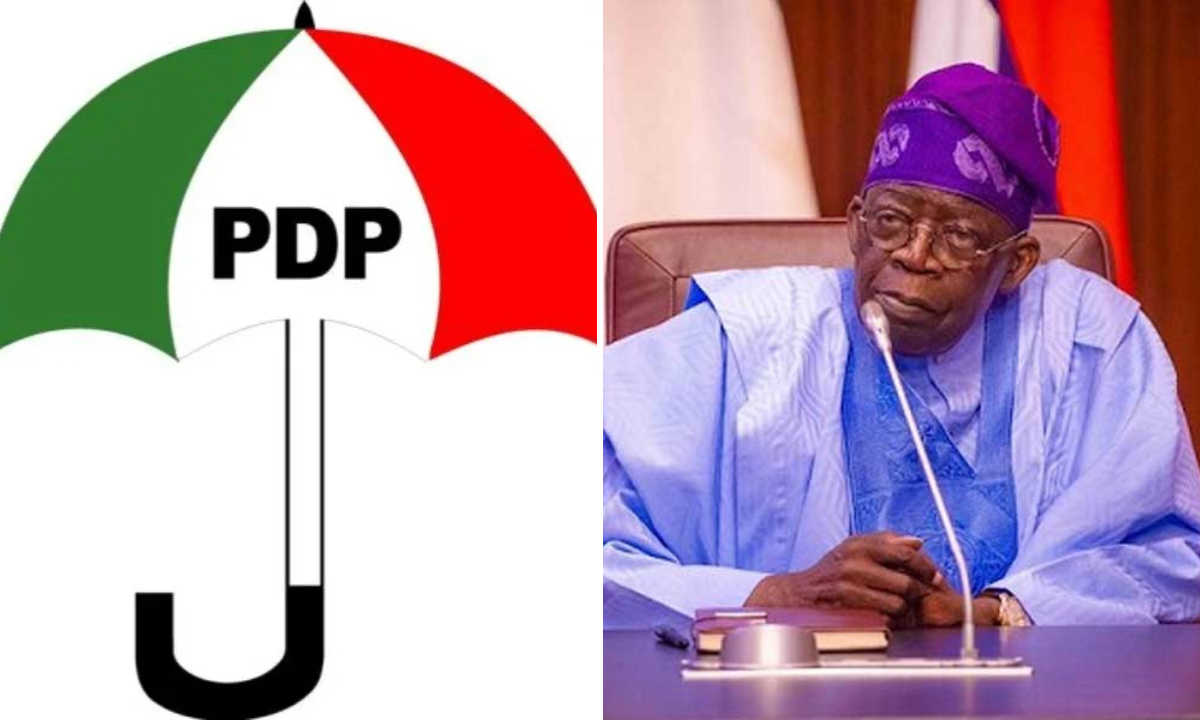
Nigeria’s main opposition party, the Peoples Democratic Party (PDP), has criticised President Bola Tinubu’s recently submitted ambassadorial nominees, objecting strongly to the placement of former Independent National Electoral Commission (INEC) Chairman, Mahmood Yakubu, on the list.
In a statement issued by its spokesperson, Ini Ememobong, the PDP labelled the 32-man list as troubling, insisting it fails to reflect credibility or merit.

“Specifically, we convey the disappointment of many right-thinking Nigerians on the nomination of Prof. Mahmood Yakubu, the immediate-past Chairman of the Independent National Electoral Commission (INEC), whose administration of our electoral umpire was characterised by countless double-speaks, flip-flops, and undelivered promises, which ultimately resulted in the birth of this administration, which is struggling in all areas of governance,” the PDP said on Saturday.
The statement further argued that offering him such a role at this moment suggests a questionable reward pattern. According to the PDP, doing so “is an excellent exemplar of a skewed reward system, which we suspect is designed as an incentive to the new INEC Chairman, to also deliver flawed elections in 2027, in expectation of future rewards. This is absolutely scandalous and completely unacceptable.”
President Tinubu’s submission to the Senate includes 32 nominees made up of both career diplomats and political appointees.
Among those selected, in addition to Yakubu, are former presidential aide Reno Omokri, former Minister of Aviation Femi Fani-Kayode, ex-Abia governor Okezie Ikpeazu, former Enugu governor Ifeanyi Ugwuanyi, former Oyo First Lady Fatima Florence Ajimobi, and ex-Lagos Commissioner Lola Akande. Also listed is Paul Oga Adikwu, a former Nigerian envoy to the Holy See.
PDP Calls for Immediate Withdrawal

The PDP denounced many of the nominees as “disgraced propagandists, characterless politicians, and public officials who are widely perceived negatively by Nigerians and the global community, for their integrity deficit and notable anti-democratic activities”.
The party, which governed Nigeria from 1999 to 2015, said the selection reflects poorly on the country’s image and amounts to a decline in the quality of Nigeria’s international representation.
It claimed the list “is very reprehensible and scandalous,” arguing that its contents mirror President Tinubu’s priorities and choices.
“By making these nominations, the President has shown Nigerians that these are the best people he has to represent our country in the countries where they will be posted,” Ememobong stated, adding that the long delay in releasing the list “speaks to the paucity of excellent people within his reach.”
The PDP insisted Nigeria deserves envoys with untainted public records and strong democratic values. According to the party, “appointing and sending ambassadors with tainted political profiles is not only a great disservice to Nigeria but a setup for a diplomatic all-time low”.
Consequently, the PDP demanded that President Tinubu retract the list and submit a new one comprised only of individuals with unquestionable character and credibility deemed capable of earning international respect.
What You Should Know
This development highlights growing political tension between the PDP and the Tinubu administration, particularly regarding governance, electoral integrity, and Nigeria’s diplomatic image.
While the President maintains constitutional authority to nominate ambassadors, the backlash underscores concerns about transparency, moral standards in public appointments, and the long-term implications for Nigeria’s foreign relations.