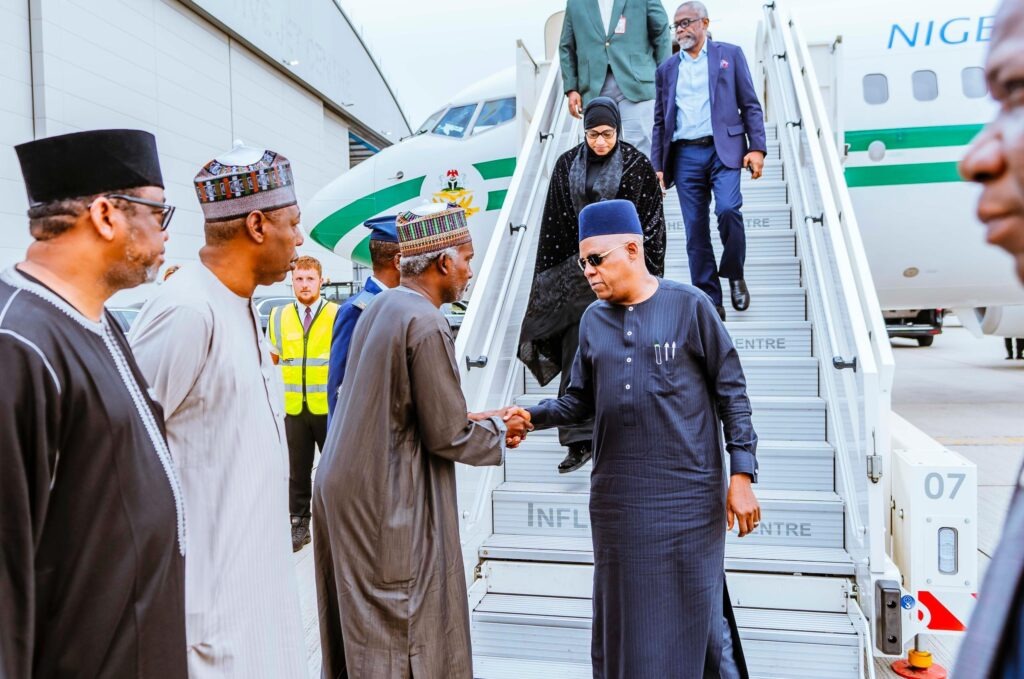
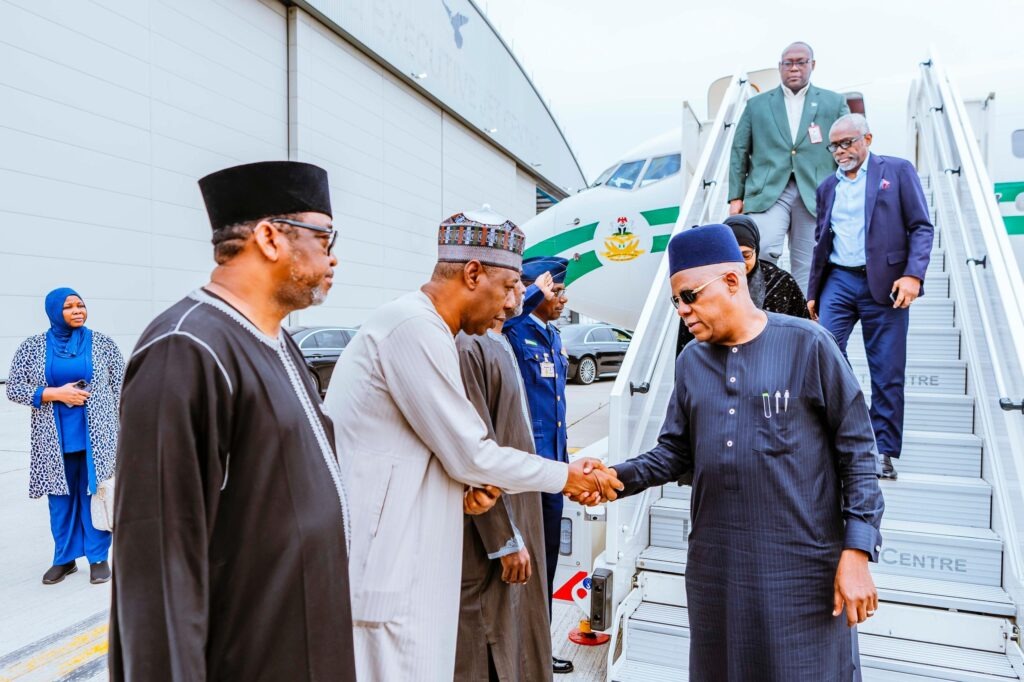
Vice President Kashim Shettima and Chief of Staff to the President, Femi Gbajabiamila, have arrived in London to receive the body of former President Muhammadu Buhari, who died on Sunday, July 13, 2025.
The duo, acting on the directive of President Bola Tinubu, are leading Nigeria’s official delegation for the solemn task. They were received in London by Nigeria’s Minister of Foreign Affairs, Yusuf Tuggar, and Borno State Governor, Babagana Zulum, among others.
Buhari passed away at about 4:30 pm in a London clinic, following a prolonged but largely undisclosed illness. His health challenges first gained national attention in 2017 when he was flown abroad for several months of treatment. While his condition reportedly worsened in recent weeks, his aides maintained he was stable and in recovery.
In response to the news, President Tinubu ordered national flags flown at half-mast and expressed condolences to Buhari’s family, describing his death as a significant national loss. Tributes have continued to pour in from leaders and citizens across the country, hailing the former leader’s personal discipline and political influence.
Buhari, from Daura in Katsina State, served as Nigeria’s military Head of State between 1984 and 1985, and later as a democratically elected President from 2015 to 2023. He was known for his austere lifestyle, firm anti-corruption message, and strong northern support base, where he was affectionately called “Baba Buhari.”
Despite initial failures in presidential elections in 2003, 2007, and 2011—each time securing over 12 million votes—Buhari eventually emerged victorious in 2015 after forming the All Progressives Congress (APC) through a historic opposition merger.
His two-term administration, shared with Vice President Yemi Osinbajo, saw a mix of praised anti-corruption rhetoric and criticized lapses in administrative oversight. In 2023, Buhari handed over power to President Bola Tinubu and Vice President Shettima.
What you should know
The repatriation of former President Muhammadu Buhari’s remains marks a pivotal and emotional moment in Nigerian history.
His death comes just two years after leaving office, and he remains one of the few leaders to have served both as military and civilian head of state. His legacy continues to stir debates around governance, integrity, and leadership in Africa’s largest democracy.