Nigeria has signed a landmark Comprehensive Economic Partnership Agreement (CEPA) with the United Arab Emirates (UAE) that will eliminate tariffs on thousands of products and create new business opportunities between the two nations, a senior government official announced on Tuesday.
The agreement, finalized during Abu Dhabi Sustainability Week from January 11 to 15, 2026, represents what Rep. Sam Onuigbo, a member of the Governing Board of the North East Development Commission, described as a “game changer” for Nigerian commerce and economic development.
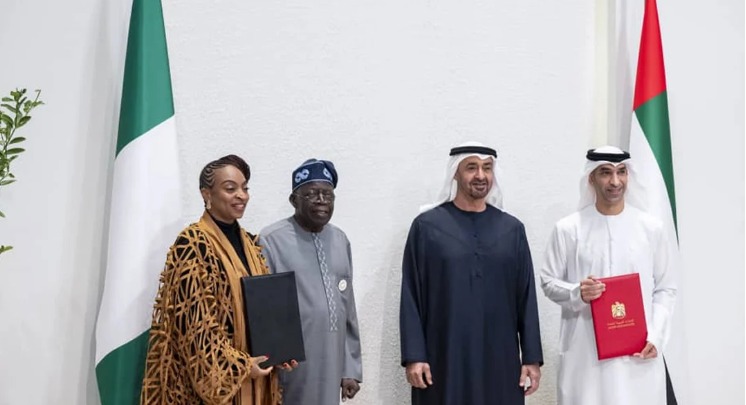
Under the terms of the bilateral trade pact, the UAE will remove tariffs on 7,315 Nigerian products. Of these, 2,805 products—representing 38.3 percent of the total—will receive immediate duty-free access to Emirati markets. The remaining tariffs will be phased out over a three-to-five-year period, covering both agricultural and industrial goods.
In a reciprocal arrangement, Nigeria has eliminated tariffs on 6,243 products imported from the UAE, creating what Onuigbo called “wonderful opportunities” for trade between the two countries.
Speaking with the News Agency of Nigeria in Abuja, Onuigbo, who previously served as Chairman of the Committee on Climate Change in the House of Representatives during the 8th Assembly, emphasized the agreement’s potential to transform Nigeria’s business landscape.
“The agreement is massive and would facilitate an environment for businesspersons in Nigeria, who have businesses that are verifiable and identifiable, to go over there and open offices, also to work there for three months and come back,” Onuigbo explained.
The former representative for the Ikwuano/Umuahia North and South Federal Constituency praised President Bola Tinubu for securing the deal, noting that it is “geared and targeted towards how to reposition Nigeria, create the enabling environment for employment, and, of course, make everybody happy.”
Beyond Trade: Energy and Climate Cooperation
The Abu Dhabi summit also served as a platform for Nigeria to unveil its carbon market framework policy, signaling the country’s commitment to addressing climate challenges while pursuing economic growth.
Onuigbo highlighted Nigeria’s ongoing struggle with energy access as a critical barrier to industrialization. The nation of nearly 250 million people has long faced insufficient power generation capacity to meet its economic and industrial development targets.
In response, the Nigerian government has implemented several initiatives, including an Energy Transition Plan, the Climate Change Act, and the Electricity Act, which President Tinubu signed just eight days after assuming office in 2023.
“This shows the importance of addressing the energy gap; having enough energy and electricity is a fundamental point to developing industrially, which Nigeria deems necessary,” Onuigbo said.
Looking Ahead
The North East Development Commission board member expressed optimism that Nigeria’s participation in the Abu Dhabi summit would “further enable global economic opportunity for people to work together within Nigeria and the UAE.”
He added that the President’s collaborative approach would help address the devastating effects of climate change while building up Nigeria’s economy throughout 2026.
The CEPA represents one of Nigeria’s most significant trade agreements in recent years, potentially opening new markets for Nigerian manufacturers, farmers, and exporters while providing Nigerian consumers with greater access to UAE products at reduced costs.
As implementation begins, business communities in both nations will be watching closely to see how effectively the agreement translates into tangible economic benefits and job creation in the months ahead.
WHAT YOU SHOULD KNOW
Nigeria and the UAE signed a game-changing trade agreement in January 2026 that will eliminate tariffs on over 7,000 Nigerian products entering UAE markets—with nearly 40% receiving immediate duty-free access. In return, Nigeria removed tariffs on over 6,000 UAE products.
This historic deal opens significant business opportunities for Nigerian entrepreneurs, who can now establish offices and operate in the UAE, while positioning Nigeria as a more competitive player in global trade.
Beyond commerce, the agreement strengthens cooperation on energy and climate issues—critical areas for Nigeria’s industrial development and economic growth in 2026.