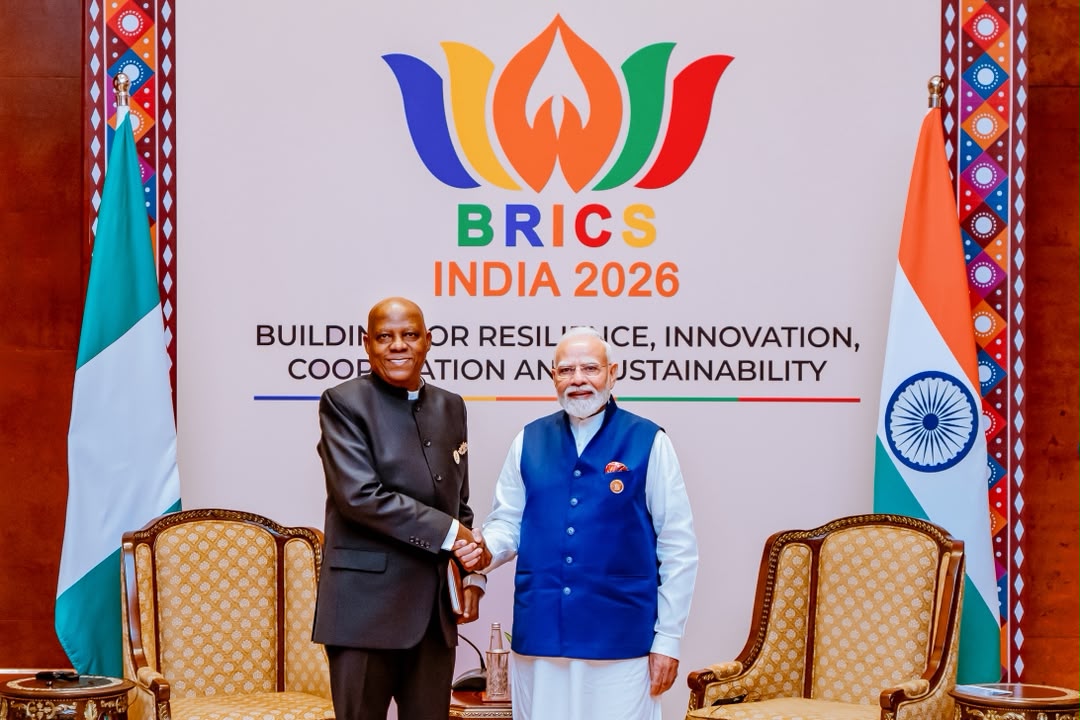
Nigeria’s Vice President Kashim Shettima and Indian Prime Minister Narendra Modi have pledged to inject fresh momentum into a bilateral trade relationship that has cooled significantly in recent years, with New Delhi making a direct pitch for expanded access to Nigerian crude.
The commitment emerged from high-level talks held on the sidelines of the 18th BRICS Leaders’ Summit in the Indian capital, where the meeting focused on expanding cooperation across strategic sectors, including oil and gas, renewable energy, power, defence, technology, healthcare, and capacity development.
Details of the discussion were relayed in a statement by Stanley Nkwocha, the vice president’s spokesperson on media matters.
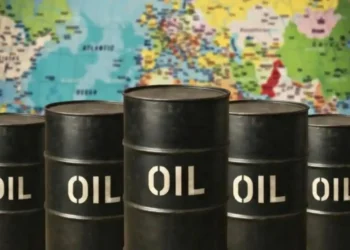
Central to the discussion was Modi’s direct appeal for Nigeria to ramp up crude sales to India. The Indian premier noted that trade volumes between the two nations have declined sharply, falling from roughly $14 billion annually to about $9 billion, a slide he framed as an argument for renewed energy cooperation.
Modi also expressed appreciation for the peaceful environment Nigeria has provided to the estimated 80,000 Indian nationals living and working in the country.
The appeal is not without context. India imports more than 80 percent of its crude requirements, and light sweet crude from the Niger Delta once served as a staple feedstock for Indian coastal refineries, a relationship that eroded as Nigerian output declined and Asian refiners pivoted toward discounted Russian barrels after the outbreak of war in Eastern Europe.
With tensions around the Strait of Hormuz and the Bab al-Mandeb pushing global oil prices past $107 a barrel, Asian buyers are now being forced to reconsider their supply security, adding urgency to New Delhi’s overture toward West African alternatives.
In response, Shettima assured Modi that Nigeria would consider the request, while emphasizing sectors he described as critical to the country’s economic development agenda: pharmaceuticals, defence, digital technology, and the creative economy.
The vice president tied Abuja’s openness on oil to reciprocal commitments elsewhere, signaling that any expanded crude relationship would come bundled with expectations of investment beyond the extractive sector.
That posture reflects a broader strategic calculation within the Tinubu administration: an effort to avoid repeating historical trade patterns in which Nigeria functioned merely as an exporter of raw petroleum and an importer of finished consumer goods.
According to Nigerian officials, Shettima specifically pressed the Indian delegation for private and public capital mobilization into local pharmaceutical production, defence industrial partnerships, digital public infrastructure, and the creative economy.
The diplomatic push follows tangible commercial movement. In August 2026, India’s state-backed Hindustan Petroleum Corporation Limited purchased two million barrels of Nigerian crude, opting for the newly commercialized Utapate and Okwuibome grades for late-September delivery, in a deal executed through an open tender.
Nigeria’s delegation in New Delhi, which included Foreign Affairs Minister Bianca Odumegwu-Ojukwu, Industry, Trade and Investment Minister Jumoke Oduwole, Communications, Innovation and Digital Economy Minister Bosun Tijani, and Environment Minister Balarabe Lawal, arrived with a broader mandate than oil alone.
Ahead of the summit, Oduwole disclosed that major investors of Indian origin had indicated interest in meeting the Nigerian delegation, signalling government efforts to convert Nigeria’s BRICS partnership into concrete investment, and said Abuja was looking to rebuild and expand its energy trade with India, telling reporters that India used to buy Nigerian oil quite heavily and that Nigeria was looking at how to expand that “with everything going on in the world.”
Nigeria became a BRICS partner country in January 2025, giving Abuja a platform it has since sought to leverage for multilateral financing and diversified trade partnerships.
Officials have framed the India push as part of President Bola Tinubu’s “Renewed Hope” economic agenda, with Oduwole noting Nigeria intends to draw on India’s strength in engaging its youth population as a model for domestic job creation.
Whether Nigeria ultimately expands crude allocations to India will likely hinge on how far New Delhi is willing to go in matching its energy demands with investment commitments in the non-oil sectors. Abuja has been flagged as a priority—a balancing act that will shape the substance of this renewed partnership in the months ahead.
WHAT YOU SHOULD KNOW
At the heart of this renewed Nigeria-India engagement is a simple trade-off: India needs a reliable crude supply amid rising Middle East tensions and wants Nigeria to fill that gap, while Nigeria is using that leverage to demand something more valuable in return: real investment beyond oil in pharmaceuticals, defence, tech, and the creative economy.
Abuja is signaling it no longer wants to be just a crude exporter waiting for finished goods in return; this time, oil is the bargaining chip, not the whole deal.