Biography and Early Life
Natasha Hadiza Akpoti-Uduaghan was born on December 9, 1979, in Ilorin, Kwara State, Nigeria. She is the second of four children and only daughter of Dr. Jimoh Abdul Akpoti, a Nigerian physician and politician from Kogi State, and Ludmila Kravchenko Rakitna, originally from Chernivtsi, Ukraine. Her parents met in the Soviet Union, where her father was studying medicine at Bogomolets National Medical University.
Natasha grew up in Ihima, Okehi Local Government Area of Kogi State, in Nigeria’s Middle Belt region. Her unique Nigerian-Ukrainian heritage would later shape her worldview and resilience. Her father died on November 3, 1998, a tragic loss that occurred when Natasha was just 18 years old. This loss forced early maturity and responsibility, with her Ukrainian mother raising the children in Nigeria.
The intersection of her Nigerian and Ukrainian backgrounds—one known for communal resilience and the other for steadfast determination in adversity—would become part of her political identity, particularly as her confrontational political style drew comparisons to Ukrainian tenacity.
Educational Background
Natasha attended Christ the King School in Okene, Kogi State, for her primary education and briefly attended Government Girls Unity Secondary School in Oboroke, Kogi. She continued at Federal Government College, Idoani in Ondo State, where she graduated in 1997.
Following her father’s death, the family relocated to Abuja. She was later admitted into the University of Abuja, where she obtained her bachelor’s degree in law from 2000 to 2004. She proceeded to the Nigerian Law School and was called to the Nigerian Bar in 2005.
In 2008, while employed as a legal counsel at Brass LNG, an international gas liquefaction company, Natasha participated in and completed resource development courses—International Gas Business Management Certificate program offered by the International Human Resources Development Corporation (IHRDC) in Boston, Massachusetts, USA. She holds a Master of Business Administration degree in Oil & Gas Management from the University of Dundee.
In 2016, she applied for the INSEAD Social Entrepreneurship Program in Singapore where she acquired applicable knowledge in social enterprise development.
This diverse educational background—combining law, oil and gas management, and social entrepreneurship—equipped Natasha with multidisciplinary expertise in sectors critical to Nigerian development.
Early Career and Entrepreneurship
Natasha began her legal career as a counsel at Brass LNG from 2007 to 2010. This experience in the oil and gas sector provided practical understanding of Nigeria’s petroleum industry and its impacts on communities.
Builders Hub Impact Investment Program (BHIIP)
In 2015, she founded the Builders Hub Impact Investment Program (BHIIP), focusing on promoting local content and economic development in Nigeria. Natasha’s decision to become a social entrepreneur and reformer in 2015 was born out of innate passion to position Nigeria on the fore of industrialization and judiciously harness the vast natural and human resources all in a bid to create employment and eradicate poverty in Nigeria.
Through BHIIP, she worked on various development initiatives including:
- Promoting local content in extractive industries
- Supporting small and medium enterprises
- Youth empowerment and skills development
- Agricultural development programs
- Technology and innovation hubs
Understanding the importance of innovating indigenous technology and building inclusive resilient economies, Natasha’s heart also rests with Start-Ups. This interest birthed a partnership between the Niger Delta Development Commission (NDDC), Small, Medium Enterprise Development Agency (SMEDAN) of Nigeria and Natasha’s Builders Hub Impact Investment Program (BHiiP) to establish Nigeria’s first integrated technology development and business growth hub situated in the city of Uyo, in the coastal, oil producing part of Nigeria.
Ajaokuta Steel Company Advocacy
Natasha’s rise to national prominence came through her fearless advocacy for the revival of the Ajaokuta Steel Company, Nigeria’s moribund steel complex in Kogi State.
Background and Investigation

Since 2015, Natasha Akpoti has been the fore advocate for the resuscitation of the Ajaokuta Steel Company with a plea asking that the federal government immediately terminate arbitration with ISPLAT/GSHL and appoint TPE to complete Ajaokuta Steel Company limited.
Her advocacy focused on exposing corruption and mismanagement in attempts to privatize the steel complex. She opposed privatization, instead advocating for government-to-government engagement with Russia (the original builders) to complete the project.
March 1, 2018 National Assembly Presentation
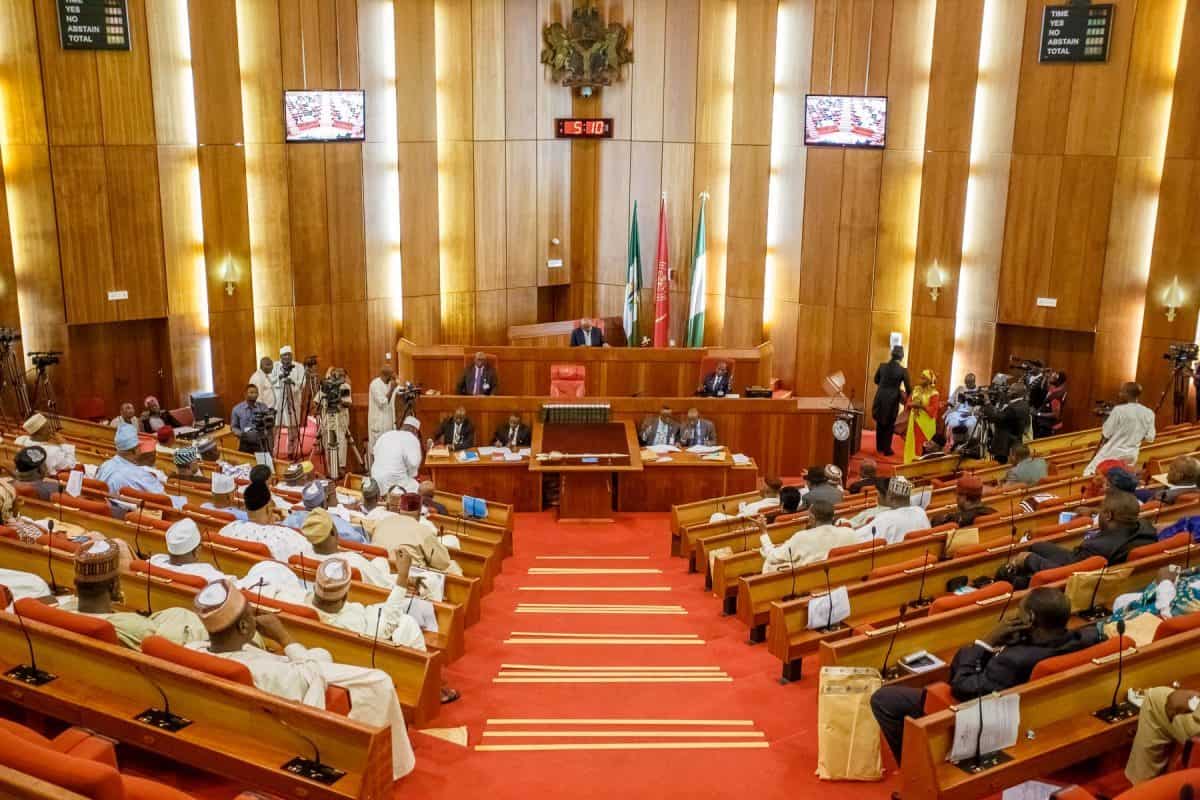
Natasha’s advocacy climaxed on March 1, 2018, when she made an expository presentation of facts before the nation on the floor of the National Assembly’s plenary debate on Nigeria’s steel sector.
Shortly after Natasha’s shocking revelation and call for action, the National Assembly took urgent steps to: Amend the privatization bill by expunging Ajaokuta steel from concession list, create a $1b lifeline funding for the revival of Ajaokuta steel company, commenced drafting a set of laws to protect the development of the Nigerian steel sector.
Her presentation exposed:
- Alleged corruption in concession agreements
- Involvement of government officials in questionable deals
- The deterioration of the steel complex under private management
- Proposals for revival through engagement with original Russian builders
Recognition for Steel Advocacy
This advocacy earned her the Special Presidential Award from the Nigerian Society of Engineers in December 2017. She’s the first woman in the modern Ebira nation and indeed first Nigerian non-engineer to receive the presidential award from the Nigerian Society of Engineers on December 2017 for her efforts on Ajaokuta Steel’s revival.
Natasha was awarded the African Women Leadership Award by Jewel Taylor, the former vice president of Liberia.
Her advocacy, while earning widespread recognition, also made her powerful enemies among those benefiting from the steel complex’s moribund state. The struggle of course came with heavy blows with smear campaigns to discredit her advocacy as one sponsored to sabotage the revival efforts.
Political Career
2019 Senatorial Campaign (SDP)
Natasha’s political aspirations became evident in 2018 when she contested for the Kogi Central Senatorial seat under the Social Democratic Party (SDP). Although unsuccessful, her campaign emphasized economic development, youth empowerment, and social justice, inspiring many, especially women and youth, to engage in politics.
She ran on a platform that exposed deep corruption in Kogi’s political system, particularly relating to the neglect of the Ajaokuta Steel Complex. Her fierce advocacy for the revival of Ajaokuta struck a chord with the people of Kogi Central, where the moribund steel plant represents a lost promise of industrial prosperity.
Her outspokenness did not sit well with the Kogi political elite. Akpoti faced open hostility, intimidation, and even violence during her campaign. Yet, she refused to back down. She became a symbol of defiance, a woman standing up to a system that sought to silence her.
2019 Gubernatorial Campaign (SDP)
In 2019, she ran for the governorship of Kogi State under the SDP, further establishing her as a formidable force in the political landscape. Though unsuccessful, these campaigns built her profile and demonstrated her determination to break into Kogi’s male-dominated politics.
2023 Senatorial Election Victory
By the 2023 electioneering season, Akpoti-Uduaghan joined the Peoples Democratic Party (PDP). Armed with a rare display of unwavering support from her constituents, she secured the PDP ticket at the primaries for the senatorial election, setting the stage for a remarkable political comeback.
In the build-up to the senatorial elections in February 2023, Akpoti-Uduaghan faced unprecedented challenges. Allegations surfaced that the Kogi State government had taken drastic measures to impede the transportation of electoral materials to her senatorial district.
While she initially lost, the election tribunal declared her the winner on September 6, 2023. On October 31, 2023, the Court of Appeal in Abuja affirmed her victory, dismissing her opponent’s petition. This legal victory made her the first elected female senator in Kogi State.
Senate Tenure and Controversies
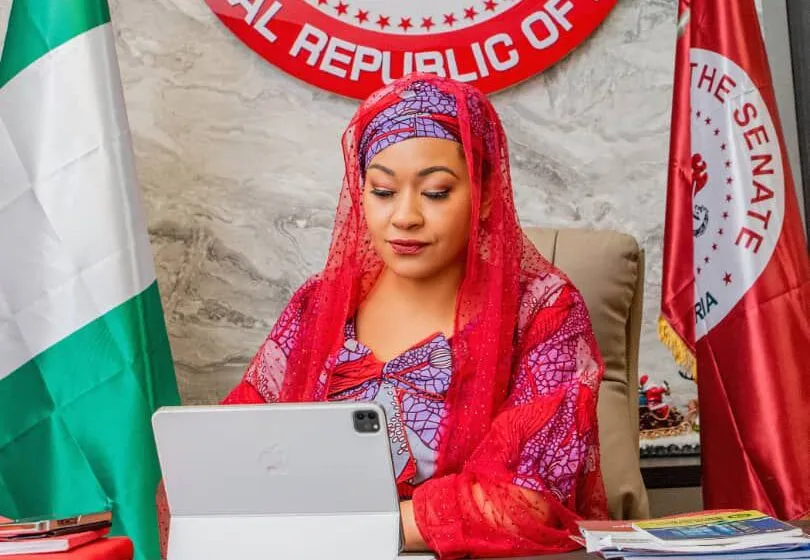
She was elected a senator under the People’s Democratic Party in 2023. As Senator representing Kogi Central Senatorial District, Natasha initially focused on legislative work related to her advocacy priorities.
Senate Activities
Her legislative focus included:
- Bills related to Ajaokuta Steel Company revival
- Economic development and industrialization
- Youth empowerment and job creation
- Gender equality and women’s rights
- Infrastructure and security in Kogi Central
Akpoti was awarded the “Politician of the Year” in the 2023 Leadership Excellence Awards, an award run by Nigerian media newspaper, Leadership. She won the This Day Senator of the Year award in 2025.
Sexual Harassment Allegation Against Senate President
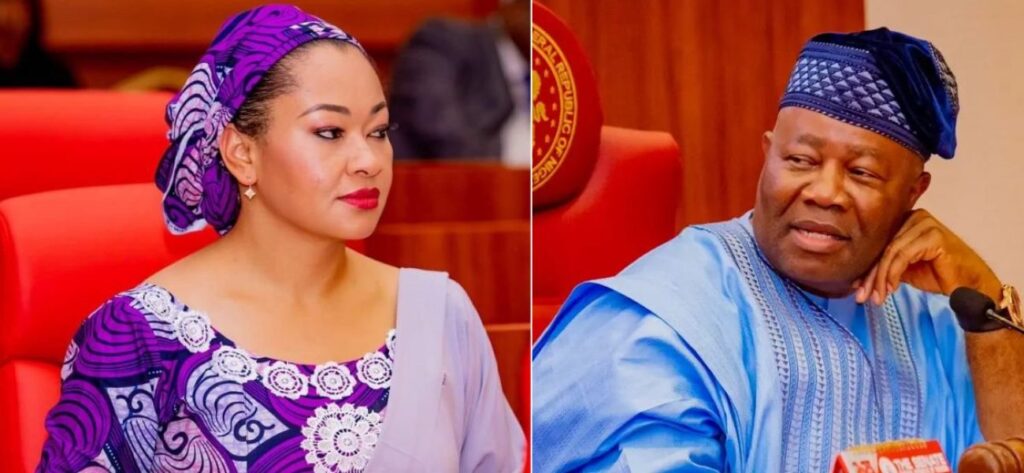
In early 2025, Senator Natasha made allegations of sexual harassment against Senate President Godswill Akpabio, sparking one of the Nigerian Senate’s most dramatic controversies in recent years.
Akpoti’s petition on Akpabio’s sexual harassment was summarily dismissed without investigation on the basis of a technicality, i.e. that she had “signed it herself”.
In a follow-up, Akpabio’s legal team led by former Nigerian Bar Association President Olisa Agbakoba demanded a retraction of the allegation, describing it as “clearly false and unsubstantiated”. Agbakoba cited contradictions in Akpoti-Uduaghan’s timeline—particularly her public praise of Akpabio on social media a day after the alleged incident—and noted that the referenced post was later deleted, which he argued further undermined her credibility.
Six-Month Senate Suspension
On March 6, 2025, following the report from the Senate’s Committee on Ethics and Privileges, Akpoti was suspended from the Nigerian Senate for six months for misconduct. The suspension cites her violation of Sections 6.1 and 6.2 of the 2023 Standing Orders of the Nigerian Senate, and includes lack of access to her office, salary, and security.
In addition, the Committee advised her to apologise to the Senate President for the sexual harassment allegations, a suggestion which was put to the vote a number of times in the Senate. Senator Michael Opeyemi Bamidele also clarified that the suspension was due to Akpoti’s “persistent acts of misconduct” including: refusing to sit in her assigned seat; speaking without recognition; engaging in disruptive behavior; and making abusive remarks against the leadership of the Senate.
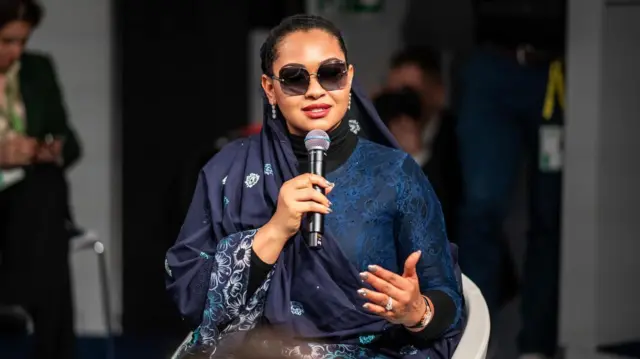
Akpoti further presented her case in a United Nations forum, during the Women in Parliament session in New York. In her statement she outlined her allegations and the fact of her subsequent suspension, insisted that she would not apologise for her allegations, and sought international intervention to hold to account the Nigerian Senate.
Following Akpoti’s suspension, many civil groups and individuals including the Conference of Nigeria Political Parties and the Coalition of National Civil Society Organizations have called for a transparent investigation of the matter.
Court Ruling and Continuing Tensions
On July 4, 2025, a court in Abuja ordered the lifting of Akpoti’s suspension, saying that it was excessive. It also convicted Akpoti for contempt and fined her five million naira ($3,250) for violating a gag order on her suspension case. Despite this, Akpoti was barred from entering the National Assembly building on July 22.
On April 18, 2025, Akpoti reported that armed men had attacked her family home in Obeiba-Ihima, Kogi State. In a statement released by her media team in Abuja, the senator stated that the assailants raided and vandalized the residence, which originally belonged to her grandfather.
The controversy surrounding her suspension divided public opinion, with supporters viewing her as victim of patriarchal intimidation and critics questioning her conduct and the credibility of her allegations.
Personal Life
On March 5, 2022, she married Emmanuel Uduaghan in a marriage ceremony at Ihima, and has three children. Her husband, Emmanuel Oritsejolomi Uduaghan, is the Alema of Warri Kingdom and comes from a politically prominent Delta State family.
Natasha balances her demanding political career with family responsibilities, representing a new generation of Nigerian women refusing to choose between family and public service.
Political Philosophy and Advocacy Focus
Natasha’s political approach is characterized by several consistent themes:
Anti-Corruption: Fearless exposure of corruption in government and business, particularly in the steel and extractive sectors.
Industrialization: Strong advocacy for Nigerian industrialization, particularly revival of Ajaokuta Steel Company as foundation for economic transformation.
Women’s Empowerment: Breaking barriers for women in politics and demonstrating that women can succeed in male-dominated environments.
Youth Engagement: Emphasis on youth employment, empowerment, and inclusion in governance.
Social Entrepreneurship: Belief in entrepreneurship and private sector development as drivers of poverty reduction.
Confrontational Advocacy: Willingness to confront powerful interests and speak truth to power, even at personal cost.
Local Content: Advocacy for Nigerian participation and ownership in key economic sectors.
Challenges and Criticisms
Political Opposition: Faced intense opposition from Kogi State political establishment throughout her career.
Electoral Violence: Allegations of violence, intimidation, and electoral manipulation in campaigns against her.
Sexual Harassment Allegation Controversy: The disputed allegations against Senate President Akpabio and subsequent suspension damaged her standing among some observers.
Suspension Conduct: Critics argue her conduct in the Senate violated institutional norms, while supporters view the suspension as retaliation.
Credibility Questions: The timeline contradictions cited by Akpabio’s lawyers raised questions among some about the harassment allegations.
Political Persecution Claims: Whether she is victim of political persecution or faces legitimate accountability remains contested.
Legacy and Impact
Barrier Breaking
As first elected female senator from Kogi State, Natasha broke significant gender barriers in one of Nigeria’s most politically challenging states for women.
Ajaokuta Advocacy
Her advocacy brought national attention to the Ajaokuta Steel Company and influenced policy discussions about industrialization and privatization.
Youth and Women Inspiration
She has inspired many young Nigerians, particularly women, to engage in politics despite systemic barriers.
Confrontational Politics
Demonstrated that confrontational advocacy and speaking truth to power, while risky, can achieve results and build public support.
Ongoing Controversy
The sexual harassment allegation and suspension controversy remains her most divisive legacy issue, with supporters and critics sharply divided.
Current Status
As of late 2025, Senator Natasha Akpoti-Uduaghan‘s political situation remains in flux following her suspension and subsequent court battles. Her case has become a focal point for discussions about:
- Senate disciplinary procedures and fairness
- Sexual harassment allegations in Nigerian politics
- Gender dynamics in legislative institutions
- Freedom of speech and consequences for legislators
- Due process in institutional governance
Whether she emerges from this controversy with her political career strengthened or damaged remains to be seen.
Assessment and Perspectives
Admirers View Her As:
- Courageous advocate who challenges corruption despite personal risk
- Trailblazer for women in Nigerian politics
- Champion of industrialization and economic development
- Victim of patriarchal retaliation for speaking out about harassment
- Symbol of resilience and determination
Critics Argue:
- Her conduct in the Senate violated institutional norms
- The sexual harassment allegations lack credibility given contradictory evidence
- She is confrontational beyond what is productive
- Her political style prioritizes drama over substantive legislative work
- The suspension resulted from her own misconduct, not persecution
Balanced Perspective: Senator Natasha Akpoti-Uduaghan represents a new generation of Nigerian politicians—educated, internationally exposed, unafraid to confront power, and determined to break gender barriers. Her Ajaokuta Steel advocacy demonstrated courage and effectiveness in exposing corruption. Her election as Kogi’s first female senator after multiple attempts shows remarkable persistence. However, the sexual harassment allegation controversy and subsequent suspension present complex questions about institutional norms, credibility, and whether she faces persecution or accountability. Her ultimate legacy will depend partly on how this controversy resolves and whether she can rebuild her Senate career or whether this episode defines her tenure. What seems certain is that she has already made history as Kogi’s first female senator and inspired many women to believe they too can break into Nigeria’s male-dominated politics.
Senator Natasha Hadiza Akpoti-Uduaghan’s journey from social entrepreneur to Ajaokuta Steel advocate to first female senator from Kogi State represents one of contemporary Nigerian politics’ most dramatic narratives. Her Nigerian-Ukrainian heritage, early loss of her father, educational achievements, successful entrepreneurship, fearless advocacy against powerful interests, and persistence through multiple electoral defeats before finally winning Senate seat demonstrate exceptional determination. The current controversy surrounding her suspension and sexual harassment allegations adds complexity to her legacy, with her case becoming a lightning rod for debates about gender, power, and accountability in Nigerian politics. Whether remembered primarily as barrier-breaking senator, courageous anti-corruption advocate, or controversial figure whose allegations sparked institutional crisis will depend on how current events unfold and which aspects of her multifaceted career history ultimately emphasizes. What cannot be disputed is that she has already influenced Nigerian politics by demonstrating that women can compete and win in even the most challenging political environments, that advocacy can influence policy despite opposition, and that speaking truth to power comes with both recognition and consequences.