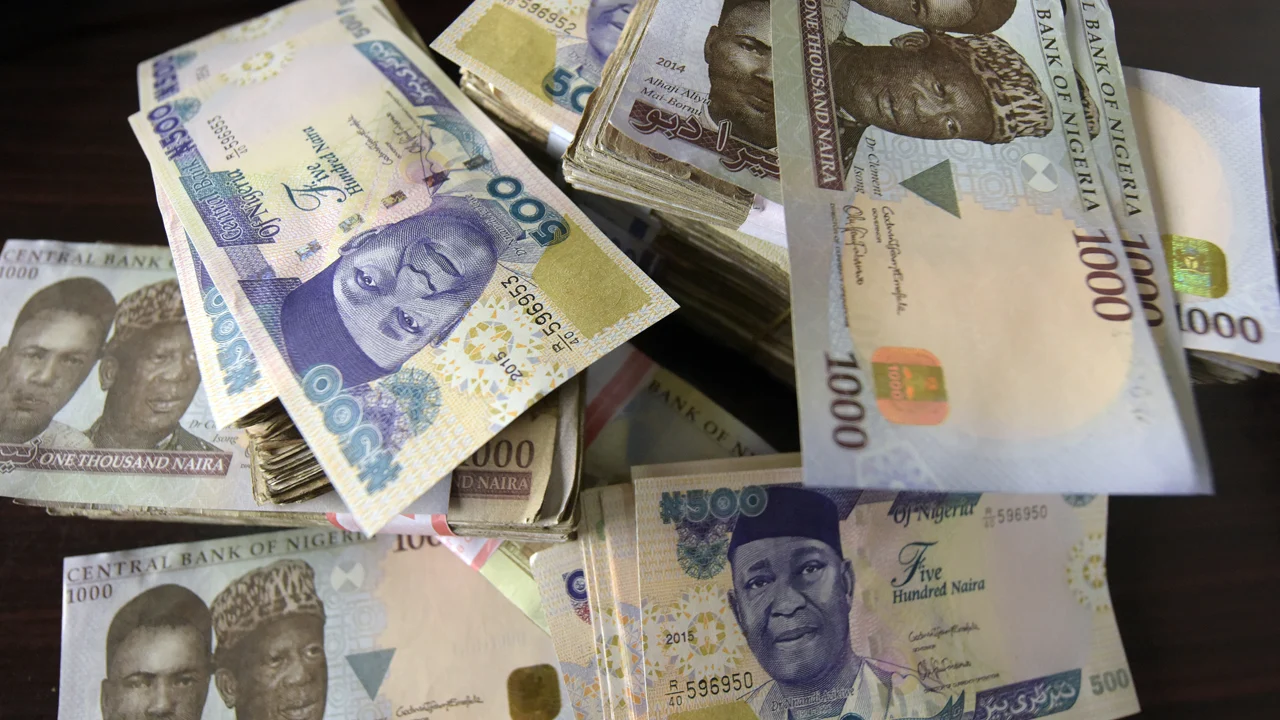
Nigeria’s naira registered its strongest performance in nearly nine months this week, appreciating sharply against the United States dollar at the official foreign exchange market, according to fresh data from the Central Bank of Nigeria.
The local currency closed at N1,354.9 to the dollar on Monday, marking a significant improvement from the N1,384.5 rate recorded the previous week, Monday—a gain of approximately N30 per dollar on a week-on-week basis.
This represents the naira’s best showing since May 29, 2024, when it closed at N1,329.65 per dollar, underscoring what appears to be a tentative turnaround in the currency’s fortunes after months of sustained pressure.
The appreciation comes at a critical juncture for Africa’s largest economy, with the Central Bank of Nigeria preparing to convene its 304th Monetary Policy Committee meeting later this month—the first such gathering in 2026. Monetary authorities are widely expected to address ongoing efforts to stabilize the foreign exchange market and contain inflationary pressures that have plagued the economy in recent quarters.
While official market data indicate renewed strength in the naira, a closer examination reveals persistent challenges across various segments of the foreign exchange ecosystem.
The naira’s Monday close of N1,354.9 per dollar showed improvement not only from the previous week’s corresponding session but also from Friday’s rate of N1,363 per dollar, suggesting sustained momentum throughout the trading period.
However, conditions in the parallel market—often viewed as a barometer of underlying demand and supply pressures—tell a more complex story. The naira weakened slightly in this unofficial segment, trading at N1,443.40 per dollar compared to N1,440.81 previously.
The divergence between the official and parallel market rates has created a substantial gap of approximately N88.5—the widest spread recorded since January 29, 2026, when the disparity hit N105.
This widening differential is raising eyebrows among investors and policymakers alike, as it signals ongoing distortions in foreign exchange pricing and points to persistent liquidity constraints and demand pressures that official interventions have yet to fully resolve.
Currency market analysts note that such disparities often reflect underlying structural challenges, including limited dollar availability, capital flow restrictions, and varying levels of market access across different economic actors.
The performance of the naira in the coming weeks will likely hinge on several factors, including the outcomes of the upcoming MPC meeting, continued dollar inflows, and the central bank’s ability to bridge the gap between official and parallel market rates.
Market watchers will be closely monitoring whether the current appreciation trend can be sustained or if it represents a reprieve in what has been a challenging period for the Nigerian currency.
The disparity between market segments remains a key indicator that investors and policymakers continue to monitor closely as authorities press ahead with efforts to enhance transparency, deepen liquidity, and restore confidence in Nigeria’s foreign exchange market.
For now, the naira’s recent gains offer a glimmer of hope—but the road to sustained stability remains uncertain.
WHAT YOU SHOULD KNOW
Nigeria’s naira has shown its strongest performance in nine months, gaining nearly N30 against the dollar to close at N1,354.9—the best rate since May 2024. However, this positive development is undermined by a troubling N88.5 gap between the official and parallel market rates, the widest disparity in two weeks.