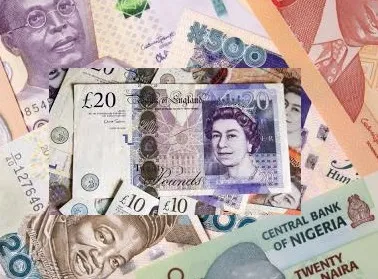
The Nigerian naira demonstrated renewed strength against the British pound on Wednesday, closing at N1,945/£ in the official foreign exchange market, as global currency markets experienced continued volatility and central bank interventions reshaped trading dynamics.
The appreciation marks a notable development in Nigeria’s ongoing currency stabilization efforts, with market analysts pointing to the Central Bank of Nigeria’s bold policy reforms as a key catalyst. The CBN’s controversial decision to float the naira and consolidate multiple exchange rate windows has begun yielding tangible results, particularly in restoring confidence among real sector operators who had long complained about rate distortions hampering business planning.
Recent trading patterns reveal that the Nigerian currency has entered a consolidation phase in the parallel market, trading within a relatively narrow band of N1,920/£ to N2,100/£ throughout October. This range-bound movement represents a marked departure from the wild swings that characterized earlier periods of the year, suggesting that speculative pressures may be easing.
Currency traders in Lagos’ bustling Bureau de Change corridor attribute the relative stability to improved foreign exchange liquidity and changing market sentiment. “We’re seeing more dollars coming into the system, and that’s taking pressure off the naira,” explained one veteran currency dealer who requested anonymity.
The naira’s performance is particularly noteworthy given its broader trajectory against the pound. Over the past five years, from 2021 to 2025, the GBP/NGN pair has surged dramatically, with the naira depreciating by a staggering 500% overall—a reflection of Nigeria’s persistent economic headwinds, including stubborn inflation and chronic foreign exchange shortages that have plagued Africa’s largest economy.
Adding to the cautiously optimistic outlook, Nigeria’s inflation rate has declined for five consecutive months, providing much-needed relief to citizens grappling with an acute cost-of-living crisis. While price levels remain elevated by historical standards, the moderation trend has bolstered expectations that the naira could maintain its short-term bullish momentum.
Economic analysts suggest that the combination of easing inflation and improving foreign exchange inflows creates favorable conditions for currency appreciation. “The fundamentals are gradually aligning,” noted a senior economist at a Lagos-based financial institution. “If we can sustain these FX inflows and keep inflation trending downward, we could see further naira gains.”
The Nigerian currency has posted impressive gains in recent months, appreciating 10.56% against the U.S. dollar over the past year and recording a 2.45% monthly gain. However, daily volatility persists, driven by speculative trading activities, domestic liquidity conditions, and the dollar’s strength in global markets.
The CBN’s strategic initiatives, including the establishment of a rate corridor and active promotion of non-dollar payment systems for trade transactions, have provided crucial support for the recovery. These measures aim to reduce excessive dollar dependence and create a more balanced foreign exchange ecosystem.
Meanwhile, the British pound exhibited broad-based strength across major currency pairs in global trading, defying conventional market logic as traders increasingly bet on additional interest rate cuts by the Bank of England.
Market pricing currently reflects expectations that the BoE will reduce interest rates by 46 basis points across its two remaining monetary policy meetings in 2025—a dovish trajectory that would typically weaken a currency. However, the pound has bucked this trend, highlighting the complex interplay of factors influencing contemporary foreign exchange markets.
The shift in BoE expectations followed the release of mixed UK labor market data for the three months ending in August. The ILO Unemployment Rate climbed to 4.8%, while Average Earnings Excluding Bonus decelerated to 4.7% year-on-year—the slowest pace since May 2022. The cooling wage growth has reinforced the case for policy easing as inflation pressures subside.
BoE Governor Andrew Bailey acknowledged the economic challenges during a recent speech at a Washington event hosted by the Institute of International Finance, noting signs of deceleration in UK economic activity.
The pound sterling extended its recovery trajectory, trading around $1.3370 against the U.S. dollar by Wednesday’s close, benefiting from broad-based dollar weakness following dovish signals from Federal Reserve officials.
The U.S. Dollar Index, which tracks the greenback against six major currencies, fell 0.25% to approximately 98.8 points as market participants digested cautious commentary from Fed Chair Jerome Powell and other Federal Open Market Committee members regarding labor market vulnerabilities.
Powell offered a nuanced assessment on Tuesday, acknowledging that while the economy maintains a “firmer trajectory than expected,” the labor market remains mired in “low-hiring, low-firing doldrums” through September. “There is some tension with the labor market data because the economic activity data is unexpectedly positive,” he observed, highlighting the conflicting signals complicating monetary policy decisions.
Fed officials Susan Collins and Michelle Bowman echoed concerns about labor market risks while expressing support for the central bank’s evolving policy stance. The CME FedWatch Tool now indicates a 94.6% probability that the Fed will implement 50 basis points of additional rate cuts, bringing the target range to 3.50–3.75% by year-end.
As global central banks navigate diverging economic conditions, currency markets are likely to remain volatile. For Nigeria, sustaining the naira’s recent gains will require continued foreign exchange inflows, persistent inflation moderation, and disciplined monetary policy implementation.
Market participants will be closely monitoring upcoming economic data releases and central bank communications for signals about the sustainability of current currency trends. While the naira’s recent performance offers encouragement, analysts caution that Nigeria’s structural economic challenges require comprehensive reforms beyond monetary policy adjustments to ensure long-term currency stability.
WHAT YOU SHOULD KNOW
The naira strengthened to N1,945/£ on Wednesday, driven by the Central Bank of Nigeria’s exchange rate reforms and improved foreign exchange inflows. Nigeria’s inflation has declined for five consecutive months, supporting the currency’s recovery after a devastating 500% depreciation against the pound over five years.
Globally, the British pound gained strength despite expectations of Bank of England rate cuts, while the U.S. dollar weakened on Fed concerns about labor market weakness. The Fed is now 94.6% likely to cut rates by 50 basis points before year-end.