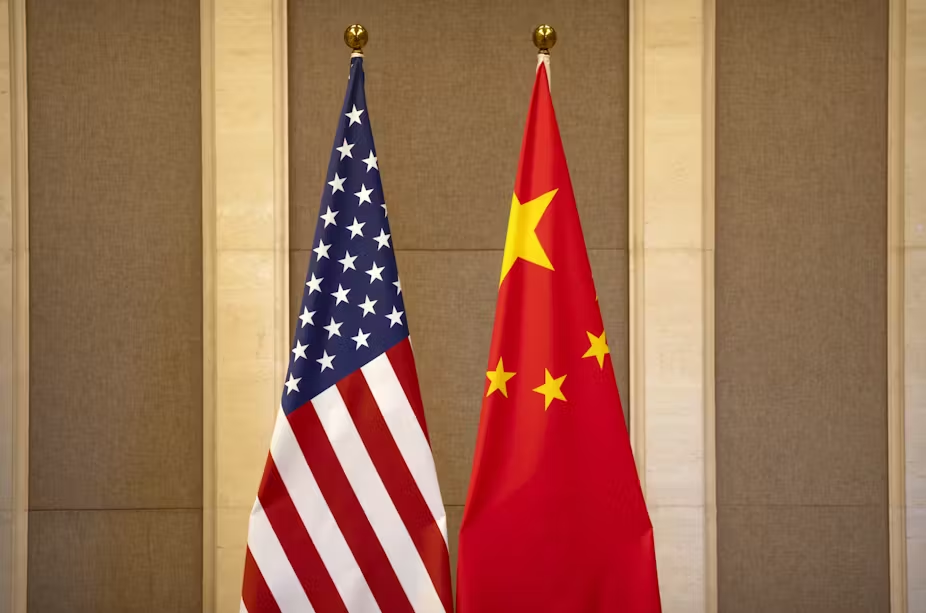
Senior U.S. and Chinese trade officials gathered in Spain’s capital on Sunday for what has become a familiar ritual: attempting to prevent the world’s two largest economies from sliding deeper into a damaging trade war that shows little sign of meaningful resolution.
The Madrid meeting represents the fourth time since spring that U.S. Treasury Secretary Scott Bessent and Trade Representative Jamieson Greer have sat across from Chinese Vice Premier He Lifeng, this time joined by China’s chief trade negotiator Li Chenggang.
Their previous encounters in Geneva, London, and Stockholm have managed to maintain a tenuous trade truce but have failed to address the fundamental economic grievances that continue to strain U.S.-China relations.
TikTok Deadline Looms Large
Perhaps nowhere is the complexity of U.S.-China relations more apparent than in the case of TikTok, the Chinese-owned social media platform that has captured the attention of millions of Americans while raising national security concerns in Washington. ByteDance, TikTok’s parent company, faces a September 17 deadline to divest its U.S. operations or see the app banned from American markets entirely.
Sources familiar with the Trump administration’s thinking suggest another extension is likely—the fourth since Trump took office in January. This would provide political cover for an administration that finds itself in the awkward position of having launched its TikTok account last month while simultaneously threatening to shut down the platform.
The inclusion of TikTok on the official agenda marks a departure from previous trade discussions, signaling the administration’s recognition that technology and security concerns have become inseparable from traditional trade issues. However, the move risks frustrating lawmakers from both parties who mandated the divestiture requirement specifically to address national security risks posed by Chinese control of the platform.
Limited Expectations for Breakthrough
Trade experts entering Sunday’s discussions harbor few illusions about the prospects for significant progress. The current arrangement—which has reduced retaliatory tariffs from triple digits and restored the flow of critical rare-earth minerals from China—represents more of a temporary ceasefire than a lasting peace.
U.S. tariffs on Chinese goods remain substantial at approximately 55%, with Trump having approved their continuation until November 10. This extension of what amounts to an economic standoff underscores the limited room for maneuver on both sides.
Wendy Cutler, a veteran trade negotiator who now heads the Asia Society Policy Institute, suggests that any substantial agreements are likely to be reserved for a potential meeting between Trump and Chinese President Xi Jinping, possibly at the Asia Pacific Economic Cooperation summit in Seoul scheduled for late October.
Russia Factor Complicates Relations
Adding another layer of complexity to the discussions is the Biden administration’s pressure campaign regarding Russian oil purchases. Bessent has been pushing G7 allies to impose “meaningful tariffs” on countries, including China and India, that continue buying Russian crude oil. The strategy aims to cut off revenue streams funding Russia’s war in Ukraine.
The U.S. has already imposed a 25% tariff on Indian goods over that country’s Russian oil purchases, but has thus far refrained from similar punitive measures against China. This restraint likely reflects the recognition that such an escalation could derail the fragile trade dialogue entirely.
Spain’s Strategic Positioning
The choice of Madrid as a venue reflects Spain’s growing ambitions to position itself as a neutral ground for complex international negotiations. Prime Minister Pedro Sánchez, whose Socialist government has sought closer ties with Beijing in recent years, sees hosting such discussions as evidence of Spain’s rising diplomatic profile.
However, this positioning has created its own tensions. Bessent previously criticized Sánchez for declaring Beijing a “strategic partner” during the height of Trump’s tariff offensive in April, describing closer China ties as tantamount to “cutting your own throat.”
The Spanish government’s enthusiasm for the talks—including a public greeting ceremony at the baroque Palacio de Santa Cruz—also serves domestic political purposes, helping to repair relationships with the Trump administration following disputes over Spain’s criticism of Israeli military actions in Gaza and its reluctance to meet NATO defense spending targets.
Structural Challenges Remain
Beyond the immediate agenda items lies a more fundamental challenge: the structural disagreements that have defined U.S.-China economic relations for years. American officials continue to demand that China shift its economic model away from state-subsidized exports toward greater domestic consumption—changes that would require Beijing to fundamentally alter its development strategy.
Chinese officials, meanwhile, prioritize relief from U.S. export controls and tariff reductions, concessions that Washington appears reluctant to grant without significant Chinese economic reforms.
As Cutler noted, China appears “in no rush” to reach an agreement without substantial American concessions, while the U.S. seems equally disinclined to make major compromises without breakthrough progress on its core demands.
This dynamic suggests that while Sunday’s talks may succeed in extending the current trade truce and pushing back the TikTok deadline, the underlying tensions that have defined the relationship are likely to persist well beyond the Madrid meeting.
For now, both sides appear content to manage the relationship rather than resolve it, leaving businesses and consumers on both sides of the Pacific to navigate continued uncertainty in the world’s most important economic partnership.
WHAT YOU SHOULD KNOW
The U.S. and China are stuck in a holding pattern—managing their trade war rather than solving it. While Sunday’s Madrid talks will likely extend the TikTok divestiture deadline again and maintain the current trade truce, neither side is willing to make the fundamental concessions needed for a real breakthrough.
America wants China to restructure its entire economic model, while China wants tariff relief and an end to export controls. Until one side blinks, expect more meetings that kick problems down the road rather than resolve them. Meanwhile, the addition of Russian oil sanctions to the mix shows how U.S.-China trade disputes are becoming inseparable from broader geopolitical conflicts.