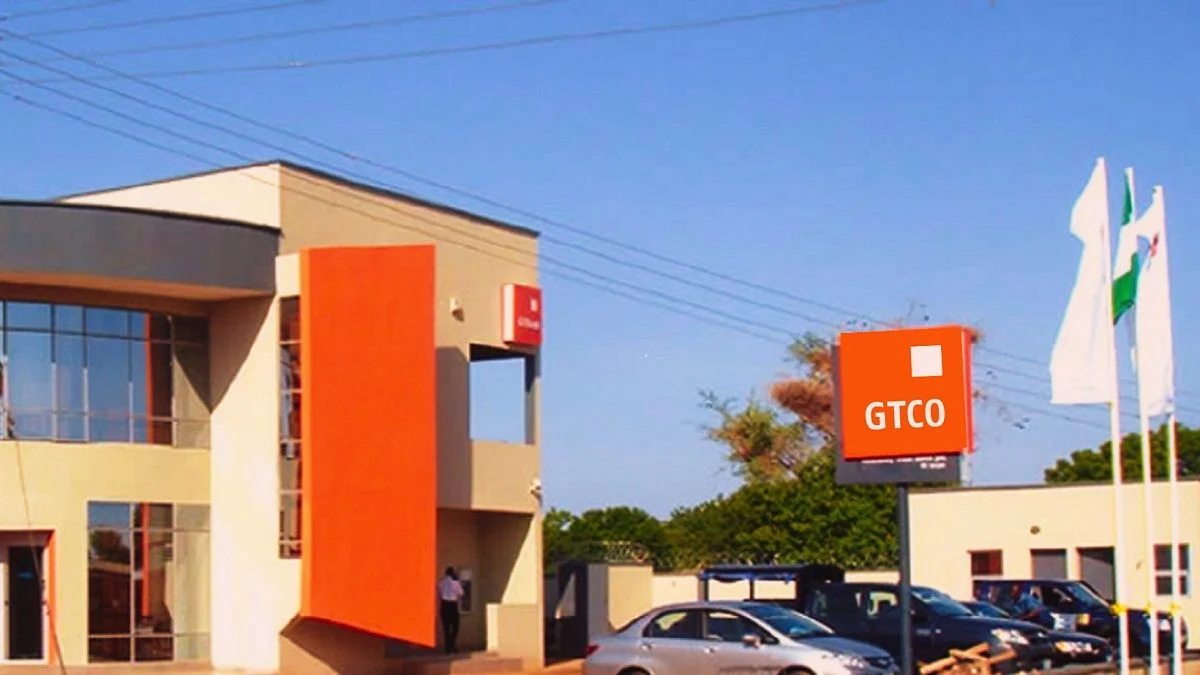
In a decisive move to strengthen its capital position and maintain its international banking license, Guaranty Trust Holding Company Plc (GTCO) has pumped ₦365.85 billion into its flagship subsidiary, Guaranty Trust Bank Limited (GTBank), catapulting the institution well above the Central Bank of Nigeria’s stringent new capital requirements.
The massive capital injection, announced in a regulatory filing on Friday and signed by Company Secretary Erhi Obebeduo, was executed through a rights issue involving nearly 7 billion ordinary shares of GTBank. The transaction represents one of the largest internal capital transfers in Nigeria’s banking sector this year as financial institutions race to comply with the CBN’s ambitious recapitalization mandate.
Regulatory Compliance Secured
The capital boost raises GTBank’s share capital from ₦138.186 billion to ₦504.037 billion, comfortably exceeding the CBN’s ₦500 billion minimum threshold for commercial banks with international authorization. This places GTBank alongside tier-1 institutions Access Bank and Zenith Bank as early adopters of the new regulatory framework.
The recapitalization comes in response to the CBN’s March 2024 directive requiring commercial banks to significantly bolster their capital bases by March 2026. The regulatory push follows a challenging economic environment marked by the naira’s sharp devaluation and persistent inflationary pressures that have strained the banking sector’s resilience.
Strategic Expansion Plans Unveiled
Beyond regulatory compliance, GTCO has outlined an ambitious deployment strategy for the fresh capital. The bank plans to expand its branch network, grow its asset base through increased lending and investment securities, and fortify its information technology infrastructure. The institution also aims to capitalize on emerging opportunities across Nigeria and its international footprint.
“The additional equity capital will be deployed by GTBank primarily for branch network expansion and asset growth, fortification of its information technology infrastructure, and to leverage emerging opportunities in Nigeria and the operating environments where it maintains banking presence,” GTCO stated in its announcement.
Sector-Wide Transformation
The capital injection underscores the broader transformation sweeping Nigeria’s banking sector as institutions scramble to meet the CBN’s elevated standards. The regulatory authority’s recapitalization program aims to create a more resilient banking system capable of weathering economic shocks and supporting Nigeria’s long-term growth ambitions.
The two-phase recapitalization program received approval at GTCO’s 2024 Annual General Meeting and was executed with full regulatory clearance. Following the completion of the share allotment, GTCO maintains 100% ownership of GTBank, preserving the holding company’s strategic control over its banking operations.
Market Implications
The successful capital raise positions GTBank favorably in Nigeria’s increasingly competitive banking landscape, where only the strongest institutions will maintain their international banking licenses. With the March 2026 deadline still more than a year away, GTBank’s early compliance provides strategic advantages in planning expansion initiatives and pursuing growth opportunities.
As Nigeria’s banking sector continues its evolution under the CBN’s enhanced regulatory framework, institutions like GTBank that move swiftly to meet new requirements are likely to emerge as market leaders in the post-recapitalization era.
The capital injection also signals confidence in Nigeria’s long-term economic prospects despite current headwinds, with GTCO’s substantial investment demonstrating a commitment to expanding its domestic and international banking operations.
WHAT YOU SHOULD KNOW
GTCO injected ₦365.85 billion into GTBank, increasing its capital from ₦138.2 billion to ₦504 billion. This puts GTBank ahead of the CBN’s March 2026 deadline requiring banks with international licenses to have a minimum capital of ₦500 billion.
GTBank is now one of only three major Nigerian banks (alongside Access and Zenith) to meet the new regulatory standards early, positioning it for expansion while many competitors still struggle to raise the required capital.