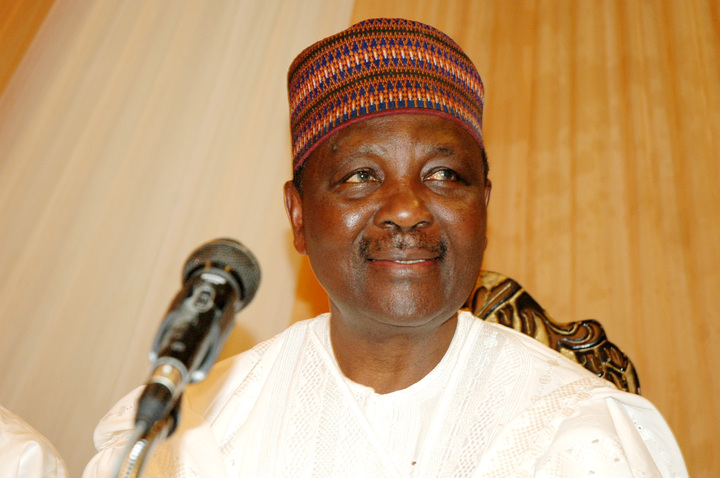
Retired former Head of State, General Yakubu Gowon, has called on Nigeria’s political class to urgently address the reckless desperation fueling what he termed “do or die politicking.”
He also warned against the persistent failure to conduct free and fair elections even at the intraparty level, declaring that despite all the nation’s challenges, he remains confident that Nigeria will not collapse.
Gowon, who turned 91 in February, made the remarks on Tuesday at the launch of his 859-page autobiography, My Life of Duty and Allegiance, in Abuja, where President Bola Tinubu was represented by Vice President Kashim Shettima.
The former Head of State said, “We all must rise to contain the desperation frequently accepted by the political class who engage in what they love to call ‘do-or-die politicking’ and their inability to conduct free, fair, and transparent elections, even in matters as minor as intraparty elections, which has continued to plague our nation since colonial times.
“We must not give room to the naysayers who see no good in our nation and would rather label it as a failed nation.”
Gowon said that each time he reflected on his years of service, he found renewed conviction that Nigeria was capable of realizing its potential as the giant of Africa and that the country’s survival, including through the civil war, was evidence of its fundamental resilience.
“Each time I reflect on my service to my country, I become further persuaded that Nigeria can get better and achieve its potential as the giant of Africa.
“On my watch as head of state, the country did not fall, and I am confident that the nation, despite all its challenges, still will not fall,” he said.
However, he criticized what he described as a national habit of self-inflicted complexity.
He said, “I am worried that Nigerians never seem to get tired of presenting difficult solutions to simple problems, which they further complicate with more complex and ambiguous solutions that invariably generate tensions in the country.”
Gowon governed Nigeria as military head of state from 1966 to 1975, a period that included the prosecution of the bloody 30-month civil war from 1967 to 1970 and the subsequent post-war reconstruction.
He was overthrown in a bloodless coup by Murtala Muhammed in July 1975 while attending a summit of the Organisation of African Unity in Kampala, Uganda.
Released six decades after he first came to power, the autobiography spans 36 chapters and 859 pages, tracing his life journey from his formative years in Plateau State and military training at Sandhurst, through the civil war, his exile in the United Kingdom, and his eventual return.
WHAT YOU SHOULD KNOW
At 91, General Yakubu Gowon remains a voice of conscience for Nigeria.
Speaking at the launch of his autobiography, his core message was clear: Nigeria’s greatest threat is not external but self-inflicted, driven by desperate, win-at-all-costs politics and a national tendency to complicate simple problems.
Yet despite these concerns, Gowon’s overriding message was one of hope, expressing unshaken confidence that Nigeria, having survived a brutal civil war and decades of turbulence, still possesses the resilience and potential to rise to its true stature as the giant of Africa.