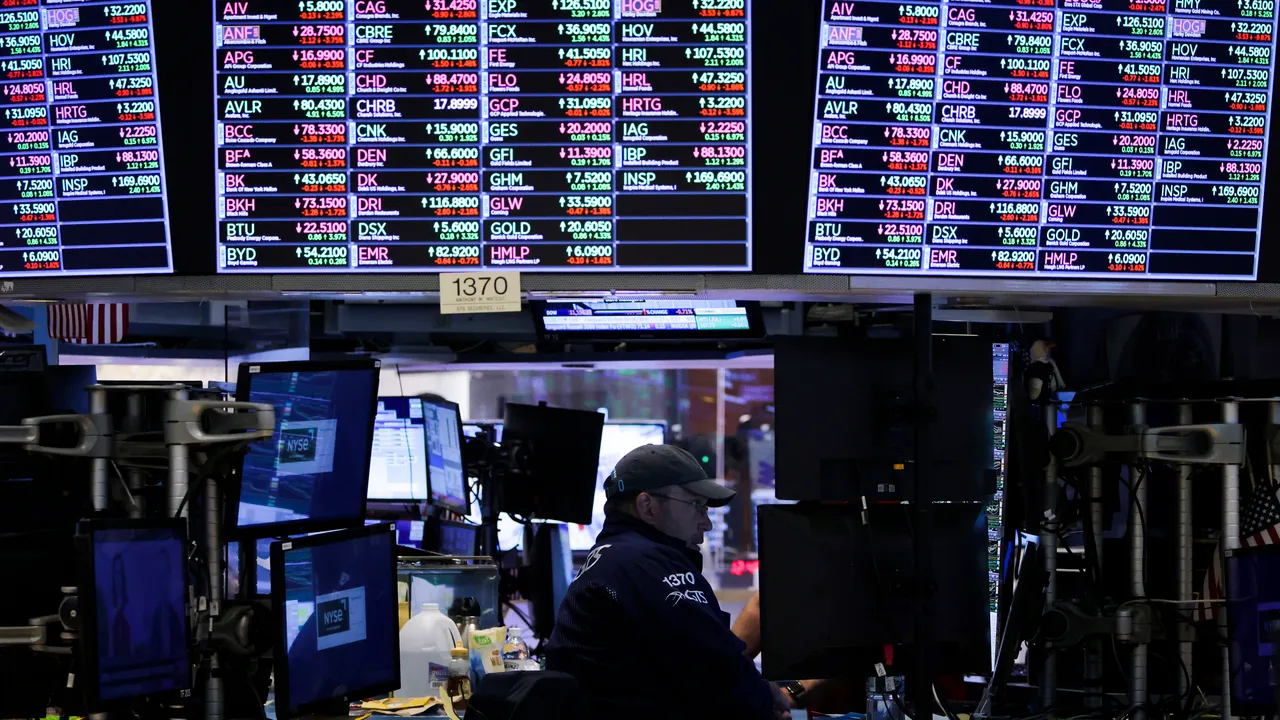
U.S. stock markets closed lower on Tuesday as disappointing economic data cast fresh doubt over the resilience of the world’s largest economy, even as international markets continued their upward trajectory on hopes of monetary policy easing.
The lackluster performance on Wall Street came after July’s services sector activity unexpectedly stagnated, marking a troubling development for an economy heavily dependent on consumer spending and business services.
The Institute for Supply Management’s services index revealed not only flat activity but also deteriorating employment conditions and surging input costs—the steepest increase in nearly three years. This cocktail of economic weakness has intensified scrutiny over how President Trump’s aggressive tariff policies may be rippling through American businesses.
Market Performance Reflects Growing Uncertainty
The Dow Jones Industrial Average shed 40.08 points to close at 44,133.14, while the S&P 500 remained virtually unchanged, slipping just 0.71 points to 6,329.23. The technology-heavy Nasdaq bucked the trend, gaining 39.72 points to reach 21,093.99, suggesting investors continue to find refuge in growth stocks despite broader economic concerns.
This mixed performance stands in stark contrast to Monday’s rally, which was fueled by generally positive earnings reports and mounting expectations of Federal Reserve intervention following Friday’s disappointing jobs data.
The weakening economic indicators have dramatically shifted investor sentiment regarding Federal Reserve policy. Market participants now assign a 94% probability to a September rate cut, a remarkable jump from just 63% odds seen on July 28.
Traders are positioning for at least two quarter-point reductions before year-end, reflecting growing confidence that monetary policymakers will need to act aggressively to support economic growth.
“The question is whether bad news is bad news or it’s good news,” explained Jefferies strategist Mohit Kumar, capturing the market’s conflicted relationship with disappointing data. “A modest weakening of the economy would be good news, as it should mean more easing from the Fed. However, a sustained and sharp rise in unemployment rates would be negative, as it would raise concerns over growth and earnings.”
International Markets Show Resilience
While American markets struggled, international equities demonstrated notable strength. The pan-European STOXX 600 index advanced 0.35%, driven by earnings optimism and reduced uncertainty following recent policy developments. Diageo led the charge with a 4.55% surge as the European earnings season gained momentum.
Asian markets were even more buoyant, with MSCI’s broadest index of Asia-Pacific shares outside Japan closing up 0.77%. Particularly encouraging were service sector readings from the region’s two largest economies: Japan’s services PMI jumped to 53.6 in July from 51.7 in June, marking the strongest expansion since February, while China’s services activity accelerated to its fastest pace in more than a year.
Currency and Commodity Movements Signal Risk-Off Sentiment
The U.S. dollar strengthened against major trading partners, with the dollar index rising 0.36% to 98.99, as investors sought safety amid domestic economic uncertainty. The euro weakened 0.29% to $1.1536, reflecting the relative appeal of dollar-denominated assets despite America’s economic headwinds.
Commodity markets told a story of global growth concerns, with oil prices extending their decline for a fourth consecutive day. Brent crude futures fell 1.21% to $67.93 per barrel, while U.S. crude dropped 1.33% to $65.41, as traders worried about both economic slowdown and potential oversupply from OPEC+ producers.
Gold, traditionally viewed as a haven, unexpectedly declined 0.04% to $3,371.59 an ounce, suggesting investors may be positioning for potential Fed easing rather than seeking traditional defensive assets.
Geopolitical Tensions Add to Market Complexity
Adding another layer of uncertainty, President Trump has renewed threats to increase tariffs on Indian goods beyond the current 25% level, citing New Delhi’s continued purchases of Russian oil. India has denounced these threats as “unjustified” and pledged to defend its economic interests, raising the specter of an expanded trade conflict.
ING strategists noted that “whether the threat of secondary sanctions on India’s financing of Russia is the core goal remains to be seen,” suggesting the moves could be part of broader U.S. leverage tactics to open Indian markets to American agricultural and energy exports.
Looking Ahead
As the second-quarter earnings season winds down, investors will be closely watching results from major companies, including Walt Disney and Caterpillar, for further insights into corporate America’s health. The divergence between weakening economic data and resilient international markets presents a complex picture for investors navigating an increasingly uncertain global landscape.
The coming weeks will likely prove crucial in determining whether recent economic softness represents a temporary pause or the beginning of a more significant downturn—a distinction that could ultimately determine the Federal Reserve’s policy path and global market direction.
WHAT YOU SHOULD KNOW
U.S. markets fell on Tuesday as services sector activity unexpectedly stagnated and employment weakened, pushing Federal Reserve rate cut odds to 94% for September—up dramatically from 63% just days ago. While American economic data disappoints, international markets are rising on hopes of monetary easing.
The critical question now is whether this economic softness is a temporary weakness that prompts helpful Fed cuts or the start of a deeper downturn that threatens corporate earnings and growth.
Trump’s renewed tariff threats against India add geopolitical uncertainty. Investors are essentially betting that bad economic news will become good news through Fed intervention—a risky assumption that will be tested in coming weeks.