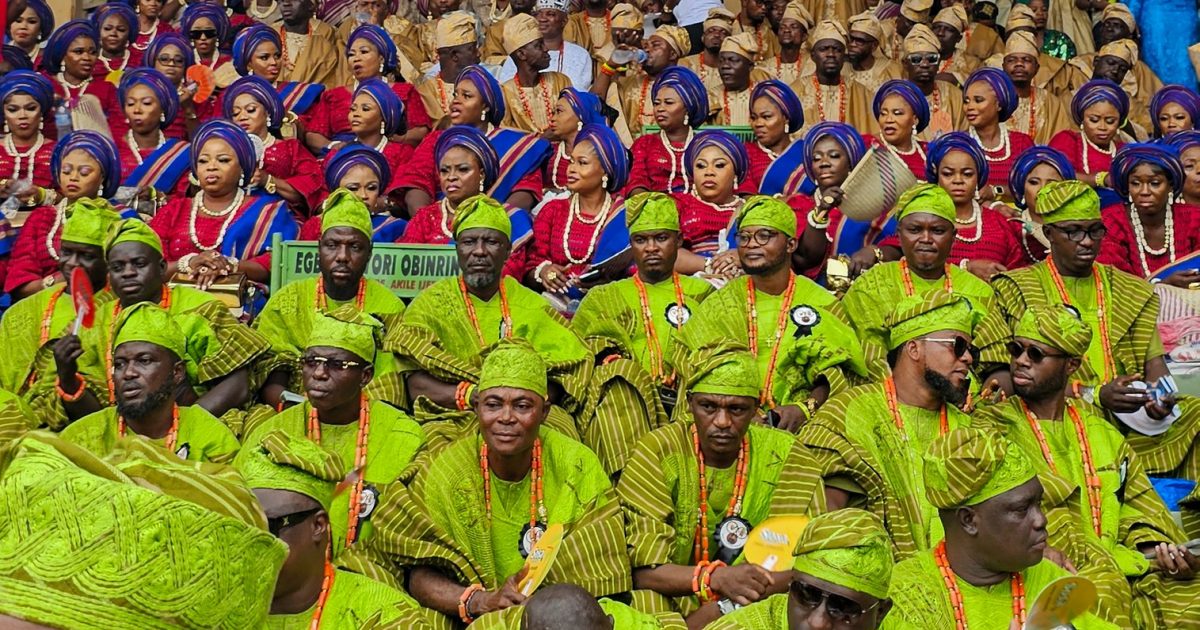
The organizing committee of the 2026 Ojude Oba Festival broke its silence on Tuesday with a clear message: the festival will go on, and the late king had already settled the matter himself.
The committee disclosed at a press briefing held within the grounds of the palace in Ijebu Ode, assembled to herald the 2026 edition of the festival under the theme “Ojude Oba 2026: Celebrating the Legacy of Oba Sikiru Adetona.”
The event drew members of the organizing committee, sponsors, partners, and cultural stakeholders, many of whom doubled as exhibitors, showcasing products and services tied to the annual extravaganza.
At the podium stood Professor Fassy Yusuf, coordinator of the festival, who wasted little time in getting to the heart of the matter.
He disclosed that the late monarch, Oba Sikiru Kayode Adetona, had made it abundantly clear during his lifetime that the festival must never be suspended on account of his death or any period of interregnum and that Oba Adetona regarded the festival as a sacred cultural institution that should continue to thrive for generations.
“The king himself said so” was the unspoken message resounding through the palace grounds.
The rumors had taken on a life of their own in recent weeks, amplified across both traditional and social media platforms.
Certain voices and interests had sought to create uncertainty around the continuity of the festival through campaigns such as “No Awujale, No Ojude Oba,” a narrative organizers said attempted to reduce a timeless cultural institution to the fate of a single individual, however great it was.
Professor Yusuf moved swiftly to dismantle that logic. Drawing a historical parallel, he pointed out that in 1995, the Ojude Oba festival was held even when Oba Adetona was critically ill and had been flown abroad for medical attention, with the late Ogbeni-Oja Bayo Okuku stepping in, supported by eminent Ijebu sons, including Otunba Subomi Balogun and the late Papa Chris Okunbadejo. History, he argued, had already answered the question being asked today.
Dismissing arguments for cancellation as illogical, he confirmed that an Awujale interregnum administrative council had been constituted to ensure institutional continuity during the period of the vacant throne.
Oba Sikiru Kayode Adetona, the Awujale and paramount ruler of Ijebuland, died in July 2025 at the age of 91, having reigned for an extraordinary 65 years. His passing left a void felt not only in Ijebuland but also across Nigeria’s cultural and political landscape.
Throughout his illustrious reign, Oba Adetona broke barriers, demystified age-long jinxes, redefined the institution of traditional monarchy, and repositioned the Ijebu nation on the global cultural and socio-political landscape. It is precisely this legacy that organizers say must be protected, not diminished, by allowing the festival to lapse.
Professor Yusuf made clear that the 2026 edition would not only celebrate the rich cultural heritage of the Ijebu people but also serve as a solemn tribute to the longest-reigning monarch in the history of Ijebuland, a royal icon whose legacies, in his words, “remain indelible and whose impact will continue to resonate across generations.”
Originally rooted in Islamic celebrations, the Ojude Oba festival has evolved over the decades into a major cultural gathering embraced by Muslims, Christians, traditional worshippers, and visitors of varied backgrounds, a testament to the unifying power of Ijebu heritage.
Professor Yusuf confirmed that the 2026 edition is scheduled to be held on either May 28 or 29, depending on the appropriate celestial signals, a detail that underscores the festival’s deep ties to tradition even as it faces a moment of modern-day controversy.
For the organizers, the press briefing was more than a clarification. It was a declaration that culture, when rooted deeply enough, outlasts even the monarchs who nurture it. Oba Adetona understood that. And he made sure, before the end, to say so.
WHAT YOU SHOULD KNOW
The 2026 Ojude Oba Festival will proceed as planned, and the most compelling reason is the late Oba Sikiru Adetona himself, Nigeria’s longest-reigning monarch, who explicitly directed that the festival must never be suspended on account of his death or any interregnum.
Far from being a reason to cancel, his passing has become the very inspiration for this year’s edition, themed in his honor. The festival transcends any single individual; it is a living institution, and the king knew it.