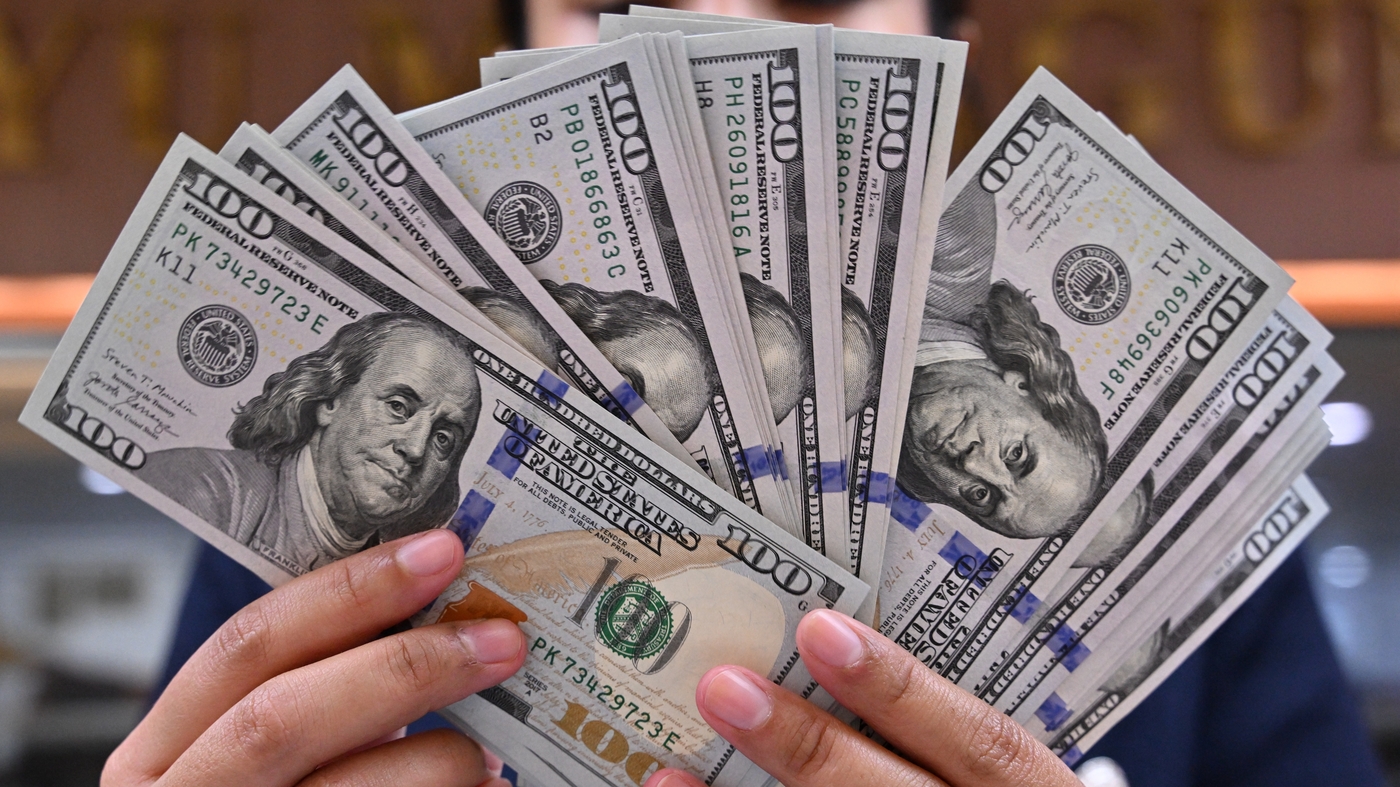
The U.S. dollar retreated against major trading partners on Friday morning, surrendering some of its weekly gains as bond markets found stability and investors positioned themselves ahead of what many consider the most consequential jobs report in months.
The greenback’s decline comes as traders increasingly bet that weak employment data will provide the Federal Reserve with the ammunition it needs to begin cutting interest rates at its September 16-17 meeting—a monetary policy reversal that would mark a significant shift from the central bank’s recent hawkish stance.
Market Positioning Ahead of Payrolls
The dollar index, which measures the currency against a basket of major peers, fell 0.2% to 98.018 in early European trading, trimming what had been a stronger weekly performance to just 0.2%. Against the Japanese yen, the dollar dropped 0.2% to 148.14, while the euro gained ground, rising 0.2% to $1.1682.
Francesco Pesole, a foreign exchange strategist at ING, suggested that Thursday’s muted market reaction to disappointing private payroll data may have been premature. “It seems to me that the reaction to the ADP yesterday was a bit too muted,” Pesole observed, referring to the private employment report that showed weaker-than-expected job creation. “All in all, it is pointing to a probably weak payroll figure today.”
The strategist noted that dollar weakness in European morning trading could signal that investors are “offloading greenbacks ahead of the U.S. job figures later in the session”—a tactical move that suggests widespread anticipation of disappointing employment numbers.
Employment Data in Focus
The Labor Department’s Bureau of Labor Statistics is set to release August nonfarm payrolls data, with economists surveyed by Reuters expecting a modest increase of 75,000 jobs—barely above July’s already-weak gain of 73,000 positions. This follows Thursday’s concerning data showing that private payrolls rose less than expected, and jobless claims in the final week of August exceeded predictions.
Joseph Capurso, head of international economics at the Commonwealth Bank of Australia, warned that “the risk is still tilted to payrolls underperforming U.S. economists’ expectations that will weigh on the USD tonight.”
Fed Policy Pivot Appears Locked In
Market pricing suggests traders are now assigning a near certainty to Federal Reserve action this month. CME FedWatch data shows investors are pricing in a near-100% probability of a rate cut at the September meeting, up from 87% just a week ago—a dramatic shift that underscores how quickly sentiment has evolved.
However, some analysts argue that the specific job numbers may be less relevant than the broader trend. Michael Brown, senior research strategist at Pepperstone, contends that Friday’s report “doesn’t really matter in the grand scheme of things.”
“The Fed will be delivering a 25-bp cut at the September meeting,” Brown wrote in a research note. “A hot report shan’t dissuade them from doing so, given the broader trend of softening jobs data. A cool report shan’t convince them to plump for a larger rate reduction, given lingering upside inflation risks.”
Political Undercurrents
Adding to market uncertainty are ongoing concerns about potential political interference in Federal Reserve policy. Bart Wakabayashi, Tokyo Branch Manager of State Street, cited “anxiety over U.S. President Donald Trump‘s meddling with Fed policy and his unpredictable tariff regime” as factors making investors hesitant about holding dollar assets.
These concerns were addressed directly on Thursday when Stephen Miran, Trump’s nominee for an open Federal Reserve seat, told lawmakers he would “not at all” be the president’s puppet and would make interest-rate decisions independently of political pressure.
Broader Market Dynamics
The currency movements occurred against a backdrop of stabilizing bond markets after recent fiscal concerns had driven up long-term yields. U.S., European, and Japanese bonds all rallied, while equity markets showed resilience with the S&P 500 reaching a new all-time high.
In other currency movements, sterling showed little reaction to stronger-than-expected UK retail sales data for July, trading 0.2% higher at $1.34695. Commodity currencies performed well, with the Australian dollar gaining 0.4% to $0.6544 and the New Zealand dollar rising 0.6% to $0.58785.
Cryptocurrency Surge
Digital assets also participated in the risk-on sentiment, with bitcoin climbing 2.16% to $112,796.78 and ether adding 2.1% to $4,398.61, suggesting broader market optimism about potential monetary easing.
As markets await the jobs data, the convergence of weak employment trends, dovish Fed commentary, and shifting market positioning suggests that, regardless of Friday’s specific numbers, the central bank appears committed to beginning a new chapter in U.S. monetary policy—one that could have far-reaching implications for currency markets and global financial conditions in the months ahead.
WHAT YOU SHOULD KNOW
The U.S. dollar is weakening as markets brace for what appears to be a done deal—the Federal Reserve cutting interest rates in September. Despite economists expecting only modest job growth of 75,000 in August, traders are betting with near-100% certainty that the Fed will cut rates regardless of Friday’s specific employment numbers.
The central message: after months of aggressive rate hikes, America’s central bank is pivoting toward monetary easing, marking a significant shift that could reshape global financial markets. Whether jobs data comes in strong or weak, the Fed’s dovish turn seems locked in, driven by broader concerns about a softening labor market.