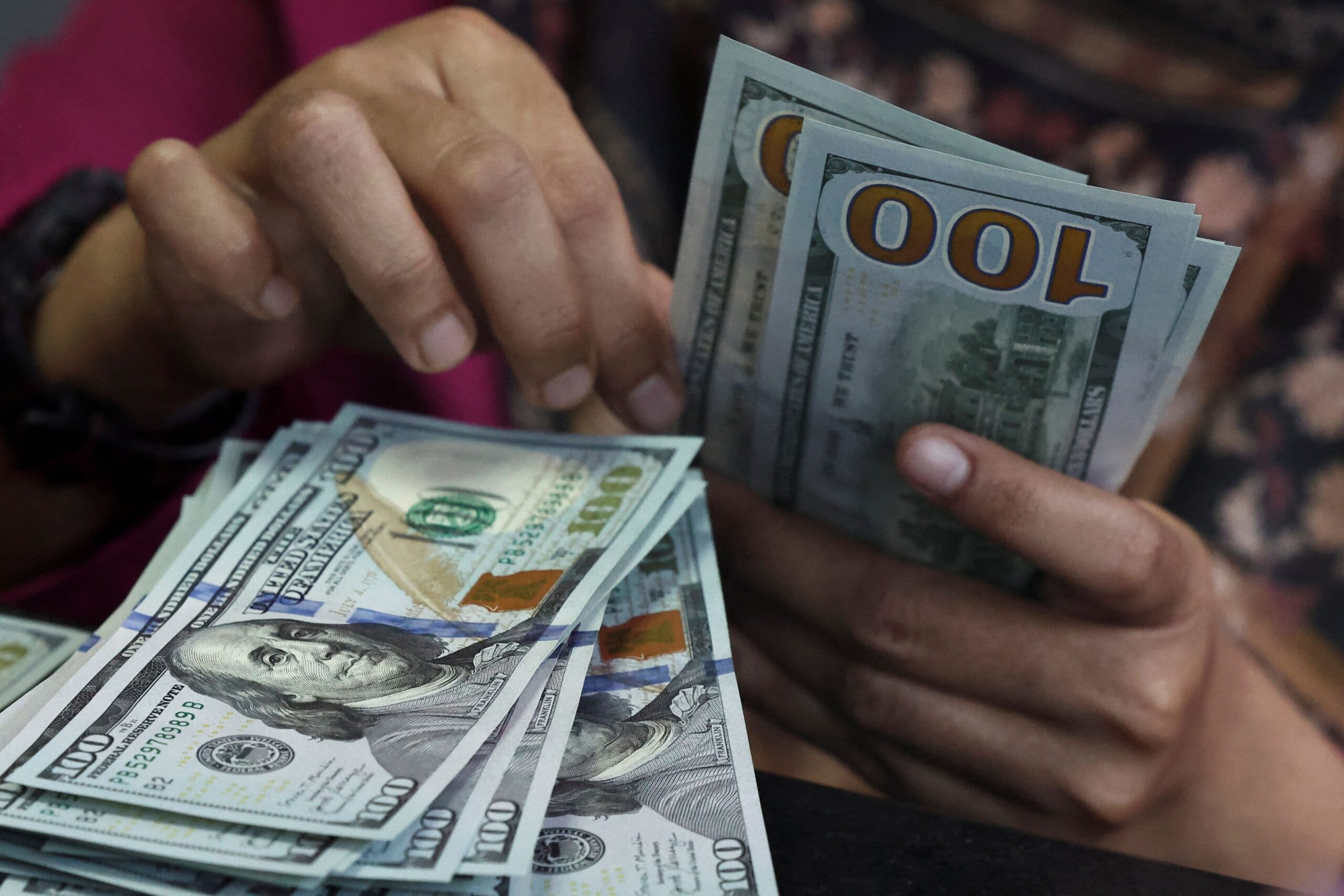
The U.S. dollar weakened sharply on Monday as global investors, rattled by President Donald Trump’s unprecedented threat to impose punitive tariffs over Greenland, sought refuge in traditional safe-haven currencies, marking another episode of market volatility stemming from Washington’s unpredictable trade policy.
The greenback’s decline came after Trump announced over the weekend his intention to slap an additional 10% tariff on imports from eight countries—Denmark, Norway, Sweden, France, Germany, the Netherlands, Finland, and Britain—effective February 1. The extraordinary measure, which links trade policy to territorial acquisition, represents an escalation in Trump’s confrontational approach to international relations, with the president demanding that the United States be allowed to purchase Greenland as a precondition for lifting the duties.
The announcement sent shockwaves through currency markets, with investors initially fleeing European currencies before sentiment shifted dramatically. The Swiss franc, long considered a port in financial storms, surged toward its strongest single-day gain against the dollar in a month, while the Japanese yen also attracted capital inflows despite ongoing domestic political uncertainty in Tokyo.
European Union ambassadors convened emergency discussions Sunday, with diplomats reporting agreement to intensify efforts aimed at dissuading the Trump administration from implementing the tariffs while simultaneously preparing retaliatory countermeasures should the duties proceed as threatened.
The threatened action represents an unusual linkage of trade policy with geopolitical demands, raising questions about the stability and predictability of U.S. economic diplomacy under the Trump administration.
In a counterintuitive market reaction that has become characteristic of Trump-era trade tensions, European currencies initially sold off in overnight trading before staging a remarkable recovery. By mid-morning European hours, the euro had reversed course to trade 0.2% higher at $1.1627, while the British pound similarly rebounded, gaining 0.1% to $1.339.
“Typically, you would think tariffs being threatened would lead to a weaker euro,” explained Khoon Goh, head of Asia research at ANZ. “But, as we’ve seen last year as well, when the ‘Liberation Day’ tariffs were getting put in place, the impact in FX markets actually has been more towards dollar weakness every time there is heightened policy uncertainty emanating from the United States.”
The pattern recalls last April’s market upheaval, when Trump’s announcement of sweeping global tariffs triggered what analysts described as a crisis of confidence in U.S. assets, prompting widespread capital flight from dollar-denominated investments.
While Monday’s trading saw notable movement away from the dollar—particularly evident in the Swiss franc’s 0.5% gain to 0.7982 per dollar—currency strategists cautioned against assuming any permanent erosion of the greenback’s traditional role as the world’s premier safe-haven currency.
“The market has been understandably anxious about the dollar’s decline in value since last April. But I would really caution against assuming that the dollar’s safe-haven status is gone,” said Jane Foley, chief currency strategist at Rabobank. She pointed to the sheer scale and liquidity of U.S. financial markets as providing inherent advantages that competing currencies cannot match.
“Even if non-U.S. investors decided to take their money out, where would they go? Other markets aren’t big enough to maintain that. The sheer size of the market means that there is always going to be some safe-haven value associated with U.S. assets,” Foley argued.
The Japanese yen edged marginally higher against the dollar to 158.055, though its gains remained modest compared to the Swiss franc. The currency has been hampered in recent weeks by domestic political developments, with an approaching snap election raising expectations of expanded fiscal stimulus that could weaken the yen further.
Trading near its weakest levels since mid-2024, the yen’s vulnerability has prompted increasingly direct verbal warnings from Tokyo officials, raising market expectations that Japanese authorities may intervene directly in currency markets to arrest further declines.
“We still remain skeptical of intervention being successful on a sustained basis and would need fundamental supportive yen factors to play out as well. Moves in yen today are certainly more contained,” noted Derek Halpenny, MUFG’s head of research for global markets EMEA.
The flight to safety extended beyond traditional currency markets. Cryptocurrencies, which have increasingly served as a barometer of investor risk appetite, tumbled sharply. Bitcoin plunged nearly 3% to $92,740, while ether suffered an even steeper 4% decline to $3,205.
Adding to the day’s economic news flow, data released Monday showed China’s economy expanded 5.0% in 2024, meeting Beijing’s official target by capturing what analysts described as a record share of global goods demand to compensate for persistently weak domestic consumption.
The onshore yuan climbed to a 32-month high of 6.9630 per dollar, brushing aside the mixed economic picture after China’s central bank set its strongest daily reference rate in more than two years—a move interpreted by some analysts as a signal of confidence despite gathering trade policy headwinds.
As markets digest the latest escalation in U.S. trade rhetoric, attention now turns to whether European capitals will follow through on threatened countermeasures and whether Trump’s unconventional linkage of trade policy to territorial ambitions represents a negotiating tactic or a genuine shift in American foreign economic policy.
WHAT YOU SHOULD KNOW
President Trump’s threat to impose 10% tariffs on eight European nations unless the U.S. can buy Greenland has paradoxically weakened the dollar rather than the targeted currencies. Investors are fleeing to safe-haven assets like the Swiss franc and yen, repeating a pattern from last year where U.S. policy uncertainty—not foreign vulnerabilities—drives dollar sell-offs.
Trump’s unpredictable trade policy is eroding confidence in U.S. assets themselves, challenging the dollar’s traditional safe-haven status even as analysts insist America’s massive financial markets give the greenback nowhere to go but up in any true global crisis. Markets are betting against U.S. stability, not European weakness.