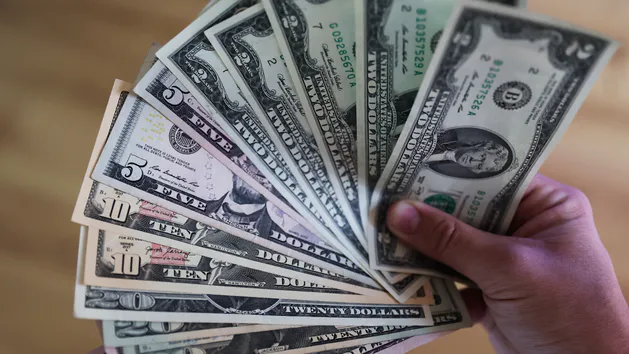
The U.S. dollar plunged toward its steepest weekly drop in nine months on Wednesday, after President Donald Trump’s casual dismissal of the currency’s sharp decline rattled global financial markets and intensified a massive sell-off that left investors doubting America’s economic management.
The greenback was poised to lose nearly 2.8% over the trading week—its steepest drop since the market turbulence that followed last April’s so-called “Liberation Day”—after Trump dismissed concerns about the dollar’s month-long rout with a terse declaration that its value was “great.”
Rather than reassuring jittery markets, the president’s remarks on Tuesday had the opposite effect, prompting traders to dump dollars with renewed urgency and driving major currencies to multi-year highs against the beleaguered U.S. currency.
The euro surged past the psychologically significant $1.20 threshold for the first time since 2021, while sterling climbed to 4 1/2-year peaks. The Japanese yen, bolstered by persistent speculation of coordinated intervention by Tokyo and Washington, was tracking toward its strongest monthly performance against the dollar since April of last year.
“It shows there’s a crisis of confidence in the U.S. dollar,” said Kyle Rodda, senior market analyst at Capital.com. “It would appear that while the Trump administration sticks with its erratic trade, foreign, and economic policy, this weakness could persist.”
The dollar index, which measures the currency against a basket of six major rivals, stood 0.22% higher at 96.114 on Wednesday but remained perilously close to four-year lows—a stark barometer of investor anxiety about U.S. asset exposure.
The currency’s troubles have been building since 2025, when the dollar tumbled more than 9% amid growing alarm over Trump’s unpredictable approach to international relations and trade policy. Already down 2.3% in January alone, the greenback has become a casualty of mounting concerns about the administration’s economic management, fears over the Federal Reserve’s independence, and ballooning federal spending.
Market participants were turning their attention to the Federal Reserve’s policy meeting later Wednesday, where the central bank was widely expected to hold interest rates steady. Investors anticipate this pause will extend well beyond Fed Chair Jerome Powell‘s final meetings in March and April, as the central bank navigates an increasingly complex economic and political landscape.
While a weaker dollar provides a competitive advantage for American exporters, the currency’s slide is already triggering alarm bells in other economic blocs. Austrian central bank governor Martin Kocher told the Financial Times that the European Central Bank may need to consider additional interest rate cuts if the euro’s strength begins threatening the inflation outlook—a comment that briefly knocked the common currency back by as much as 0.5% to $1.1975 before it recovered to $1.1989.
“We are still in the heat of the moment, and it is hard to consider fundamentals at a time when markets move so much on sentiment and on such short periods of time,” noted Barclays analysts led by Themistoklis Fiotakis. They cautioned, however, that “the more these moves extend, the higher the bar for further easy gains,” particularly in the euro-dollar exchange rate.
As confidence in dollar-denominated assets has eroded, investors have piled into alternative stores of value. Gold prices have soared over the past fortnight, while currencies perceived as safer bets have enjoyed substantial rallies.
The fragile yen received an additional boost from dollar weakness, surging more than 1% to a three-month high of 152.10 per dollar on Tuesday, though it pulled back 0.3% to 152.64 on Wednesday. Yet skepticism remains about whether any potential intervention would prove effective, especially with Japanese Prime Minister Sanae Takaichi campaigning on expanded stimulus measures ahead of the February 8 snap election.
Meanwhile, the Australian dollar climbed to $0.70225—its strongest level since February 2023—after inflation data for the December quarter came in hotter than expected, fueling speculation that the Reserve Bank of Australia could raise interest rates in the near term. The currency later retreated 0.16% to $0.70.
As global markets brace for the Fed’s decision and digest the implications of Trump’s dismissive stance on the dollar’s weakness, the question looming over trading floors from New York to Tokyo is whether this represents a temporary correction or a fundamental shift in the currency landscape—one that could reshape international trade flows and central bank policies for months, if not years, to come.
WHAT YOU SHOULD KNOW
The U.S. dollar is experiencing its worst weekly decline in nine months, plummeting to four-year lows after President Trump dismissed concerns about the currency’s slide. His “great” comment triggered intensified selling rather than reassurance, revealing what analysts call a “crisis of confidence” in American economic stewardship.
The dollar has lost nearly 2.8% this week and over 9% since 2025 began, driven by investor fears over Trump’s erratic trade policies, concerns about Federal Reserve independence, and massive government spending increases. Major currencies—the euro, pound, and yen—have surged to multi-year highs as investors flee dollar-denominated assets for safer alternatives, including gold.