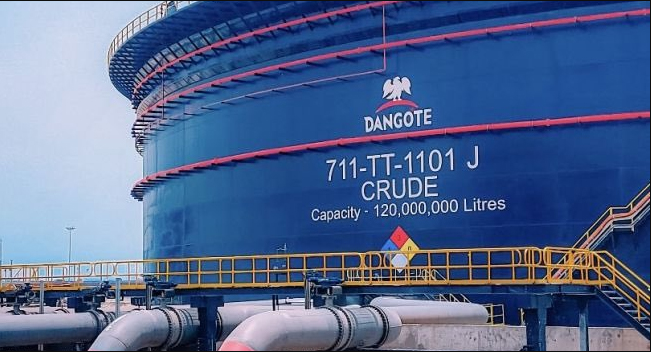
The Dangote Oil Refinery will stop importing crude oil and rely entirely on Nigerian supply by December 2025, according to a Bloomberg report that signals a major shift in Africa’s largest refinery operations.
The ambitious timeline was announced by Devakumar Edwin, vice president at Dangote Industries, who oversees the massive 650,000-barrel-per-day facility situated in Lagos. Edwin confirmed that existing contracts with foreign crude suppliers would expire by year-end, allowing the refinery to source its feedstock entirely from domestic producers.
Currently, the refinery maintains a mixed supply chain, importing crude from Brazil, Angola, Ghana, and Equatorial Guinea. However, recent data reveals the facility’s growing reliance on local sources, with domestic producers supplying 53 percent of crude requirements in June, while the United States provided the remaining 47 percent.
The transition comes as the refinery processes 550,000 barrels of crude daily, operating below its full nameplate capacity. Edwin expressed confidence in the shift, stating that improved relationships between the refinery, local oil traders, and government officials would ensure a steady supply of Nigerian crude.
“We expect some of the long-term contracts will expire. Personally, and as a company, we expect that before the end of the year, we can transition 100 percent to local crude,” Edwin was quoted as saying.
The refinery’s supply arrangements with the Nigerian National Petroleum Company Limited (NNPCL) are already expanding, with five cargo allocations scheduled for July and August. Each shipment contains approximately one million barrels of crude.
This strategic pivot addresses the original vision of Aliko Dangote, who invested $20 billion to build the refinery specifically to end Nigeria’s paradoxical practice of exporting crude oil to Europe for refining, only to import the finished products at significantly higher costs.
The facility’s gradual ramp-up has already begun transforming Nigeria into a net exporter of petroleum products, despite ongoing challenges in securing adequate crude supplies before reaching full operational capacity. The refinery’s initial dependence on overseas crude occurred after domestic traders failed to meet demand requirements.
Industry analysts note that the transition reflects broader improvements in Nigeria’s oil sector coordination and supply chain management. The move is expected to reduce foreign exchange pressures on the naira while strengthening domestic oil market linkages.
However, questions remain about the consistency of local crude supply, given historical challenges with production levels and infrastructure constraints that have previously necessitated imports to maintain refinery operations.
The December 2025 deadline represents a critical test of Nigeria’s ability to support its domestic refining capacity while maintaining the operational efficiency that has made the Dangote facility a cornerstone of the country’s energy independence strategy.
WHAT YOU SHOULD KNOW
The Dangote Refinery, Africa’s largest oil processing facility, plans to eliminate crude oil imports by December 2025 completely and rely entirely on Nigerian crude. This $20 billion investment was designed to end Nigeria’s costly cycle of exporting raw oil abroad for refining, then importing expensive finished products back home.
Currently processing 550,000 barrels daily with a 53% domestic supply mix, the refinery’s transition to 100% local crude represents a pivotal moment for Nigeria’s energy independence. Success hinges on whether domestic producers can consistently meet the facility’s massive demand—a challenge that previously forced reliance on imports when local traders fell short.
if achieved, this shift could transform Nigeria from an oil importer to a net petroleum product exporter, strengthening the naira and reducing foreign exchange pressures while finally realizing the vision of keeping Nigeria’s oil wealth within its borders.