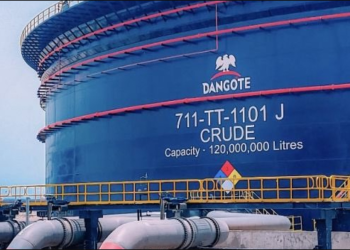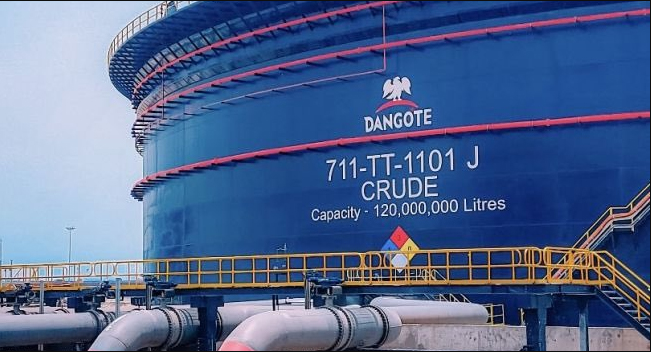
The Dangote Petroleum Refinery, Africa’s most ambitious energy infrastructure project, is undergoing significant modifications that will boost its daily production capacity from 650,000 to 700,000 barrels per day by the fourth quarter of 2025, according to company executives.
The $20 billion facility, located in Lekki, Lagos, represents a cornerstone of Nigeria’s drive toward energy self-sufficiency, though current operations remain hampered by ongoing technical upgrades. During a recent facility tour, Dangote Group President Aliko Dangote revealed that the refinery’s Residue Fluid Catalytic Cracking (RFCC) unit is operating at 85 percent capacity as crews work to complete the enhancement project.
“Our RFCC is at 85 percent. We are not up to 100 percent because there are some modifications that we are doing,” Dangote explained to reporters and visitors. The RFCC unit serves as a critical component in the refining process, converting heavy petroleum residues into lighter, more valuable products, including gasoline, diesel, and liquefied petroleum gas.
Heavy Reliance on US Crude Imports
The refinery’s current operational profile reveals significant dependence on American crude oil supplies. Dangote disclosed that the facility purchased 19 million barrels from United States suppliers between June and July 2025, with US sources accounting for approximately 55 percent of the refinery’s crude oil requirements.
“As a company, we bought 10 million barrels of crude this month,” Dangote noted, referring to July purchases. This import strategy underscores both the facility’s substantial appetite for feedstock and the complex global supply chain dynamics affecting African energy infrastructure.
A Vision Born from Frustration
The genesis of Africa’s largest refinery traces back to 2007, when Dangote’s initial attempt to acquire Nigeria’s government-owned refineries was blocked by the late President Umaru Musa Yar’Adua. That setback catalyzed Dangote’s decision to construct an entirely new facility from the ground up.
“If I knew what we were going to face, I wouldn’t have started it at all,” Dangote candidly admitted, acknowledging the project’s unprecedented complexity. The industrialist drew a sharp distinction between refinery construction and conventional building projects, emphasizing the technical and logistical challenges that nearly derailed the venture multiple times.
The billionaire businessman described critical decision points where the project team faced stark choices between abandonment and persistence. “As the project got deeper, the group was faced with whether to stop and sink or continue and succeed,” he recalled.
Continental Energy Security Imperative
Dangote positioned the refinery within the broader context of African energy independence, noting that most sub-Saharan countries rely heavily on petroleum imports. “Apart from Algeria and Libya, which are self-sufficient in Africa, technically, everybody is an importer,” he observed.
The entrepreneur delivered pointed criticism of what he characterized as deliberate economic undermining of African industrial capacity. “Some foreign actors were attacking all industries through importation,” Dangote asserted, citing the concentration of import vessels in regional ports like Lomé as evidence of systematic industrial suppression.
He highlighted the broader continental refining crisis, noting that South African refineries have largely ceased operations, with only one facility remaining active. This context frames the Dangote refinery as potentially transformative for regional energy markets.
Operational Excellence Despite Constraints
While the RFCC modifications continue, other refinery components are demonstrating robust performance, with some departments operating at 145 percent of designed capacity, according to Dangote. This operational flexibility suggests the facility’s potential to exceed nameplate capacity once all systems achieve full integration.
The timeline for completing current modifications remains tied to the fourth quarter of 2025, with company leadership expressing confidence in achieving the enhanced 700,000 barrel-per-day target. The successful completion of this upgrade would cement the facility’s position as a pivotal player in global petroleum markets and African energy security.
As Nigeria and the broader West African region grapple with energy supply challenges, the Dangote refinery’s evolution represents both the promise and complexity of large-scale industrial transformation in developing economies.
WHAT YOU SHOULD KNOW
The Dangote Petroleum Refinery in Lagos is upgrading its capacity from 650,000 to 700,000 barrels per day, with completion expected by late 2025. Currently operating at 85% capacity due to ongoing modifications, the $20 billion facility relies heavily on US crude oil imports (55% of supply).
Aliko Dangote admitted the project’s unexpected complexity, saying he wouldn’t have started if he’d known the challenges involved. He positioned the refinery as crucial for African energy independence, noting that most sub-Saharan countries depend on fuel imports, and accused foreign actors of deliberately undermining African industries through importation strategies.
The facility represents Africa’s largest single-train refinery and potentially its most significant step toward energy self-sufficiency.