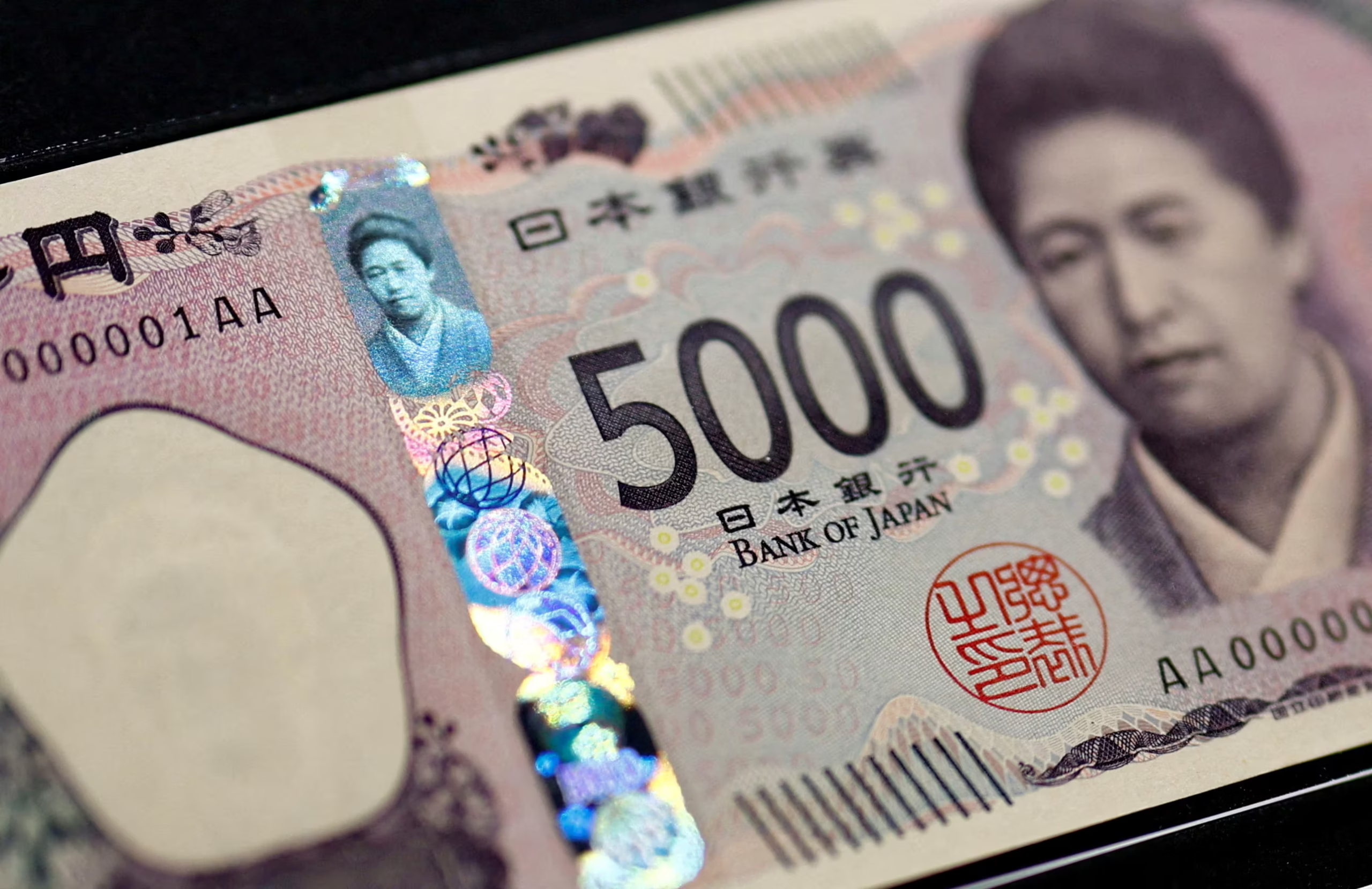
International currency markets experienced significant volatility on Monday as political instability in Japan and France, combined with weakening U.S. economic indicators, sent shockwaves through global financial systems.
The Japanese yen suffered its steepest decline in over a year after Prime Minister Shigeru Ishiba announced his resignation on Sunday, creating a leadership vacuum in the world’s fourth-largest economy. The currency’s sharp depreciation—falling as much as 0.78% against the dollar at one point—reflects investor concerns about prolonged policy uncertainty in a nation already grappling with the burden of being the most heavily indebted industrialized country globally.
Market participants are now closely watching potential successors to Ishiba, particularly focusing on whether a more dovish candidate like Liberal Democratic Party veteran Sanae Takaichi might emerge. Takaichi’s previous criticism of the Bank of Japan’s interest rate hikes has investors speculating about a potential reversal in monetary tightening policies.
“The probability of an additional rate hike in September was never seen as high to begin with,” noted Hirofumi Suzuki, chief currency strategist at SMBC. The uncertainty has created a wait-and-see atmosphere that currency analysts expect to persist well into the fall, with policy directions largely dependent on whoever ultimately assumes the prime ministership.
Meanwhile, across the Pacific, the U.S. dollar continued to reel from Friday’s disappointing employment data, which revealed significant cracks in America’s labor market foundation. The August nonfarm payrolls report painted a concerning picture: job growth decelerated sharply while unemployment climbed to 4.3%—a near four-year peak that has economists reconsidering the resilience of the U.S. economic expansion.
This labor market deterioration has dramatically shifted Federal Reserve policy expectations. Financial markets, which showed virtually no expectation of aggressive monetary easing just one week ago, are now pricing in a 10% probability of a substantial 50-basis-point rate cut at the Fed’s upcoming September meeting.
The currency market reactions underscore how quickly sentiment can shift in today’s interconnected global economy. Sterling capitalized on dollar weakness, climbing 0.1% to $1.352, while the euro maintained its position near $1.1727 after reaching month-long highs on Friday.
Adding another layer of complexity to the global financial landscape, France finds itself teetering on the edge of a political crisis. Prime Minister François Bayrou faces a confidence vote that political observers widely expect him to lose, threatening to plunge the eurozone’s second-largest economy into further governmental instability.
This confluence of political and economic uncertainties has created what Charu Chanana, chief investment strategist at Saxo, describes as an environment where “investors will be cautious until a successor is confirmed, keeping volatility elevated across yen, bonds, and equities.”
Perhaps most tellingly, the Japanese yen showed virtually no reaction to domestic economic data on Monday, revealing that Japan’s economy had expanded faster than initially estimated in the second quarter. This muted response demonstrates how political uncertainty can overshadow positive economic fundamentals in currency markets.
As global markets navigate these choppy waters, the coming weeks will likely prove crucial in determining whether current volatility represents a temporary adjustment or the beginning of a more sustained period of financial market instability. With central bank policies, political leadership changes, and economic data all pulling in different directions, currency traders and international investors face an increasingly complex landscape that demands careful navigation and strategic patience.
The interconnected nature of these developments—from Tokyo’s political upheaval to Washington’s monetary policy debates to Paris’s governmental crisis—serves as a stark reminder of how quickly local political events can reverberate through global financial markets in our increasingly interconnected world.
WHAT YOU SHOULD KNOW
Global currency markets are experiencing significant turmoil driven by three critical developments: Japan’s political crisis following PM Ishiba’s resignation has sent the yen plummeting to year-long lows, weak U.S. jobs data has sparked expectations of aggressive Federal Reserve rate cuts this month, and France faces potential governmental collapse with PM Bayrou’s expected confidence vote loss.