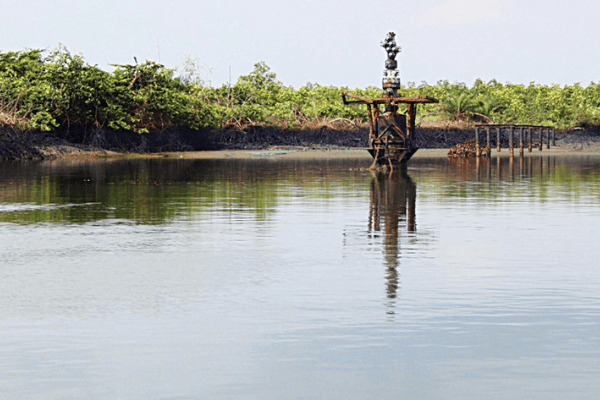
A heated territorial dispute over billions of naira in oil revenue has resurfaced as Cross River State challenges the ownership of 76 offshore oil wells currently controlled by neighboring Akwa Ibom State, despite two separate Supreme Court rulings that appeared to settle the matter over a decade ago.
The controversy centers on oil wells that were transferred from Cross River to Akwa Ibom following the 2002 International Court of Justice (ICJ) ruling on the Bakassi Peninsula dispute with Cameroon. The Nigerian Supreme Court twice upheld Akwa Ibom’s ownership of the wells in 2012, citing their location within the state’s 200-meter isobath maritime boundary.
However, Honorable John Lebo, a lawyer and former Speaker of the Cross River State House of Assembly, speaking on Arise News, The Morning Show, argues that both the ICJ judgment and subsequent Supreme Court decisions were based on incomplete boundary demarcation and flawed geographical assessments.
The Genesis of the Dispute
The roots of this complex legal battle trace back to 1994, when Cameroon filed a petition at the ICJ claiming sovereignty over the oil-rich Bakassi Peninsula. After an eight-year legal process, the ICJ ruled in 2002 that Bakassi belonged to Cameroon, based on the 1913 Anglo-German treaty that established colonial boundaries.
Following this international ruling, Nigeria’s National Boundary Commission redrew internal state boundaries, effectively landlocking Cross River State and transferring its offshore oil assets to Akwa Ibom. The decision was later ratified by Nigeria’s Supreme Court, which ruled that the remaining oil wells were “contiguous within the 200-meter isobath to Akwa Ibom.”
To compensate Cross River for the loss, Akwa Ibom initially agreed to pay ₦250 million monthly, later increased to ₦500 million. However, this arrangement has done little to quell Cross River’s sense of injustice over what it considers an unlawful seizure of its maritime territory.
“We Were Never a Landlocked State”
In a passionate defense of his state’s position, Lebo argued that the ICJ never declared Cross River a landlocked state, pointing to specific pages of the 960-page judgment. “The ICJ judgment did not in any way landlock Cross River State,” he insisted, referencing pages five, six, and nine of the international court’s decision.
The former speaker contends that the National Boundary Commission made critical errors by drawing maritime boundaries before completing the physical demarcation of the Nigeria-Cameroon border—a process that remains 90 kilometers short of completion in the Bakassi region.
“What theory of geography would you apply to a judgment that provides for maritime boundary demarcation when you have not done the demarcation, and then you relocate the oil wells?” Lebo was questioned during a recent television interview.
New Evidence and Expert Consultations
Cross River State claims to have commissioned independent hydrological and geological surveys that challenge the current boundary arrangement. The state has also obtained legal opinions from Queen’s Counsel, including the wife of a former UK prime minister, who reportedly advised that Cross River remains a littoral state with legitimate claims to territorial waters.
According to Lebo, these new surveys identify at least 67 oil wells as being within Cross River’s legitimate territorial boundaries. The state has presented these findings to federal authorities, including the President, on what it describes as “security grounds.”
Akwa Ibom’s Response
Akwa Ibom State has dismissed the renewed controversy, with state officials maintaining that the Supreme Court’s decision is final and cannot be appealed. The state’s Commissioner for Information urged the public to disregard what he termed “circulating claims or rumors,” emphasizing that the July 2012 Supreme Court ruling remains binding.
Broader Security Implications
Perhaps more troubling than the interstate dispute are allegations that Cameroon is exploiting the boundary confusion to advance territorial claims beyond the original ICJ judgment. Lebo warns that Cameroon has already occupied 16 islands in the oil-rich Effiat area of Akwa Ibom State, which contains an estimated 2,600 oil wells.
“The open-ended error of judgment-based line drawn by the National Boundary Commission” has created a dangerous precedent, according to Lebo, potentially encouraging Cameroon to extend its claims further south toward the Rio del Rey area.
The Nigerian Senate has announced plans to probe these alleged illegal annexations of Nigerian territory by Cameroon, highlighting the international dimensions of what began as a domestic boundary dispute.
Legal and Political Pathways
While acknowledging that “the judgment of the Supreme Court is final,” Cross River State argues that new federal legislation or policy changes could render the previous ruling “academic” without directly challenging the court’s authority.
The state is pursuing what Lebo describes as a “post-case management strategy” that could benefit both parties while addressing what he sees as fundamental flaws in the original boundary demarcation process.
The Stakes
The dispute involves far more than legal technicalities. Cross River State’s claim to littoral status affects its constitutional right to 13% derivation revenue from offshore oil production—a sum that could amount to hundreds of billions of naira annually, given Nigeria’s oil wealth.
For Akwa Ibom, maintaining control over these assets is crucial to its status as one of Nigeria’s wealthiest states and a major contributor to national oil revenue.
What’s Next?
As this complex legal and territorial dispute continues to unfold, several key questions remain unanswered: Will the Nigerian government order a comprehensive review of the boundary demarcation process? Can Cross River State successfully challenge a Supreme Court ruling through legislative means? And most critically, how will Nigeria prevent further territorial encroachment by Cameroon while resolving its internal boundary disputes?
With billions of naira in oil revenue at stake and potential national security implications, this decades-old dispute shows no signs of resolution. As Lebo concluded in his interview, “This is a developing story,” and indeed, it appears far from over.
The federal government now faces the delicate task of balancing competing state interests while ensuring Nigeria’s territorial integrity remains intact in the face of external pressure from Cameroon.
WHAT YOU SHOULD KNOW
Cross River State is challenging the loss of 76 offshore oil wells worth billions in annual revenue, despite two Supreme Court rulings that transferred ownership to Akwa Ibom State over a decade ago.
The Core Issue
This isn’t just a legal dispute—it’s about whether an entire state can lose its coastal status and oil wealth based on potentially flawed boundary decisions made after an international court ruling.
The Stakes Are Enormous
We’re talking about hundreds of billions of naira annually in oil revenue that could fundamentally change Cross River State’s economic prospects and development capacity.
National Security Implications
The boundary confusion has allegedly allowed Cameroon to encroach on Nigerian territory, potentially seizing thousands more oil wells—making this a sovereignty issue, not just a state dispute.
The Legal Precedent
If Cross River succeeds in challenging Supreme Court rulings through legislative means, it could set a dangerous precedent for how final judicial decisions are treated in Nigeria.
Incomplete Business
The Nigeria-Cameroon border demarcation remains unfinished 20+ years after the ICJ ruling, creating ongoing vulnerabilities that foreign nations may exploit.
The Critical Question:
Can Nigeria afford to have states fighting over oil resources while foreign countries potentially grab territory due to poorly executed boundary agreements?
This story matters because it exposes how international legal defeats can cascade into domestic conflicts that threaten both economic prosperity and national territorial integrity.