Africa is hemorrhaging $90 billion annually while becoming a dumping ground for toxic petroleum products that would be banned in developed nations, according to Aliko Dangote, president of Dangote Industries Limited, who delivered a stark warning at the West African Refined Fuel Conference in Abuja.
Speaking at the event organized by Nigeria’s Midstream and Downstream Petroleum Regulatory Authority and S&P Global Commodity Insights, Dangote painted a troubling picture of a continent rich in crude oil yet dangerously dependent on imported refined products of questionable quality.
The Staggering Economics of Dependency
The numbers reveal Africa’s paradoxical energy predicament: while the continent produces approximately seven million barrels of crude oil daily, it refines only 40 percent of its daily consumption of 4.3 million barrels domestically. This stands in sharp contrast to Europe and Asia, which refine over 95 percent of their consumption locally.
This refining deficit forces Africa to import over 120 million tonnes of refined petroleum products annually – a market worth $90 billion that Dangote argues represents “exporting jobs and importing poverty.” To put this in perspective, only about 15 percent of African countries have a GDP exceeding $90 billion.
“We are effectively handing over an entire continent’s economic potential to others—year after year,” Dangote emphasized, highlighting how Africa’s energy dependence undermines its broader economic sovereignty.
The Quality Crisis
Perhaps more alarming than the economic drain is the decline in the quality of imported fuels. Dangote specifically called out the “increasing dumping of cheap, often toxic, petroleum products” that are “blended to substandard levels that would never be allowed in Europe or North America.”
He identified a particular concern with discounted, low-quality fuel originating from Russia, which was blended with Russian crude under international price caps and subsequently sold in African markets. This practice effectively makes Africa a secondary market for products deemed unfit for Western consumption standards.
Regulatory Fragmentation Compounds Problems
The continent’s fuel quality issues are exacerbated by a lack of harmonized standards across African nations. Dangote illustrated this with a technical example: Nigeria requires diesel with a cloud point of four degrees Celsius—a specification that increases costs and limits crude processing options, despite few Nigerian locations ever experiencing such low temperatures. Other African countries maintain more reasonable standards of seven to 12 degrees.
“The fuel we produce for Nigeria cannot be sold in Cameroon or Ghana or Togo, even though we all drive the same vehicles,” Dangote noted, describing how this fragmentation “benefits no one, except, of course, international traders, who thrive on arbitrage.”
Infrastructure and Commercial Challenges
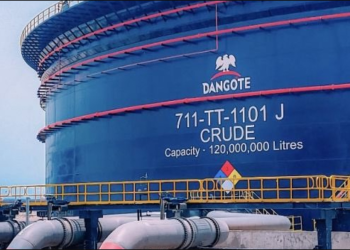
The Dangote Petroleum Refinery experience exemplifies the massive challenges facing African refining development. The world’s largest single-train refinery required clearing 2,735 hectares (seven times Victoria Island’s size), with 70 percent being swampland requiring 65 million cubic meters of sand for stabilization.
At peak construction, over 67,000 workers—including 50,000 Nigerians—worked around the clock. The project even necessitated building a dedicated seaport, as existing Nigerian ports couldn’t handle the required equipment scale.
Despite this technical achievement, commercial realities remain daunting. Exchange rate volatility saw costs escalate from ₦156/$ at project inception to ₦1,600/$ at completion. Even more problematically, the refinery struggles to secure Nigerian crude at competitive terms, often forced to purchase through international trading companies that add hefty premiums.
The Port Charges Paradox
Logistics costs present another competitive disadvantage. Port and regulatory charges account for 40 percent of total freight costs, sometimes equaling two-thirds of vessel charter costs. This creates the absurd situation where “refiners in India, who purchase crude oil from regions even farther away, enjoy lower freight costs than we do right here in West Africa.”
Adding insult to injury, domestic petroleum product loading from Dangote Refinery incurs charges at both loading and discharge points, while competitors loading from Lomé pay only discharge fees.
A Call for Continental Action
Dangote’s revelations underscore a broader narrative of resource curse and regulatory failure across Africa. His call for protective measures similar to those implemented by the United States, Canada, and the European Union reflects growing frustration with a system that perpetuates African economic subjugation.
The monthly import of nine to 10 million barrels of crude by Dangote Refinery from the United States and other countries – despite Nigeria’s substantial domestic production—epitomizes the structural inefficiencies plaguing African energy markets.
As African governments grapple with energy security challenges, Dangote’s warnings serve as a clarion call for urgent policy reforms. The choice facing the continent is stark: develop domestic refining capacity with proper quality standards, or continue serving as a dumping ground for the world’s substandard fuel while exporting billions in economic opportunities.
The question remains whether African leaders will heed these warnings before the continent’s energy dependence becomes even more entrenched, potentially compromising both economic development and public health for generations to come.
WHAT YOU SHOULD KNOW
Africa is trapped in a devastating cycle: despite producing 7 million barrels of crude oil daily, the continent only refines 40% of what it consumes, forcing it to import $90 billion worth of refined petroleum products annually. Worse still, Africa has become a dumping ground for toxic, substandard fuels that would be banned in Europe and North America—particularly cheap Russian blends sold under international price caps.
The core problem isn’t lack of resources but structural failures: fragmented fuel standards across African countries, exorbitant port charges that make domestic refining uncompetitive, and regulatory barriers that force local refineries like Dangote’s to buy their crude through expensive international middlemen rather than directly from domestic producers.