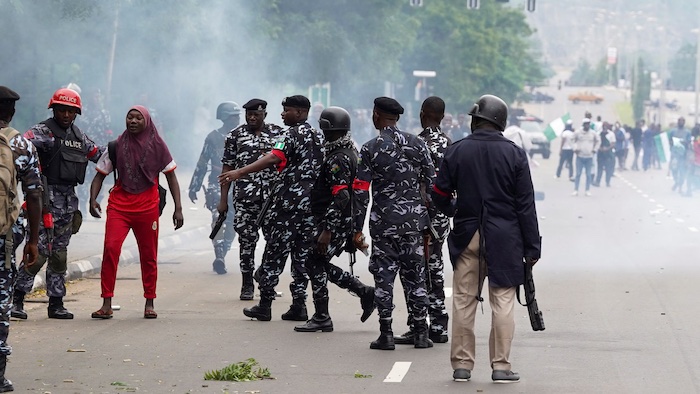
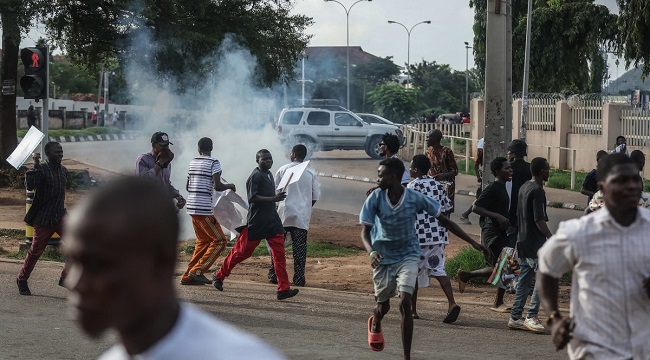
Security operatives on Monday fired tear gas at demonstrators demanding the release of Nnamdi Kanu in Abuja.
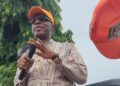
Led by activist Omoyele Sowore, the protest went ahead despite a court injunction and police warnings. Protesters chanted, “Free Nnamdi Kanu now,” “It’s our constitutional right to protest,” and “Don’t tear gas us,” before police action scattered the crowd.
As they fled, some protesters shouted, “Tear gas cannot stop us.” The #FreeNnamdiKanuNow protest began near Transcorp Hilton and extended to other parts of the Federal Capital Territory.
Police arrived early, firing tear gas to disperse protesters and bystanders. Officers were stationed along key routes leading to Aso Rock, with heavy presence around Eagle Square, Unity Fountain, and the Three Arms Zone.
Access roads to the Federal Secretariat and the Three Arms Zone were sealed off, while Unity Fountain—the rally’s starting point—was blocked to vehicles and pedestrians. Heavily armed security personnel patrolled the area, leaving central Abuja locked down.
During an appearance on Channels Television’s The Morning Brief, Sowore said the police had been notified about the protest beforehand. He claimed that several demonstrators were arrested and that bystanders were forced into police vehicles.
The protest defied an interim injunction issued by Justice Mohammed Umar of the Federal High Court, which banned demonstrations near the Presidential Villa, National Assembly, Force Headquarters, and other sensitive areas.
Police had warned that any defiance of the order would result in arrests, adding that digital surveillance would track social media incitement. Sowore, however, dismissed the validity of the order, questioning why similar restrictions were not imposed on groups opposing Kanu’s release. He added that a team of 115 lawyers was ready to challenge the injunction once formally served.
Nnamdi Kanu, leader of the proscribed Indigenous People of Biafra (IPOB), was first arrested in 2015 on charges of treason and later granted bail. He fled during trial but was rearrested in Kenya in 2021 and extradited to Nigeria under controversial circumstances.
A recent ruling by the Federal High Court dismissed his no-case submission, paving the way for him to face terrorism charges. His legal team has raised concerns over his deteriorating health in detention and requested his transfer to the National Hospital, Abuja. Meanwhile, governors from Nigeria’s southeast region continue to advocate for his release as a step toward restoring peace.
The protest coincided with the fifth anniversary of the #EndSARS movement, which demanded police reform and justice for victims of brutality. Many Nigerians still commemorate the October 2020 protests, remembering those who died at the Lekki Toll Gate.
What You Should Know
Nnamdi Kanu, a central figure in Nigeria’s secessionist movement, remains in detention amid renewed public outcry.
His supporters view him as a symbol of resistance, while the government insists he must face trial for terrorism. Monday’s protest shows that despite restrictions and heavy policing, the call for his release continues to echo across the nation.