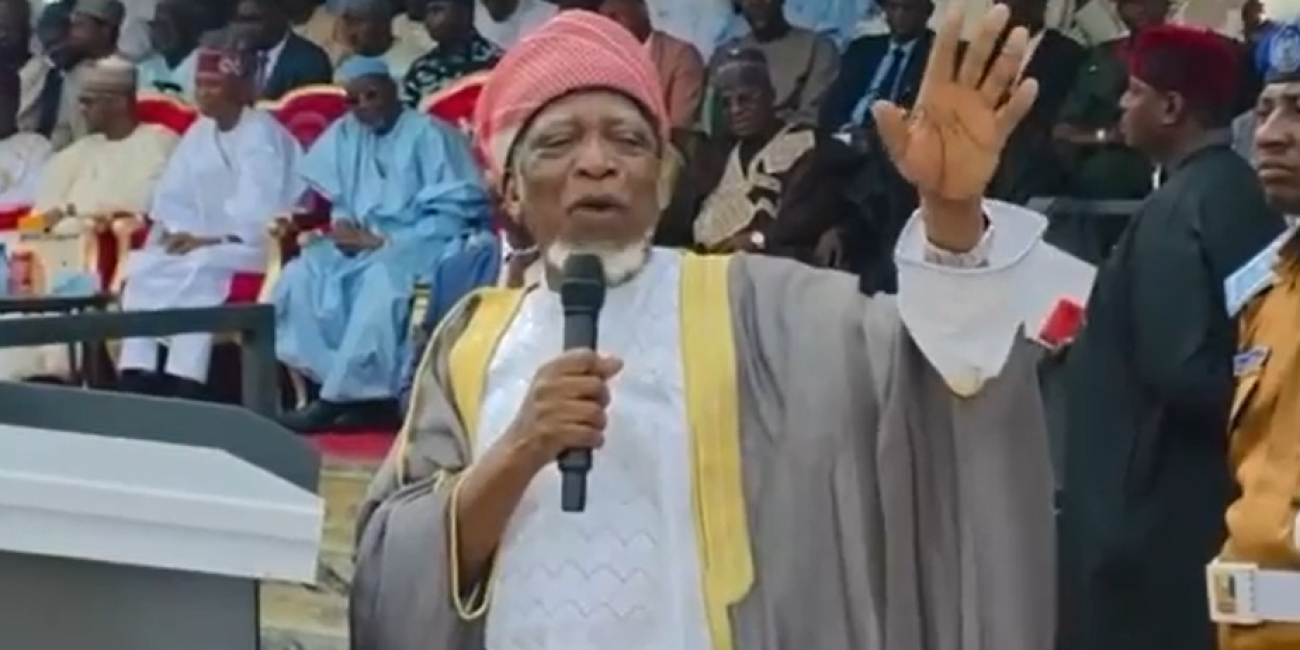
The controversy trailing Sheikh Muhammad Sani Yahaya Jingir’s renewed advocacy for a Muslim-Muslim presidential ticket shows no sign of abating, as the influential Islamic cleric has doubled down on his position, insisting he has nothing to apologize for.
Jingir, Chairman of the Ulama Council of the Jama’atu Izalatil Bid’ah Wa’ikamatis Sunnah (JIBWIS), told the BBC in an interview published Wednesday that his support for a same-faith presidential ticket did not begin with President Bola Tinubu’s emergence in 2023, and would not end with it either.
He said his position was not politically motivated or intended to campaign for President Tinubu but was based on what he described as his responsibility as a Muslim.
The latest firestorm traces back to a mass wedding reception organized by the Kano State Government for 1,500 couples, at which Jingir used the platform to renew calls for the Muslim-Muslim arrangement to continue beyond 2027.
At the event, he urged Muslims to vote in a way that would demonstrate their numerical strength in the country and argued that, as a Muslim preacher, he had the right to advocate a political arrangement consistent with his religious convictions.
He went further, challenging claims that Christians or other religious groups form a larger proportion of Nigeria’s population than Muslims.
What has proven most incendiary, however, was not the core message but the language in which it was delivered.
According to the Christian Association of Nigeria’s Kaduna State chapter chairman, Rev. Yohanna Buru Hayab, it was Jingir’s reported reference to Christians as “infidels” captured in a video that circulated widely on social media that escalated a familiar political argument into something more combustible.
Hayab was blunt about the distinction: “if Jingir said, ‘Let’s vote for our Muslim brothers to show we are strong,’ it would have been different, but adding ‘infidel’ makes it offensive.”
Rather than retreat, Jingir has used a string of interviews, including with BBC Hausa, to reassert his stance with unmistakable defiance. “I have absolutely no regrets.
I stand firmly by my words and will never apologize. I will continue to advocate for a Muslim-Muslim ticket,” he said. He has also claimed a groundswell of grassroots backing, telling reporters that he had received immense support from the Muslim community and that a vast majority of Muslims agreed with his stance, pointing to crowd reactions during his Kano address as evidence.
Pressed on why he keeps returning to the subject despite the outrage it provokes, Jingir framed his persistence as a matter of principle rather than provocation, arguing that a person convinced of their own truth has a duty to keep repeating it rather than be cowed into silence by criticism.
Amid the uproar, Jingir moved to draw a line between his personal advocacy and the organization he chairs.
He clarified that his call for a Muslim-Muslim presidential ticket for the 2027 elections represented his personal view alone and carried no endorsement from JIBWIS, one of Nigeria’s largest Islamic organizations, which had not itself issued any official statement on the matter.
It was in this same vein that he insisted, somewhat pointedly, that he was “promoting Islam” rather than any individual politician, a distinction he appeared eager to preserve as speculation mounts over whether his remarks amount to an early endorsement of a Tinubu-Shettima second term.
The backlash has been swift and has come from multiple directions. Former Kano State governor and NDC presidential hopeful for 2027, Rabiu Musa Kwankwaso, condemned the remarks directly, writing that he was “deeply concerned by the comments made by Sheikh Sani Yahaya Jingir at an event in Kano.”
More significantly, the National Human Rights Commission weighed in, with Executive Secretary Tony Ojukwu describing the comments in stark terms: “The commission finds these remarks to be hate speech and incitement to religious hatred and potential violence,” he said, warning that “at a time when we are preparing for another general election, such utterances are reckless and dangerous.
They serve no purpose other than to divide Nigerians along religious lines. “Ojukwu cautioned that inaction risked emboldening other influential figures to make more extreme statements as the 2027 elections approach.
Reactions have also come from the Obidient Movement’s Yunusa Tanko and Nigeria’s ambassador-designate to South Africa, Femi Fani-Kayode, adding a further political dimension to a controversy that cuts across party lines.
On the religious front, CAN’s Hayab called for restraint on all sides, while Professor Ahmad Suleiman of the Ambassadors of Peace and Social Welfare Initiative took issue with Jingir’s theology itself, arguing that referring to Christians as infidels was contrary to Islamic teaching, noting that the Quran speaks respectfully of people of the book and acknowledges righteous individuals among Christians.
The Muslim-Muslim ticket question is not new to Nigerian politics, but it has retained an unusual staying power since 2023, when Tinubu’s decision to pick Kashim Shettima, a fellow Muslim, as his running mate produced Nigeria’s first same-faith presidential ticket since the return to democracy in 1999.
Jingir was among the Islamic clerics who rallied behind that ticket at the time, and his current remarks suggest he sees the 2027 election as an opportunity to entrench, rather than merely defend, that precedent.
With the 2027 race already taking shape and religious identity re-emerging as a fault line in the contest, Jingir’s comments and the sharp reactions they have provoked from human rights bodies, opposition politicians, and Christian leaders alike signal that the debate over faith-balanced tickets is likely to remain one of the most contentious undercurrents of the campaign season ahead.
WHAT YOU SHOULD KNOW
Sheikh Jingir’s unrepentant stance on the Muslim-Muslim ticket underscores a deeper truth about Nigeria’s 2027 election cycle: religious identity is once again being weaponized as a political mobilization tool, and this time the rhetoric has crossed from political advocacy into what rights bodies are formally labeling hate speech.
The key factor to watch isn’t the ticket arrangement itself; Nigeria already has precedent for it since 2023, but rather the escalating language around it, particularly the use of terms like “infidel,” which has transformed a policy debate into a flashpoint for religious tension.
With the NHRC warning that unchecked rhetoric from influential figures could embolden further extremism and reactions pouring in from across the political and religious divide, Jingir’s refusal to moderate his tone signals that faith-based polarization will likely intensify, not fade, as the 2027 campaign progresses.